


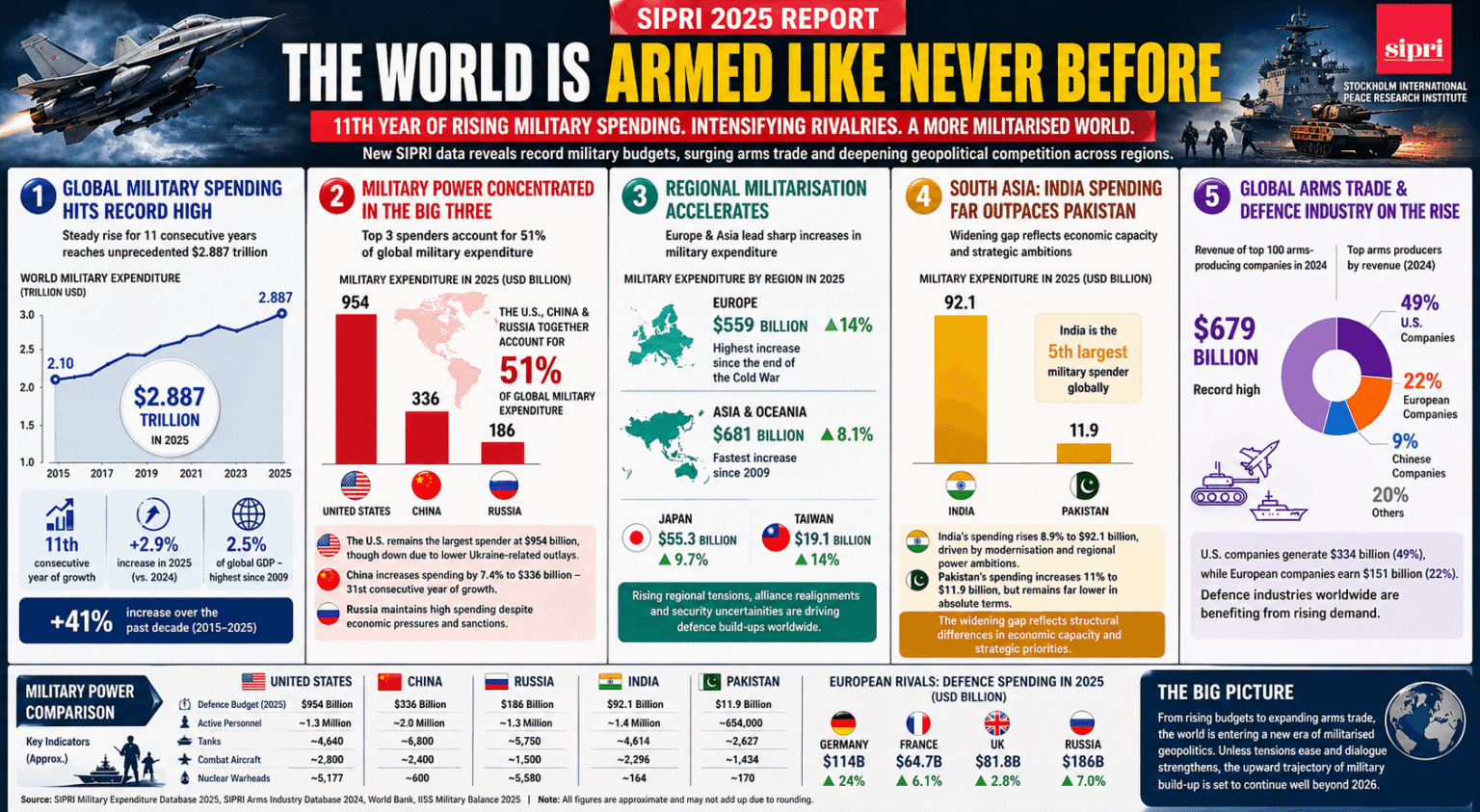
Stockholm, SE/Rochester, NY: The latest assessment by the Stockholm International Peace Research Institute (SIPRI) presents a stark picture of an international system steadily drifting toward militarization.
Its 2025 data, released in April 2026, reveals not just rising defence budgets but a structural shift in how states perceive security, power, and geopolitical competition. What SIPRI visualizes through its “five charts” is essentially a world where military expenditure, arms production, and strategic rivalry are reinforcing each other at unprecedented levels.
Chart One: The Relentless Rise of Global Military Spending
The most striking trend is the continued expansion of global military expenditure. In 2025, total spending reached $2.887 trillion, marking the 11th consecutive year of growth and the highest level ever recorded.
Although the annual increase of 2.9% was slower than the 9.7% surge in 2024, the broader trajectory remains steep. Over the past decade alone, global military spending has increased by 41%, indicating that militarization is not cyclical but structural.
This spending now accounts for 2.5% of global GDP, the highest level since 2009, reflecting how security concerns are increasingly dominating national budgets.
The key drivers behind this rise include the prolonged effects of the Russia–Ukraine war, intensifying US-China rivalry, Middle East instability, and growing uncertainty about alliance structures.
Chart Two: Concentration of Military Power—The Big Three
SIPRI’s second major visualization highlights the dominance of the world’s leading military powers: the United States, China, and Russia. Together, these three countries accounted for 51% of global military expenditure, spending a combined $1.48 trillion in 2025.
The United States remains the largest military spender, with expenditure around $954 billion, despite a temporary decline linked to reduced Ukraine-related outlays.
China continues its long-term military expansion, increasing spending by 7.4% to $336 billion, marking its 31st consecutive year of growth—a clear signal of sustained strategic ambition.
Russia, while facing economic constraints, maintains high levels of military expenditure driven by its war economy and strategic priorities.
This concentration illustrates a bipolar-to-multipolar transition, where military capability is clustered among a few dominant actors, intensifying strategic competition.
Chart Three: Regional Militarization—Europe and Asia Surge
The third major trend is the rapid regionalization of military build-ups. Europe recorded a 14% increase in military spending, the fastest growth since the early Cold War period.
European NATO members collectively spent $559 billion, with countries like Germany increasing expenditure by 24% to $114 billion, crossing the NATO benchmark of 2% of GDP for the first time since reunification.
In Asia and Oceania, spending reached $681 billion, rising 8.1%, the fastest increase since 2009.
Japan’s military budget rose by 9.7%, while Taiwan recorded a 14% increase, reflecting intensifying tensions around the Taiwan Strait and broader Indo-Pacific rivalry.
These regional surges indicate a shift from globalised security dependence toward localized arms races driven by regional threat perceptions.
Chart Four: South Asia—India-Pakistan Strategic Imbalance
In South Asia, SIPRI data reveals a widening asymmetry between India and Pakistan.
India emerged as the fifth-largest military spender globally, with expenditure rising by 8.9% to $92.1 billion.
Pakistan’s military spending stood at $11.9 billion, increasing by 11%, but still significantly lower in absolute terms.
This gap reflects structural differences in economic capacity and strategic ambitions. India’s military expansion is tied not only to regional rivalry with Pakistan but increasingly to its competition with China, while Pakistan’s spending remains security-driven and constrained by economic limitations.
The imbalance contributes to a deterrence-based stability, but also sustains a persistent low-intensity arms competition in the region.
Chart Five: The Expanding Global Arms Trade and Defence Industry
Beyond state budgets, SIPRI’s data shows a parallel rise in the global arms industry. Revenues of the world’s top 100 arms-producing companies reached $679 billion, reflecting growing demand for advanced weapons systems.
The United States dominates the arms production sector, with American firms generating $334 billion, while European companies collectively reported $151 billion in revenue.
Russia’s defence industry grew despite sanctions, and Middle Eastern and Asian producers are also expanding their footprint.
This trend indicates that militarization is not only about state policy but also about an increasingly profitable and globalised defence-industrial ecosystem.
Comparative Military Dynamics: Major Power Blocs
United States–China–Russia
The US retains unmatched global military reach, but China’s sustained growth is narrowing the gap in regional dominance, particularly in the Indo-Pacific. Russia, though economically weaker, remains a major military power due to its nuclear arsenal and wartime mobilization.
India–Pakistan
India’s defence strategy is transitioning toward great-power competition, while Pakistan remains focused on regional deterrence. The disparity in spending underscores a shift in South Asia’s strategic balance.
European Rivals
Within Europe, a new hierarchy is emerging. Germany’s rapid militarization positions it as a central military power, while France and the United Kingdom maintain strong but comparatively stable defence budgets. Meanwhile, Eastern European states are accelerating spending due to proximity to Russia.
The Broader Meaning: A New Era of Militarized Geopolitics
The SIPRI 2025 report ultimately illustrates a world entering a prolonged phase of militarization. The five key trends—rising global spending, concentration of power, regional arms races, asymmetric rivalries, and expanding arms industries—are interconnected.
What emerges is not a temporary surge driven by isolated conflicts but a systemic transformation. States are preparing for long-term strategic competition, alliances are being recalibrated, and defence spending is becoming embedded in economic and political planning. The data suggests that unless there is a major shift in global governance or conflict resolution mechanisms, the trajectory of military expansion will continue well beyond 2026, redefining the balance between security and development in the international system.
Stay Tuned The Variant US for latest news updates and analysis.







