


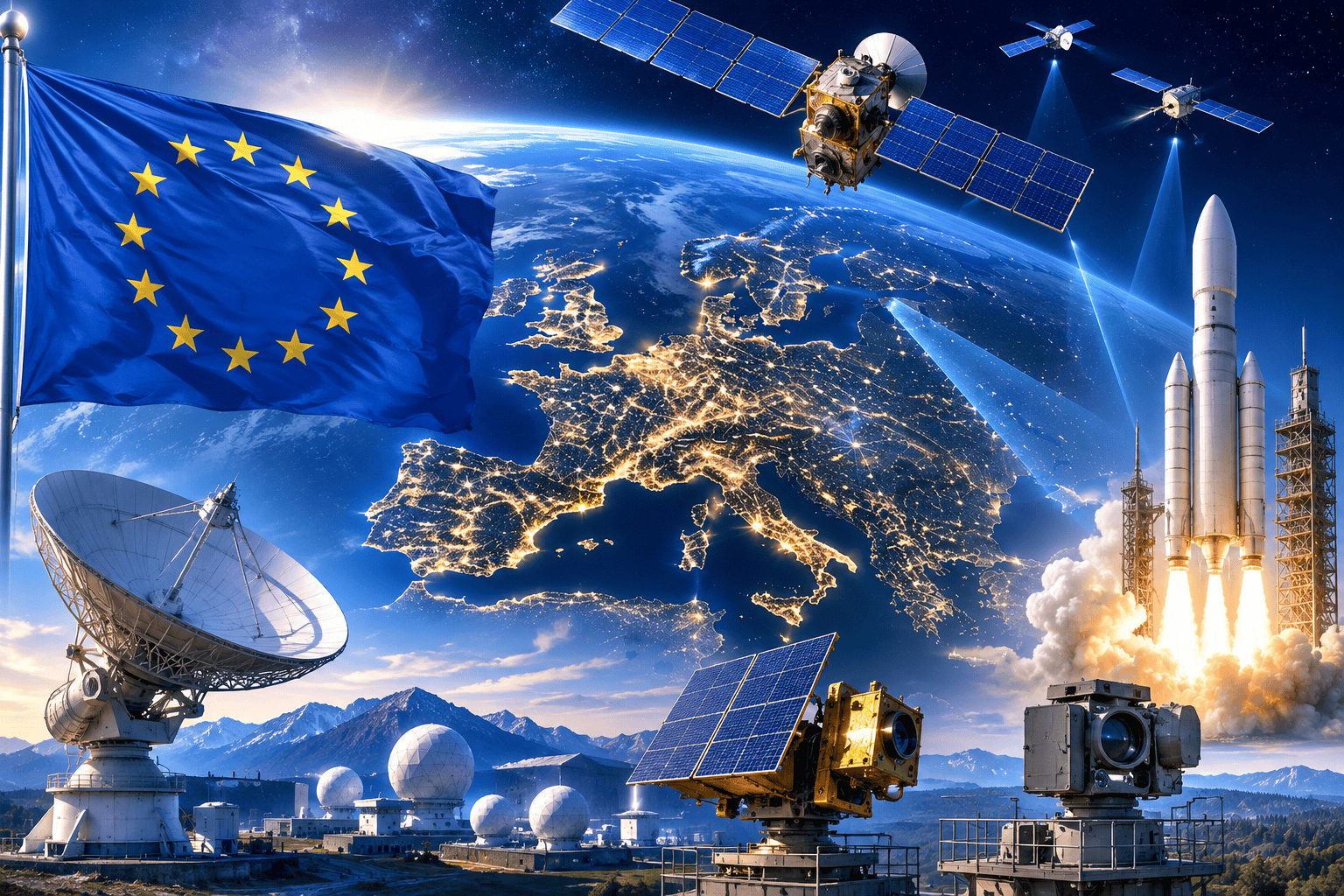
Paris, FR: Europe’s governments significantly increased investment in the space sector during 2025, demonstrating that space has evolved far beyond scientific exploration into a cornerstone of national security, economic competitiveness, and geopolitical influence.
According to the European Space Agency (ESA)’s July 13 report, European government space spending climbed 12% to €13.5 billion ($15.4 billion) in 2025 despite a 3% decline in global government space expenditures.
The contrast reflects Europe’s changing strategic priorities amid heightened security concerns following Russia’s invasion of Ukraine, growing military competition among global powers, and the increasing militarization of outer space.
The latest figures underline a broader transformation taking place across Europe.
Governments that once viewed space primarily as a scientific endeavor are now treating satellites, launch capabilities, Earth observation systems, secure communications, navigation services, and space surveillance as essential components of national defense infrastructure.
Defense Has Become the Primary Driver of Europe’s Space Investment
The most important factor behind Europe’s spending surge is the continent’s rapidly expanding defense budgets.
Following years of relatively modest military investment, European NATO members have dramatically increased defense spending in response to Russia’s war in Ukraine, persistent cyber threats, missile proliferation, and growing concerns over the security of critical infrastructure. Space capabilities now form an integral part of modern military planning.
Military commanders increasingly depend upon satellite imagery, encrypted communications, missile-warning systems, positioning services, weather forecasting, intelligence gathering, and real-time battlefield monitoring. Modern warfare in Ukraine has demonstrated that access to reliable space-based information can significantly influence military operations.
European governments have consequently accelerated investment in dual-use technologies that serve both civilian and military purposes. These include Earth observation satellites, secure communications constellations, space situational awareness systems, and resilient navigation networks capable of operating during conflict.
Unlike previous decades, defense ministries are becoming major customers of Europe’s commercial space industry.
Lessons from Ukraine Changed European Thinking
The war in Ukraine fundamentally reshaped European perceptions regarding space security.
Commercial satellite imagery became indispensable for intelligence gathering. Satellite internet systems maintained communications despite attacks on terrestrial infrastructure. Space-based navigation supported precision operations, logistics, and humanitarian activities.
European policymakers observed how vulnerable modern societies become when satellite services are disrupted.
The conflict also highlighted new threats including anti-satellite weapons, electronic jamming, cyber attacks targeting satellites, and interference with GPS signals.
As a result, European governments increasingly view investment in resilient space architecture as an investment in national resilience.
Europe Wants Greater Strategic Autonomy
Another important driver behind increased spending is Europe’s ambition to reduce dependence on external partners.
Although cooperation with the United States remains central to European security, policymakers increasingly seek “strategic autonomy” in critical technologies.
Recent geopolitical uncertainty has reinforced concerns about relying excessively on foreign launch providers, satellite systems, cloud infrastructure, or navigation networks.
Europe therefore continues investing in independent capabilities including:
* Galileo satellite navigation
* Copernicus Earth observation
* IRIS² secure communications constellation
* Next-generation launch vehicles
* Space surveillance and tracking
* Secure governmental communications
These programs strengthen Europe’s ability to operate independently during crises while supporting civilian economic development.
Competition Is Intensifying with the United States and China
Global competition in space has entered an entirely new phase.
The United States continues to dominate overall investment through NASA, the Department of Defense, the Space Force, and a rapidly expanding commercial ecosystem led by companies such as SpaceX, Blue Origin, Amazon’s Project Kuiper, Rocket Lab, and numerous defense contractors.
China has simultaneously accelerated its own ambitions through lunar exploration, the Tiangong space station, reusable launch systems, satellite constellations, deep-space missions, and military modernization.
Against this backdrop, Europe faces growing pressure not to fall behind technologically.
European leaders increasingly recognize that competitiveness in space directly influences economic growth, scientific innovation, digital infrastructure, artificial intelligence, and climate monitoring, telecommunications, and defense preparedness.
The latest spending increase reflects an effort to preserve Europe’s relevance in an increasingly multipolar space race.
Commercial Space Industry Will Be Among the Biggest Beneficiaries
Government investment is expected to stimulate Europe’s private space industry.
Companies involved in satellite manufacturing, launch services, robotics, artificial intelligence, cyber security, advanced sensors, propulsion systems, and Earth observation technologies stand to benefit from increased public procurement.
European governments increasingly favor public-private partnerships similar to those successfully adopted in the United States.
This shift could strengthen Europe’s innovation ecosystem while encouraging venture capital investment and supporting startups focused on defense technology and commercial space applications.
Small and medium-sized enterprises may also benefit through participation in supply chains supporting larger aerospace programs.
Economic Returns Extend Beyond the Space Sector
Investment in space generates benefits far beyond rockets and satellites.
Modern economies increasingly depend on satellite-enabled services including navigation, banking synchronization, precision agriculture, disaster response, telecommunications, aviation, maritime transport, weather forecasting, and environmental monitoring.
Climate research relies heavily on satellite observations to monitor glaciers, sea levels, droughts, forest fires, and greenhouse gas emissions.
Improved satellite infrastructure therefore strengthens multiple sectors simultaneously, creating spillover benefits across the broader economy.
European policymakers increasingly frame space spending as long-term industrial investment rather than discretionary expenditure.
Challenges Still Remain
Despite the encouraging increase, Europe continues facing structural challenges.
The continent’s space sector remains fragmented among multiple national agencies, industrial champions, and regulatory frameworks.
Launch capability has also faced setbacks in recent years following delays to the Ariane 6 program and reduced access to Russian Soyuz launch services after the invasion of Ukraine.
Competition from lower-cost commercial launch providers has intensified pressure on European manufacturers.
Budget coordination among ESA, the European Union, and individual member states remains complex, sometimes slowing decision-making.
Maintaining sustained investment during periods of fiscal pressure will require political consensus across diverse governments.
Security and Civilian Missions Must Remain Balanced
While defense has become a major spending driver, Europe must avoid allowing military priorities to overshadow scientific exploration.
ESA has historically built its reputation through groundbreaking scientific missions exploring Mars, Jupiter, comets, exoplanets, astronomy, and Earth sciences.
Balancing security requirements with scientific discovery, climate research, and international cooperation will remain essential for maintaining Europe’s leadership in peaceful space exploration.
The challenge will be ensuring that increased military investment complements rather than replaces civilian innovation.
The Geopolitical Significance of Europe’s Investment
The latest spending figures send a broader geopolitical message.
Europe increasingly views space as a strategic domain comparable to land, sea, air, and cyberspace.
Rather than reacting to crises, European governments appear to be building long-term capabilities designed to enhance resilience, deter adversaries, protect critical infrastructure, and strengthen technological sovereignty.
This shift aligns with broader European efforts to expand defense manufacturing, improve cyber security, develop artificial intelligence, and secure critical supply chains.
Space has become one of the central pillars of this strategy.
Conclusion
Europe’s 12% increase in government space spending to €13.5 billion in 2025 represents more than a budgetary milestone—it reflects a profound strategic shift in how European governments perceive the role of space in the twenty-first century.
At a time when global public investment in space declined, Europe moved decisively in the opposite direction, signaling that satellites, launch systems, secure communications, and space-based intelligence are no longer viewed as optional scientific assets but as essential components of national security, economic resilience, and geopolitical influence.
The trajectory suggests that European space policy will increasingly be shaped by the intersection of defense, technological innovation, and strategic autonomy. If sustained, this investment could strengthen Europe’s industrial base, enhance its competitiveness against the United States and China, and reinforce its ability to respond to emerging security challenges.
However, long-term success will depend on maintaining coordination among European institutions, supporting commercial innovation, and preserving the balance between military priorities and the scientific missions that have long defined Europe’s leadership in space exploration.
Keep following The Variant as we continue to monitor developments and provide informed perspectives on this evolving situation.


