


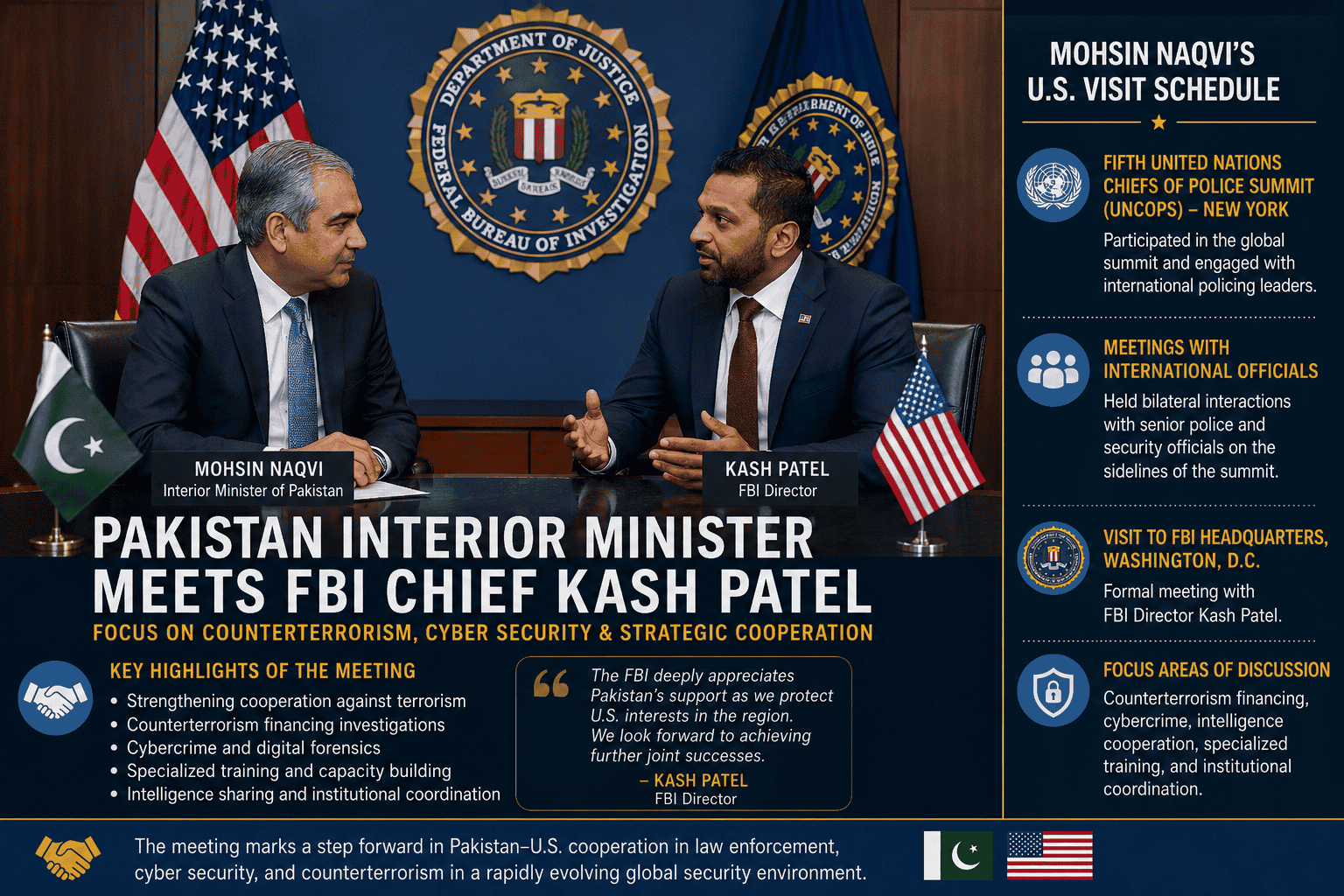
New York City, NY: Pakistan’s Interior Minister Mohsin Naqvi’s official visit to the United States has attracted considerable attention after his meeting with FBI Director Kash Patel at the Bureau’s headquarters in Washington.
The meeting comes at a time when Pakistan and the United States are attempting to rebuild trust after years of fluctuating relations, particularly following the U.S. withdrawal from Afghanistan and evolving regional security dynamics.
Unlike previous engagements that were largely centered on Afghanistan, the latest discussions demonstrate that both countries are now broadening cooperation into areas including cybercrime, terrorism financing, digital investigations, transnational organized crime, border security, and intelligence sharing.
Public statements issued after the meeting suggest that Washington continues to view Pakistan as an important security partner despite persistent political differences.
A Meeting That Carries Symbolic and Strategic Weight
According to statements released by FBI Director Kash Patel, the discussions focused on expanding bilateral cooperation against terrorism financing, cyber investigations, specialized law-enforcement training, and resource sharing.
Patel described Pakistan–United States cooperation as a “critical partnership” and publicly thanked Pakistan for supporting U.S. interests in the region.
Such language is significant because FBI directors rarely characterize bilateral relationships in strategic terms unless Washington considers the cooperation operationally valuable.
For Pakistan, the meeting represents recognition that despite periodic diplomatic tensions, its intelligence and law-enforcement institutions continue to play an important role in regional security.
Counterterrorism Returns to the Center of the Relationship
Counterterrorism remains the strongest pillar connecting Islamabad and Washington.
Both countries continue facing threats from transnational terrorist organizations, including ISIS-K, Al-Qaeda affiliates, financial facilitators, online extremist recruitment networks, and cyber-enabled criminal organizations.
Reports indicate that discussions emphasized:
- Counterterrorism financing investigations
- Cybercrime cooperation
- Specialized FBI training programs
- Information sharing
- Technical assistance for digital investigations
- Enhanced institutional coordination between law-enforcement agencies
Unlike military cooperation that dominated relations during the post-9/11 era, today’s engagement increasingly revolves around intelligence, financial investigations, digital evidence, and cyber capabilities.
Cyber Security Emerges as a New Priority
One of the notable aspects of the meeting was its emphasis on cyber investigations.
Pakistan has experienced increasing cyber threats targeting government institutions, financial networks, and critical infrastructure.
Similarly, the FBI has expanded international cooperation against Ransomware groups, cyber fraud, crypto currency-based money laundering, and online extremist financing.
Enhanced cooperation may include:
- Digital forensic training
- Cybercrime investigation techniques
- Joint capacity building
- Technical exchanges
- Financial intelligence cooperation
If implemented effectively, such collaboration could strengthen Pakistan’s law-enforcement capabilities while improving interoperability with international investigative standards.
Why Kash Patel’s Public Statement Matters
Following the meeting, Kash Patel publicly stated that the FBI “deeply appreciates Pakistan’s support as we protect U.S. interests in the region” and expressed optimism about further joint successes.
Diplomatically, this statement is noteworthy because it signals that the current U.S. administration continues to distinguish between broader political disagreements and practical security cooperation.
Public messaging from senior U.S. security officials often serves as an indicator of Washington’s willingness to sustain institutional relationships even when political relations fluctuate.
Mohsin Naqvi’s Broader U.S. Engagement Schedule
The FBI meeting formed part of a wider U.S. visit by Interior Minister Mohsin Naqvi.
Before arriving in Washington, Naqvi represented Pakistan at the Fifth United Nations Chiefs of Police Summit (UNCOPS) in New York, where he met international policing leaders and officials on the sidelines of the conference.
His reported schedule during the visit included:
- Participation in the Fifth United Nations Chiefs of Police Summit in New York.
- Meetings with senior international police and security officials attending the summit.
- Visit to FBI Headquarters in Washington.
- Formal meeting with FBI Director Kash Patel.
- Discussions focused on counterterrorism financing, cybercrime, intelligence cooperation, specialized training, and institutional coordination.
Publicly available information confirms these engagements. While some media have referred broadly to meetings with U.S. administration officials, there has not yet been official confirmation of separate bilateral meetings with Cabinet-level U.S. executive officials beyond the FBI engagement during this visit. Any additional meetings should therefore be treated cautiously until officially announced.
A Shift from Military-Centric Relations
Historically, Pakistan–United States cooperation was dominated by military-to-military engagement.
Today’s relationship appears increasingly institution-driven.
Instead of focusing primarily on defense cooperation, recent engagements highlight:
- Federal law enforcement
- Intelligence coordination
- Financial investigations
- Cyber security
- Counterterrorism financing
- Border management
- Criminal investigations
This reflects broader changes in U.S. national security priorities.
Regional Context
The timing of Naqvi’s visit is equally important.
The Middle East remains volatile, with ongoing tensions involving Iran and U.S. regional interests. Afghanistan continues to pose security challenges, particularly regarding ISIS-K and cross-border militant activity. At the same time, digital crime and illicit financial networks increasingly transcend national borders.
Against this backdrop, both Washington and Islamabad have practical incentives to maintain operational cooperation even where strategic interests do not fully align.
What Pakistan Hopes to Gain
For Islamabad, the visit offers several potential advantages:
- Improved access to advanced investigative expertise.
- Greater cooperation against financial crimes.
- Enhanced cyber investigation capabilities.
- Stronger international credibility in counterterrorism efforts.
- Continued engagement with U.S. security institutions despite political differences.
Pakistan also seeks to demonstrate that it remains a relevant partner in regional stability rather than solely an actor viewed through the lens of Afghanistan.
The U.S. Perspective
From Washington’s standpoint, engagement with Pakistan serves pragmatic objectives.
Pakistan occupies a strategically important geographic position bordering Afghanistan, Iran, China, and India. It also possesses extensive experience combating militant organizations and maintains intelligence networks that remain relevant to U.S. counterterrorism objectives.
Institutional cooperation with Pakistan therefore continues to offer operational value even as broader geopolitical priorities evolve.
Challenges Ahead
Despite the positive tone, several obstacles remain.
Political mistrust accumulated over two decades cannot be eliminated through a single meeting.
Future cooperation will likely depend on:
- Sustained intelligence sharing.
- Measurable progress against terrorist financing.
- Expanded cyber cooperation.
- Transparent implementation of agreed training initiatives.
- Continued political engagement between both governments.
Domestic political developments in both countries may also influence the pace of cooperation.
Conclusion
Interior Minister Mohsin Naqvi’s meeting with FBI Director Kash Patel represents more than a routine diplomatic engagement. It reflects a gradual recalibration of Pakistan–U.S. relations toward practical cooperation in law enforcement, cyber security, counterterrorism financing, and intelligence exchange. Patel’s unusually warm public remarks underscore Washington’s interest in preserving institutional ties with Islamabad despite broader geopolitical complexities.
While expectations should remain measured, the visit suggests that both countries recognize mutual security interests that transcend periodic political disagreements.
Whether this momentum develops into a more comprehensive strategic partnership will depend on consistent follow-through, tangible operational cooperation, and sustained political commitment on both sides.
Bookmark The Variant for trusted updates, informed analysis, and comprehensive coverage of the stories that matter most.


