


Rochester, NY: World Press Freedom Day, observed every year on May 3 under the auspices of UNESCO, is often presented as a symbolic celebration of journalism’s role in sustaining democracy, accountability, and truth.
Yet behind the commemorative speeches and institutional statements lies a far more troubling global reality—one marked by violence, intimidation, displacement, unemployment, and the systematic weakening of press freedom across continents. In 2026, the condition of journalism worldwide is not simply strained; it is, by multiple indicators, in crisis.
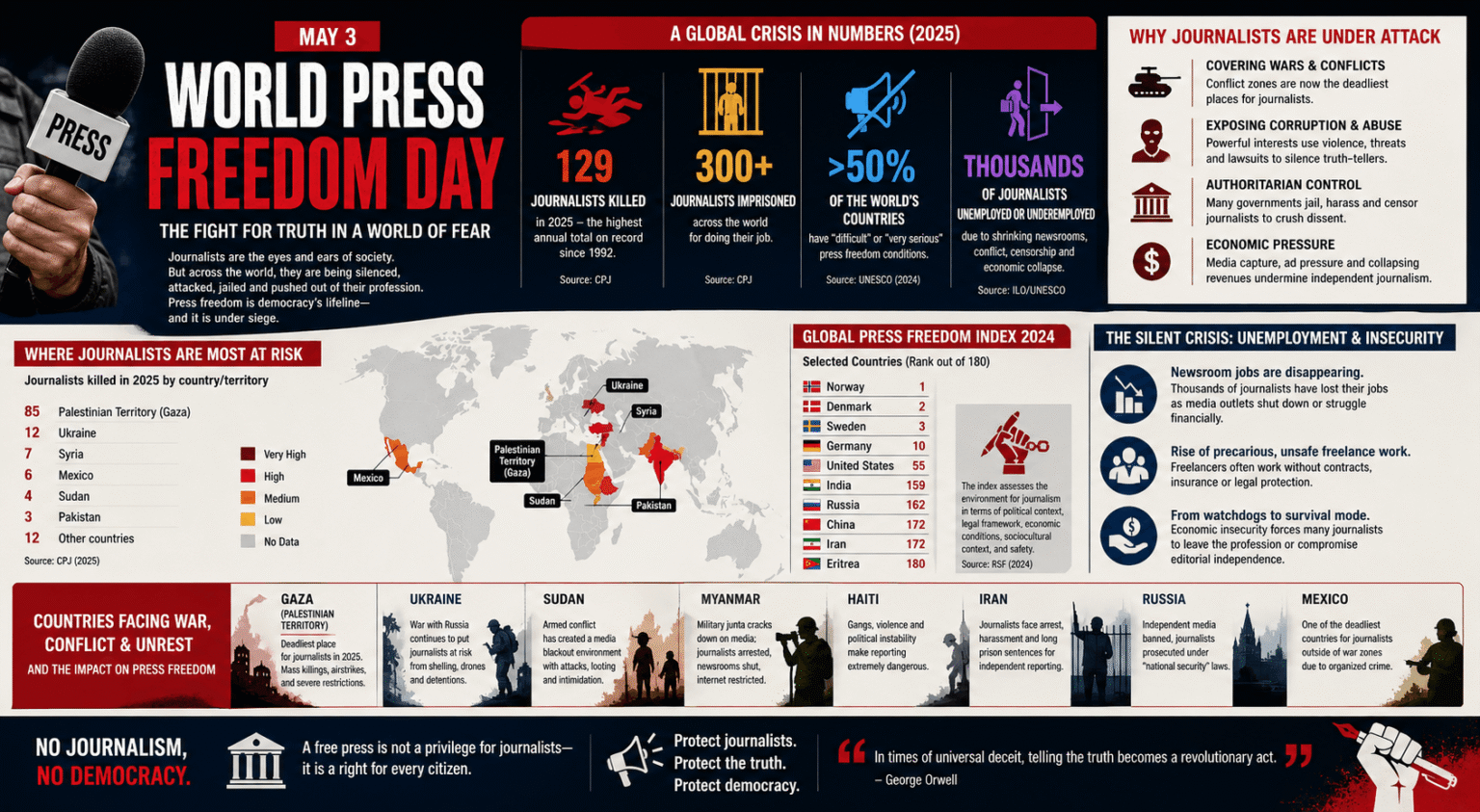
According to the Committee to Protect Journalists (CPJ), 2025 became the deadliest year for journalists on record, with at least 129 journalists and media workers killed globally, surpassing all previous annual totals since tracking began in 1992.
What is particularly alarming is that this marked the second consecutive year of record-breaking deaths, reflecting an escalating pattern rather than an isolated spike.
A significant proportion of these killings—over three-quarters—occurred in active conflict zones, underscoring how modern warfare has increasingly turned journalists into direct targets rather than incidental casualties.
One of the most devastating theaters for press freedom has been Gaza, where journalists have been killed in unprecedented numbers amid the ongoing Israel–Palestine conflict.
CPJ data indicates that a large majority of journalist deaths in 2025 were linked to Israeli military operations, making it one of the most lethal environments for media workers in recent history.
Ukraine has also remained a dangerous front, where journalists continue to be killed by drone strikes and artillery fire in the Russia–Ukraine war, reinforcing the growing reality that modern conflicts increasingly unfold in information-saturated but physically dangerous environments for reporters.
Beyond the battlefield, the crisis of press freedom extends into authoritarian governance and internal repression.
Countries such as China, Iran, Myanmar, Russia, and Eritrea continue to be among the most hostile environments for journalism, where arrests, censorship, and long-term imprisonment of reporters are routine instruments of state control.
In Russia, independent journalism has been heavily suppressed since the Ukraine war began, with media outlets shut down and reporters prosecuted under broad national security laws.
China continues to maintain one of the world’s largest systems of journalist imprisonment, particularly targeting those reporting on human rights, corruption, and ethnic minority issues.
Globally, imprisonment of journalists has reached historic highs. Recent international monitoring reports indicate that more than 300 journalists are currently detained worldwide, with cases spanning from Hong Kong to Iran and Vietnam.
High-profile cases such as the long prison sentences of reporters in Hong Kong under national security legislation, and the imprisonment of journalists in Iran on charges of “anti-state propaganda,” reflect a broader pattern where journalism is increasingly treated as a criminal act rather than a civic function.
However, the crisis is not limited to killings and imprisonment. A quieter but equally devastating dimension is the economic collapse of journalism as a profession.
Across Africa, South Asia, Latin America, and parts of Eastern Europe, thousands of journalists face unemployment, underemployment, or forced transition into precarious freelance work due to shrinking media markets, political pressure on advertisers, and the collapse of independent news organizations.
In many countries, especially those experiencing conflict or economic instability, newsrooms have shut down entirely or been absorbed by state-controlled entities, leaving journalists without stable income or institutional protection.
This economic fragility has fueled a global migration of journalists into public relations, corporate communications, or completely unrelated sectors, further weakening independent media ecosystems.
In conflict-affected regions such as Sudan, Myanmar, Haiti, and parts of the Middle East and Latin America, journalism has become not only dangerous but unsustainable as a livelihood.
Reporters often work without contracts, insurance, or safety guarantees, and freelance journalists are particularly vulnerable, frequently operating without institutional backing. The result is a profession increasingly defined by insecurity—both physical and financial.
At the structural level, press freedom is also declining. UNESCO-linked assessments and global media indices show that press freedom has fallen significantly over the past decade, with rising self-censorship, increased legal harassment of journalists, and growing governmental control over digital and traditional media platforms.
In more than half of the world’s countries, press conditions are now classified as “difficult” or “very serious,” meaning that independent journalism is either heavily restricted or actively endangered.
What emerges from this global picture is a profession under siege from multiple directions at once.
Journalists are being killed in war zones, imprisoned under authoritarian regimes, silenced through legal intimidation in democracies, and economically pushed out of their professions due to collapsing media industries.
The romanticized image of journalism as a stable pillar of democracy increasingly contrasts with the lived reality of reporters navigating fear, instability, and financial uncertainty.
World Press Freedom Day therefore stands less as a celebration and more as a warning. It is a reminder that the erosion of press freedom is not abstract; it is measurable in lives lost, voices silenced, and careers destroyed.
It reflects a world where information is increasingly contested, and where those tasked with delivering it are often the first to pay the price. If the current trajectory continues, the question is not only how many journalists will be killed or imprisoned in the coming years, but how much independent journalism will even survive to document the truth.
Stay tuned The Variant US and get updates, analysis and reports.


