


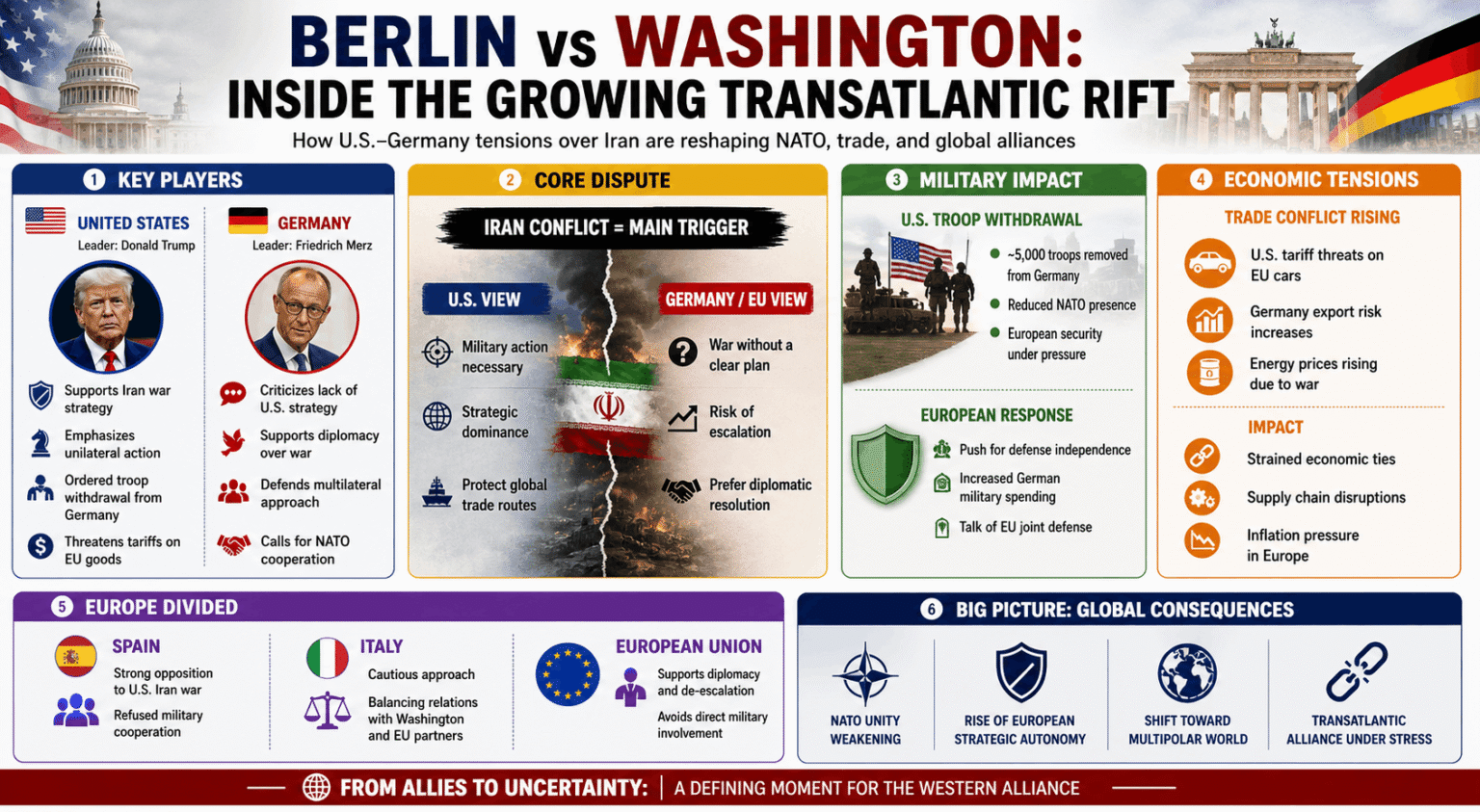
Washington, D.C/Berlin, DE: The relationship between Donald Trump and Friedrich Merz has entered a phase of visible strain, marked by sharp rhetoric, policy divergence, and an emerging strategic disconnect.
What began as a disagreement over the United States’ approach to Iran has quickly evolved into a broader confrontation over the nature of global leadership, alliance obligations, and the future of transatlantic cooperation.
This unfolding rift is not merely diplomatic theater; it reflects a deeper transformation in how Washington and Berlin perceive power, responsibility, and the rules governing international order.
The immediate trigger for the tension lies in contrasting public statements from both leaders. Friedrich Merz, representing a Germany increasingly confident in its European role, openly questioned the strategic coherence of the U.S. approach toward Iran.
He argued that Washington had entered the conflict without a clear roadmap, warning that such a policy risks prolonging instability rather than resolving it. His remarks, suggesting that Iran had gained leverage in negotiations, were perceived in Washington as both dismissive and undermining.
Donald Trump’s response was swift and characteristically personal. He dismissed Merz as ineffective, accused him of mismanaging Germany, and asserted that the German leadership lacked understanding of the complexities surrounding Iran.
The rhetoric was not confined to words alone; it was reinforced by policy decisions, including the announcement of a partial withdrawal of U.S. troops from Germany. In doing so, Trump signaled that criticism from allies would not be tolerated without consequence.
This exchange reveals more than a disagreement over Iran. It highlights a fundamental divergence in worldview.
Berlin’s language remains rooted in institutional diplomacy and alliance management, while Washington under Trump has embraced a more transactional and personalized style of engagement, where alliances are contingent and criticism invites retaliation.
The Strategic Divide: Multilateralism vs. Transactional Power
At the core of the rift lies a philosophical divide. Germany continues to advocate for a multilateral, rules-based international system, where decisions—especially those involving war—are grounded in collective legitimacy and long-term strategy.
The United States, by contrast, is increasingly projecting a unilateral posture, emphasizing national interest, rapid decision-making, and the use of economic and military leverage to shape outcomes.
The Iran conflict has exposed this divide most clearly. Washington frames its actions as necessary to counter Iranian influence and secure global stability, particularly in strategic waterways.
Berlin, however, views the conflict as lacking both clarity and proportionality, warning that it risks escalating into a broader regional crisis with global economic consequences.
This divergence is not simply ideological; it has tangible implications for alliance cohesion. Where the United States expects alignment, Germany insists on deliberation. Where Washington demands support, Berlin calls for restraint.
Military Recalibration and the Future of NATO
The decision by the Trump administration to withdraw thousands of troops from Germany marks a turning point in transatlantic security relations.
For decades, the U.S. military presence in Germany has symbolized not only deterrence but also trust and shared strategic purpose. Its reduction signals a shift toward conditional security commitments.
For Germany, this move reinforces the urgency of building greater European defense autonomy. Berlin has already begun reassessing its military posture, increasing defense spending, and advocating for a more cohesive European security framework.
While NATO remains intact, the cohesion that once defined it is visibly weakening. The alliance is no longer insulated from political disputes; instead, it is becoming a space where those disputes are actively contested.
The broader implication is a gradual decoupling of U.S. and European security priorities. While Washington recalibrates its global focus, Europe is being compelled to assume greater responsibility for its own defense, potentially reshaping NATO’s long-term structure.
Economic Undercurrents and Trade Friction
Parallel to the security tensions, economic relations between the United States and Germany are also under strain.
Threats of tariffs, particularly targeting Europe’s automotive sector, have introduced a new layer of friction. For Germany, whose economy is heavily export-driven, such measures carry significant risk.
The Iran conflict further complicates the economic landscape. Rising energy prices and disrupted supply chains are placing additional pressure on European economies already navigating post-pandemic recovery and geopolitical uncertainty.
In this context, economic interdependence—once a stabilizing factor in transatlantic relations—is increasingly being used as leverage.
The result is a feedback loop in which political disagreements fuel economic measures, and economic tensions deepen political mistrust.
Europe’s Response: Between Unity and Fragmentation
The European Union, while broadly aligned with Germany’s cautious stance, is not monolithic in its response. The bloc has collectively emphasized diplomacy and de-escalation, resisting calls to support U.S. military action against Iran. However, internal differences persist.
Spain has taken a more assertive line, openly distancing itself from Washington’s approach and restricting cooperation in military logistics.
Italy, on the other hand, has adopted a quieter, more cautious strategy, seeking to maintain functional relations with the United States while avoiding overt alignment with its policies. These differing approaches reflect the complexity of Europe’s position: united in principle, but varied in execution.
What emerges is a Europe attempting to navigate between dependence and autonomy, balancing the need to preserve transatlantic ties with the imperative to assert its own strategic identity.
Iran as the Fault Line
The ongoing tensions surrounding Iran serve as the central fault line in this dispute. For the United States, the conflict represents a test of resolve and leadership in a volatile region.
For Germany and much of Europe, it is a cautionary example of how military intervention without clear objectives can destabilize not only the region in question but also the broader international system.
This divergence has exposed the limits of transatlantic consensus. While both sides share concerns about Iran’s role in regional security, they differ fundamentally on how those concerns should be addressed. The result is a fractured approach that undermines collective effectiveness.
A Relationship Redefined
The current rift between Berlin and Washington is not an isolated rollup; it is indicative of a deeper transformation in global politics.
The era of unquestioned transatlantic unity is giving way to a more complex, and at times contentious, relationship. Alliances are being tested, not just by external threats, but by internal differences over strategy, values, and priorities.
For Donald Trump, the message is clear: alliances must serve immediate national interests or risk being reconsidered. For Friedrich Merz, the challenge lies in preserving the alliance while asserting Europe’s autonomy and strategic judgment.
The trajectory of this relationship will have far-reaching consequences. It will shape the future of NATO, influence global trade dynamics, and determine whether the Western bloc can maintain coherence in an increasingly multipolar world.
In essence, what is unfolding is not merely a diplomatic disagreement but a redefinition of the transatlantic partnership itself—one that will likely endure well beyond the current crisis.
Daily Visit Our Blog and stay well informed.


