


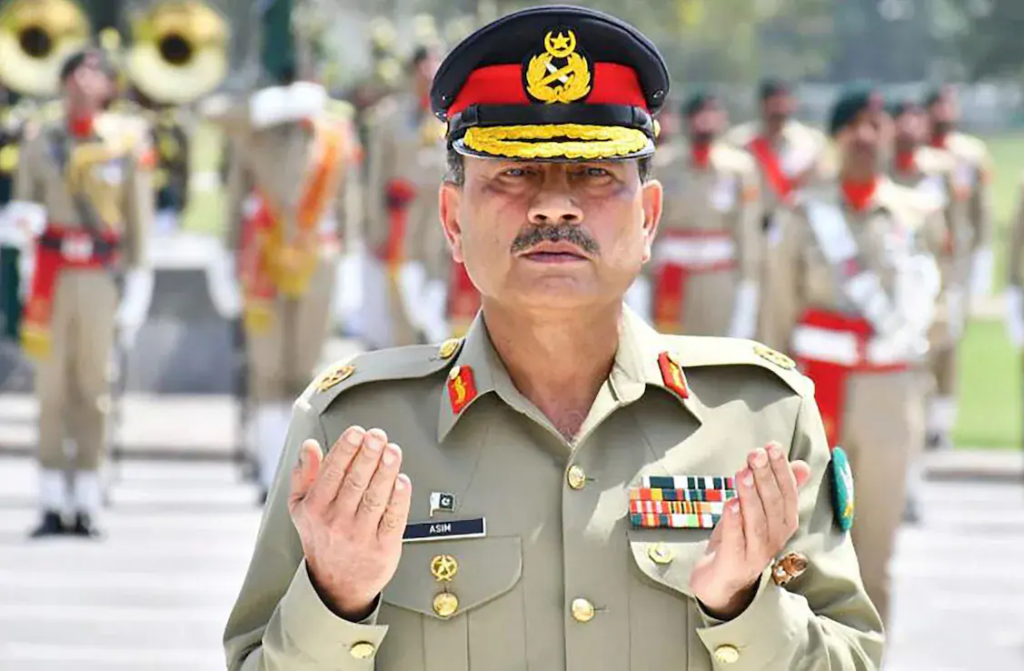
Rochester, NY: Pakistan’s Military Leadership Frames Current Conflict as Battle Beyond Borders – The recent address delivered by Chief of Defense Forces (CDF), Syed Asim Munir at the General Headquarters (GHQ) in Rawalpindi reflected not only Pakistan’s evolving military posture but also the broader strategic anxieties shaping South Asia after the recent escalation between Pakistan and India.
The speech carried strong political, military, and ideological messaging, portraying Pakistan as a state confronting hybrid warfare, regional instability, terrorism, and what the military leadership described as coordinated external pressure from India and hostile intelligence networks.
During the address, the Pakistan’s Army Chief repeatedly emphasized that the armed forces had demonstrated professionalism, discipline, and operational superiority during what Pakistan officially calls “Marka-e-Haq,” the military confrontation period linked with the aftermath of the Pahalgam incident and the later phase of Operation Bunyan-ul-Marsoos.
According to the military narrative presented at GHQ, the conflict became a symbol of national unity and strategic deterrence rather than merely a conventional military exchange. Munir argued that Pakistan’s response elevated the country’s international standing and proved the operational readiness of its armed forces in modern warfare conditions.
The address also highlighted the transformation of warfare from traditional battlefield engagements into multi-domain conflict involving cyber operations, information warfare, proxy networks, economic pressure, and intelligence competition.
Munir stressed that Pakistan’s security doctrine is now increasingly focused on hybrid warfare threats and cross-border destabilization attempts. He warned that Pakistan would respond decisively to any external aggression while simultaneously continuing counterterrorism operations within its borders.
A central element of the speech was the claim that Marka-e-Haq produced strategic and psychological gains for Pakistan. Pakistani military circles argue that the confrontation strengthened national cohesion, improved coordination among the armed services, and reinforced deterrence against India.
The military leadership also portrayed the episode as evidence that Pakistan could withstand diplomatic, military, and informational pressure simultaneously. In official discourse, the operation is increasingly being presented as a defining moment for Pakistan’s modern military doctrine.
Munir also strongly linked internal security challenges with regional geopolitics. He claimed that hostile foreign actors were attempting to exploit instability in Balochistan and along Pakistan’s western border.
In several previous speeches, the Army Chief accused India of supporting anti-Pakistan militant proxies and destabilizing elements, particularly after tensions between Islamabad and New Delhi intensified.
The issue of Afghanistan remained a significant underlying theme in Pakistan’s strategic thinking. Pakistani security officials have increasingly expressed concern that Afghan territory could become a platform for anti-Pakistan militant activity if regional rivalries deepen further.
Islamabad has frequently alleged that Indian intelligence networks, particularly India’s external intelligence agency Research and Analysis Wing (RAW), historically attempted to increase influence inside Afghanistan in ways Pakistan considered hostile to its national security interests.
Indian officials, however, have consistently denied allegations of sponsoring militancy against Pakistan and maintain that their engagement in Afghanistan has focused on development projects, infrastructure, humanitarian assistance, and diplomatic cooperation. This remains one of the most disputed dimensions of South Asian geopolitics.
India’s outreach toward Afghanistan is widely viewed by Pakistani strategists as part of a broader regional influence strategy. Over the years, India invested in Afghan infrastructure, parliament buildings, highways, dams, education, and medical support programs to strengthen diplomatic and economic ties with Kabul.
Pakistan’s security establishment, however, has long interpreted some aspects of India’s Afghan presence through a security lens, fearing encirclement and intelligence penetration along Pakistan’s western frontier. These competing narratives continue to fuel mistrust between the two nuclear-armed neighbors.
Another major point in Munir’s address was the emphasis on ideological unity and national resilience. He framed Pakistan’s security challenges not only as military threats but as battles over identity, sovereignty, and social cohesion.
According to his remarks, the armed forces believe that information manipulation, sectarian divisions, economic uncertainty, and digital propaganda are increasingly being used as strategic tools against Pakistan.
The speech also reinforced the military’s message that Pakistan seeks peace but will not compromise on territorial integrity or strategic deterrence. Munir warned against miscalculations in a nuclearized South Asian environment and reiterated that any future confrontation could carry severe regional consequences.
Analytically, the GHQ address demonstrates how Pakistan’s military leadership is attempting to consolidate a long-term strategic narrative after recent regional tensions. Marka-e-Haq is being projected domestically as proof of military preparedness and institutional cohesion, while externally the speech served as a warning against what Pakistan perceives as coordinated geopolitical pressure.
At the same time, the continued accusations surrounding Afghanistan and RAW reveal the deep strategic mistrust that still dominates relations between Islamabad and New Delhi.
Ultimately, the speech was not merely ceremonial. It reflected Pakistan’s attempt to redefine regional deterrence, reinforce domestic confidence, and signal that future conflicts in South Asia will increasingly involve intelligence competition, information warfare, proxy influence, and geopolitical positioning beyond conventional military engagements.


