Courtesy: Reporting Contribution by Salman-Bin-Kareem [A Senior Journalist I Doha, Qatar]
Rochester, NY/Doha, QA: The military confrontation between the United States and Iran has entered a more dangerous phase after Iran’s Islamic Revolutionary Guard Corps targeted commercial vessels in and around the Strait of Hormuz, prompting Washington to launch additional strikes against Iranian military and maritime infrastructure.
What began as a struggle over Iran’s nuclear program and regional military activities has increasingly transformed into a direct contest for control of one of the world’s most strategically important waterways.
Iran appears determined to demonstrate that sustained attacks on its territory will carry an international economic cost. The United States, meanwhile, is attempting to prove that Tehran cannot use commercial shipping and global energy supplies as leverage without facing overwhelming military retaliation.
The result is an escalating cycle in which both sides claim to be acting defensively while steadily expanding the range of targets, weapons and economic interests involved.
The Latest Attack in the Strait of Hormuz
The latest escalation followed an attack on a tanker in the Strait of Hormuz that forced its crew to abandon the vessel. The incident came after several previous attacks on tankers and commercial cargo ships blamed on Iranian forces.
U.S. officials have presented the attacks as evidence that Iran is deliberately targeting civilian maritime trade to pressure Washington and its regional allies.
Iran’s Revolutionary Guard has also claimed responsibility for striking or intercepting tankers in the waterway, presenting such operations as retaliation for continuing U.S. military action and restrictions imposed on Iranian shipping.
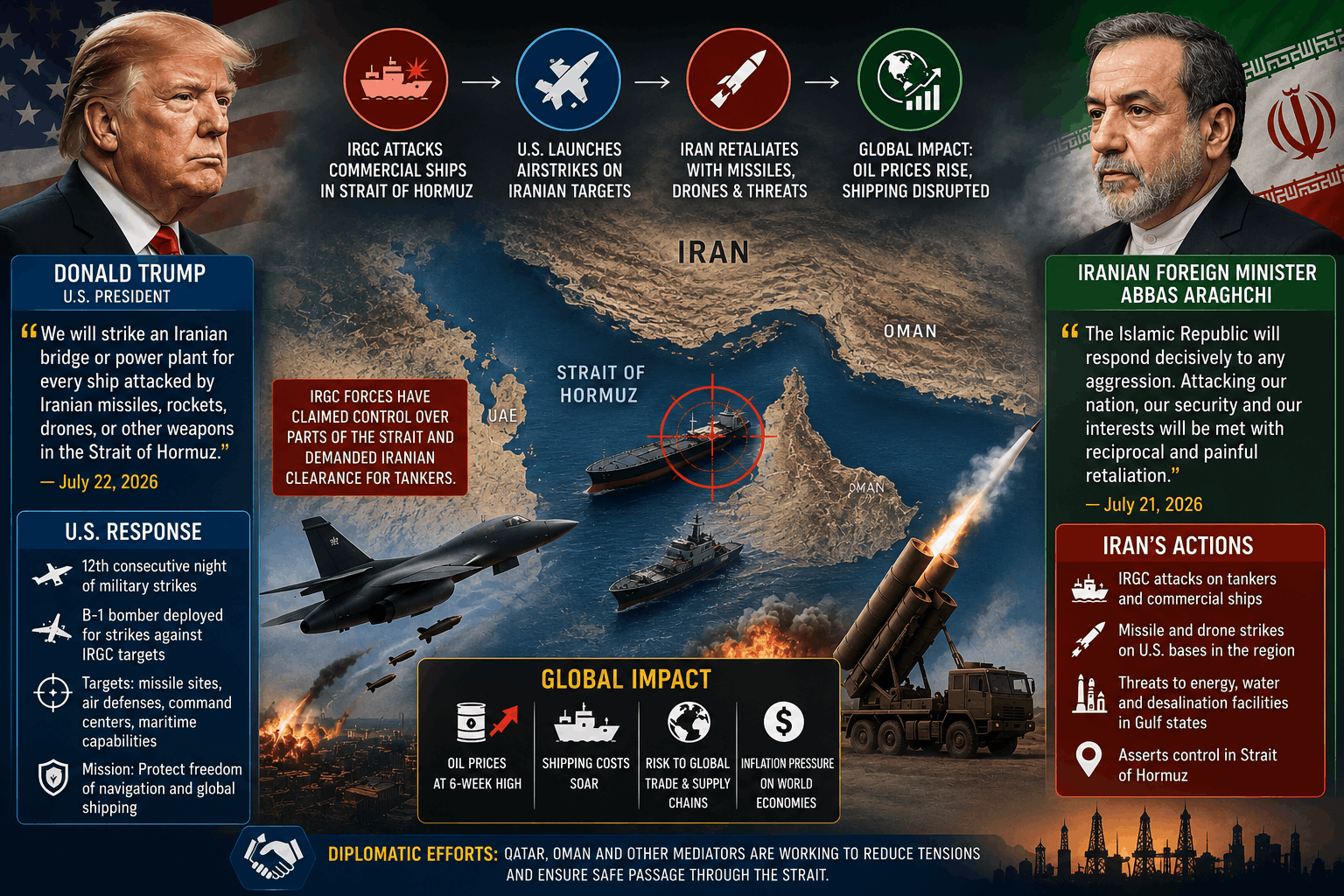
Reportedly, the IRGC said two tankers were hit during the latest period of confrontation, while U.S. missiles struck several Iranian cities.
The United States responded by extending its air campaign against targets inside Iran. According to U.S. Central Command, the strikes have focused on military command centers, air-defense systems, coastal surveillance facilities; missile and drone launch sites, communications networks and maritime capabilities associated with attacks on commercial vessels.
Washington therefore describes its operations as an effort to defend freedom of navigation. Tehran describes them as acts of aggression designed to weaken Iran and impose foreign control over waters adjacent to its territory. These competing narratives are central to understanding why neither side has shown a willingness to retreat.
Trump’s Warning and the Expansion of U.S. Retaliation
President Donald Trump has adopted increasingly direct and punitive language. On July 22, he warned that the United States would strike an Iranian bridge or power plant for every ship attacked by Iranian missiles, rockets, drones or other weapons in the Strait of Hormuz. His warning included infrastructure located in or near Tehran.
The statement represents a significant escalation because it moves beyond attacking military assets directly connected to Iranian maritime operations. Bridges and power plants may support military logistics, but they also serve civilian populations.
Any systematic campaign against such infrastructure could increase civilian hardship, deepen electricity and water shortages and raise serious questions about proportionality and international humanitarian law.
Trump has also said that Iranian officials “want to desperately meet,” but that Washington has no interest in negotiations unless Iran is prepared for what he called meaningful talks.
At the same time, he indicated that the United States could target Iran’s fortified underground nuclear facilities, including the area described by U.S. officials as Pickaxe Mountain.
Trump’s approach appears intended to establish a clear deterrent formula: each attack on shipping will produce an identifiable and increasingly costly response inside Iran. The administration hopes this will force Iranian leaders to conclude that disruption of the strait is militarily unsustainable.
However, deterrence works only when the opposing side believes that restraint will improve its position. Iran may instead conclude that American strikes will continue regardless of its conduct.
In that case, Tehran has less incentive to limit its response and a greater incentive to use every remaining source of leverage, including shipping, regional armed groups, missiles and drones.
Iranian Leadership Declares a Wider War
Iranian political and military leaders have characterized the confrontation as a full-scale war rather than a limited maritime dispute.
Iranian officials have argued that attacks on commercial vessels are part of a broader policy of reciprocal retaliation against American military pressure and economic restrictions.
Tehran has also maintained that it has the right to manage shipping through the Strait of Hormuz and resist what it considers U.S. domination of the waterway.
Iran’s military leadership warned that any American attack on nuclear or other sensitive facilities would constitute a major escalation. That warning suggests Tehran may respond to attacks on strategic sites by expanding operations against U.S. bases, American allies and energy infrastructure across the Gulf.
Iran has presented its doctrine as one of reciprocal retaliation. Iranian state media and officials have suggested that attacks on Iranian infrastructure would be answered with attacks on American or allied interests.
This policy has reportedly included strikes directed toward Gulf States hosting U.S. forces, as well as threats against energy, water and desalination facilities.
From Tehran’s perspective, targeting commercial shipping is intended to demonstrate that Iran cannot be attacked while neighboring states and the global economy continue operating normally.
The leadership appears to believe that disruption in Hormuz will raise the financial and political cost of the war for Washington.
Yet this strategy carries enormous risks. Commercial tankers are not automatically legitimate military targets simply because they trade with countries friendly to the United States.
Attacks on civilian vessels can kill mariners from uninvolved countries, cause environmental disasters and alienate states that may otherwise oppose American military action.
The Strait as Iran’s most Powerful but Most Dangerous Weapon
The Strait of Hormuz has long been Iran’s most important strategic pressure point. Before the current conflict, roughly one-fifth of global oil supplies moved through the waterway. Even limited disruption can increase insurance costs, delay shipments and push global energy prices higher.
Iran does not need to close the strait completely to create economic damage. The threat of missiles, drones, mines or fast-attack boats is enough to discourage shipping companies, raise freight charges and force tankers to wait or consider longer routes.
Reports of repeated attacks have already contributed to sharply reduce maritime activity and rising oil prices.
This gives Tehran asymmetric leverage. Iran cannot match the United States in aircraft, satellite surveillance, precision weapons or naval firepower. It can, however, make the cost of protecting every tanker extremely high.
The weakness in Iran’s strategy is that prolonged disruption harms its own economy and relations with neighboring states.
Gulf countries depend on secure energy exports, desalination plants and stable ports. Even governments critical of Washington are unlikely to accept an Iranian policy that places their economic survival at risk.
Iran may therefore win short-term attention through maritime disruption while losing long-term diplomatic support.
Are the U.S. Strikes Defensive or an Expanding War?
The United States has a legitimate interest in protecting commercial navigation and preventing attacks on civilian crews.
Freedom of navigation in an internationally used strait is not exclusively an American concern. Asian economies, European states, Gulf exporters and developing countries all depend on stable energy supplies passing through Hormuz.
Nevertheless, the scale and duration of the U.S. response raise questions about whether the campaign remains narrowly focused on maritime protection.
Repeated strikes on Iranian cities, ports, energy installations and communications networks can weaken Iran’s ability to attack shipping, but they can also resemble a broader strategy of coercion and economic degradation.
American officials appear to believe that overwhelming force will restore deterrence. The danger is that sustained bombardment may instead strengthen nationalist support for the Iranian government.
This is an important strategic contradiction. Military pressure may weaken Iran’s infrastructure while strengthening the government’s claim that the country is defending itself against foreign aggression.
If Washington expects airstrikes to produce internal political revolt, the available evidence suggests that outcome is far from certain. External attacks often unify populations temporarily, even when those populations remain deeply dissatisfied with their own rulers.
The Risk of Regional Expansion
The conflict is no longer confined to Iranian territory and nearby waters. Iranian missiles and drones have threatened U.S. positions and allied states across the Gulf.
Iran-aligned Houthi forces in Yemen have also threatened or attacked maritime traffic in the Red Sea, creating the possibility of simultaneous pressure on the Strait of Hormuz and Bab el-Mandeb.
If both waterways become unsafe, the consequences for international trade would be severe. Energy shipments from the Gulf and commercial traffic between Asia and Europe would face major disruption.
Regional governments are in a difficult position. They rely heavily on U.S. military protection but remain vulnerable to Iranian retaliation.
They may support protection of shipping while resisting an American strategy that turns their territory, ports or energy installations into targets.
Pakistan, Qatar, Oman and other potential mediators may still attempt to revive negotiations. However, diplomacy becomes harder after each new strike because leaders on both sides fear appearing weak.
Conclusion: Hormuz Is Becoming a Test of Global Order
Iran’s attacks on commercial cargo and tanker traffic are a serious threat to civilian mariners, energy security and international trade. Tehran’s attempt to use the Strait of Hormuz as an instrument of military and economic retaliation risks isolating Iran and widening a conflict that its population can ill afford.
At the same time, the expansion of U.S. strikes and Trump’s threat to destroy bridges and power plants risk transforming a maritime-security campaign into a broader war against Iran’s national infrastructure. Such a strategy may impose heavy costs without necessarily producing political capitulation.
The central danger is that both governments increasingly view escalation as proof of credibility. Iran believes that retaliation is necessary to prevent American domination. The United States believes that stronger retaliation is necessary to prevent Iran from controlling international shipping.
Unless diplomacy establishes enforceable rules for commercial passage, Iranian maritime conduct, American military operations and nuclear negotiations, the Strait of Hormuz will remain more than a shipping route. It will become the central battlefield in a prolonged conflict capable of damaging the global economy and drawing the entire region into war.
Keep following The Variant as we continue to monitor developments and provide informed perspectives on this evolving situation.