Courtesy: Reporting Contribution by Salman-Bin-Kareem [A Senior Journalist I Doha, Qatar]
Courtesy: Reporting Contribution by Ghulam Murtaza [A Senior Journalist I Islamabad, Pakistan]
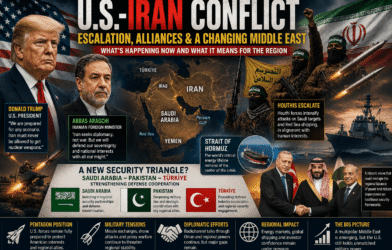
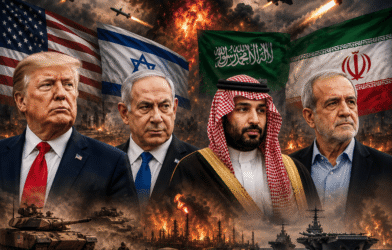
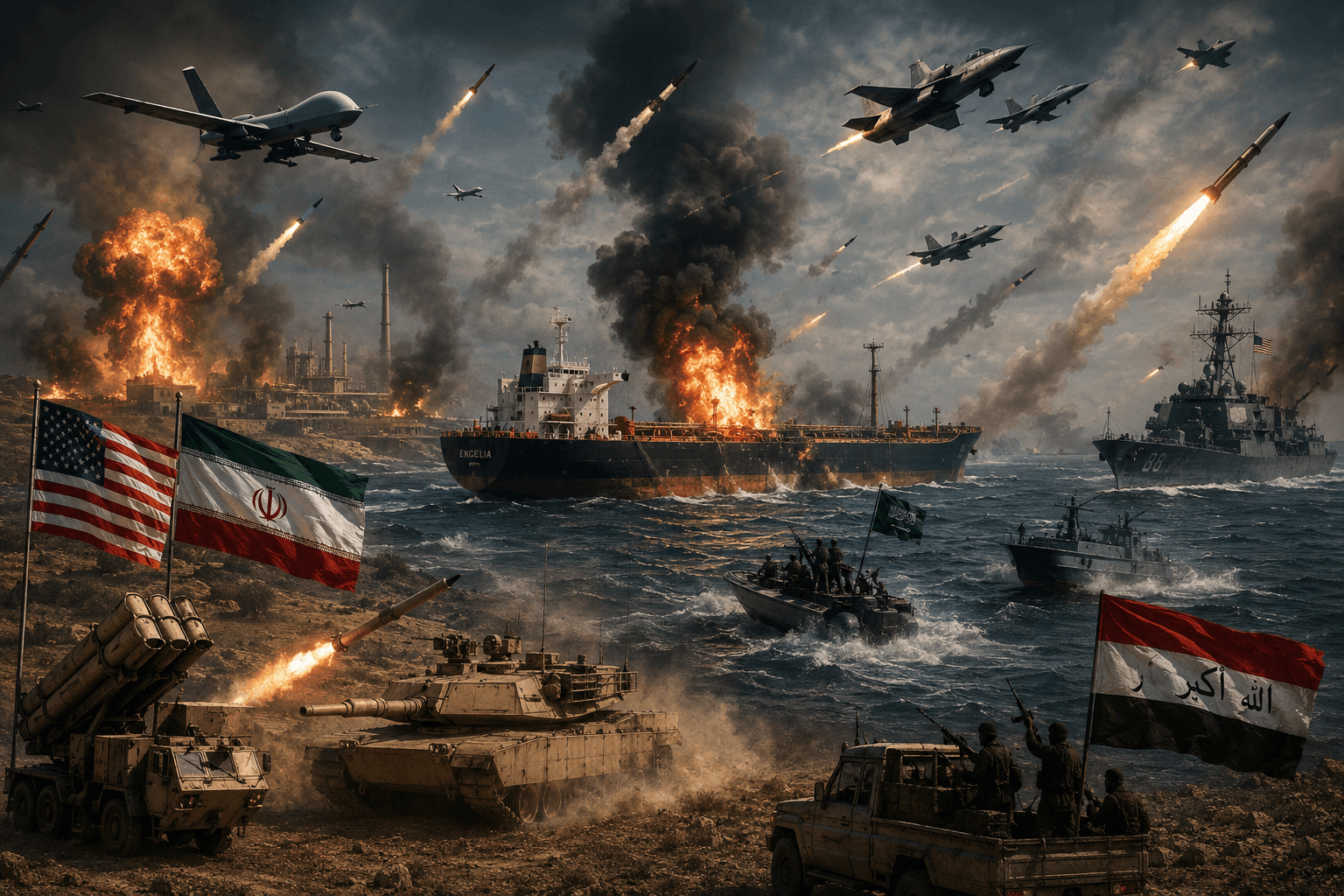
Rochester, NY/Washington, D.C/Doha, QA: The confrontation between the United States and Iran has entered a more dangerous phase, spreading beyond Iranian territory and the Strait of Hormuz into the Red Sea, Yemen, Saudi Arabia and American military positions across the Middle East.
What began as a direct exchange of strikes between Washington and Tehran is increasingly developing into a multidimensional regional conflict involving Iran’s Islamic Revolutionary Guard Corps, Yemen’s Houthi movement, Gulf Arab militaries and thousands of United States personnel deployed across the region.
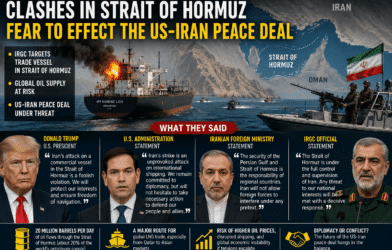
The most alarming change is the simultaneous pressure on two of the world’s most important maritime passages.
Iranian forces have continued threatening or attacking commercial vessels around the Strait of Hormuz, while the Houthis have declared what they describe as a naval blockade against Saudi Arabia and claimed missile and drone attacks on Saudi-flagged oil tankers in the Red Sea.
Together, these actions create the possibility that both Hormuz and the Bab el-Mandeb Strait could become active battle zones, endangering global energy supplies and international shipping.
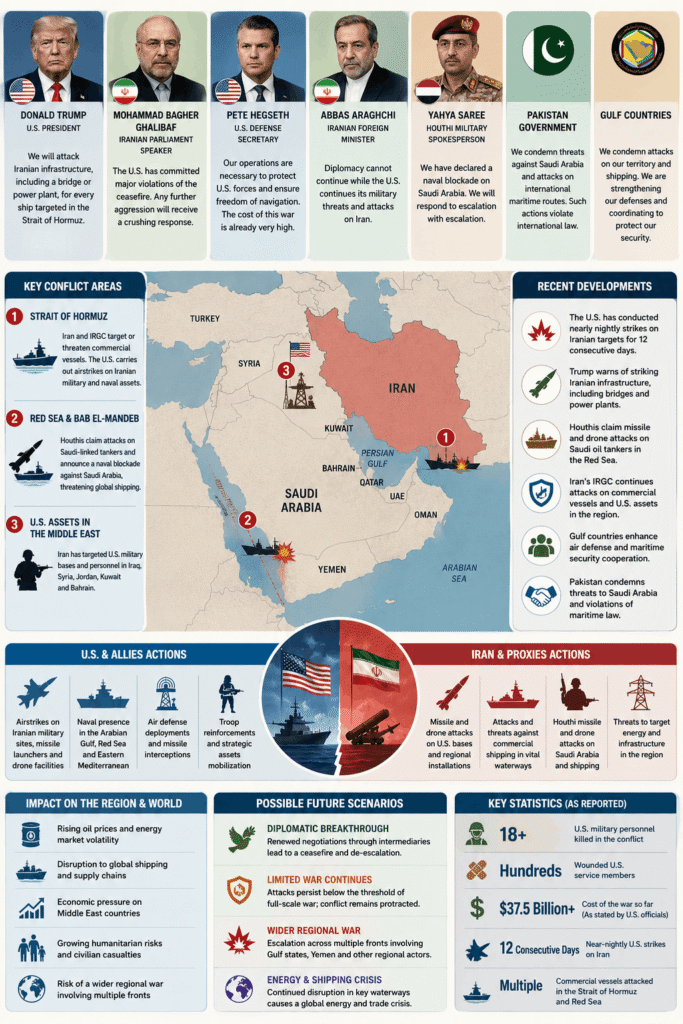
According to reports published on July 22 and 23, the United States has conducted nearly nightly strikes against Iranian targets for twelve consecutive days.
Washington says these operations are intended to reduce Iran’s ability to attack commercial shipping and American interests.
Tehran, however, describes the strikes as acts of aggression and violations of the understandings that temporarily reduced fighting earlier in the summer.
Trump Threatens Direct Retaliation against Iranian Infrastructure
President Donald Trump has adopted increasingly explicit retaliatory language. On July 22, Trump said the United States would respond to each Iranian attack on a vessel in the Strait of Hormuz by striking Iranian infrastructure, including a bridge or power plant. His warning suggested that targets could include facilities in or around Tehran.
The statement represents a significant escalation in American deterrence policy. Rather than limiting retaliation to missile batteries, drone installations, naval units or Revolutionary Guard facilities directly connected to maritime attacks, Trump is threatening damage to infrastructure that supports Iran’s civilian population and economy.
The administration appears to believe that predictable and disproportionate retaliation could force Tehran to stop targeting ships.
However, the strategy carries serious risks. Strikes on electrical networks, bridges or other dual-use facilities could produce civilian casualties, deepen humanitarian suffering and encourage Iran to answer with attacks on Gulf energy plants, water facilities or American bases.
Trump has also promised to “take care of” the Houthis should they attempt to enforce their blockade against Saudi shipping. That language indicates that the United States may expand operations toward Yemen while continuing its campaign against Iran.
The deployment of additional American aircraft, special-operations forces, medical teams and logistical units suggests that Washington is preparing for an extended confrontation rather than a limited series of retaliatory strikes.
Long-range bombers have reportedly been placed on alert, while reinforcements are being moved toward the region following Iranian attacks that killed American personnel in Jordan and Iraq.
Hegseth Defends a Costly and Expanding Military Campaign
US Defense Secretary Pete Hegseth has defended the administration’s military strategy as congressional concerns grow over casualties, expenditure and the absence of a clearly defined political end state.
Hegseth told lawmakers that the war had already cost approximately $37.5 billion, while the administration sought tens of billions of dollars in additional military funding. Critics in Congress warned that the United States could be entering another prolonged Middle Eastern war without a realistic exit strategy.
The military burden is becoming increasingly visible. Reports indicate that at least 18 American service members have been killed and hundreds wounded during the wider conflict, although casualty totals may continue to change.
The Pentagon is also balancing the Iranian campaign against the possibility of renewed large-scale operations against Houthi missile and drone networks in Yemen.
Hegseth’s central argument is that American military action is necessary to protect US forces, defend international navigation and prevent Iran from controlling regional shipping routes through force.
The unresolved question is whether air power can achieve those objectives without requiring an open-ended deployment.
Iran has spent years dispersing missile systems, constructing underground facilities and developing mobile launch capabilities.
The Houthis have similarly demonstrated that repeated bombing can reduce but not permanently eliminate their ability to fire missiles and drones. A campaign designed to restore deterrence could therefore become a war of attrition.
Iranian Parliament Speaker Accuses Washington of Destroying the Ceasefire
Iranian Parliament Speaker Mohammad Bagher Ghalibaf has accused the United States of violating the understandings that produced the earlier pause in fighting.
He has cited renewed American attacks, threats of additional military action and the restoration of economic pressure as evidence that Washington has not honored its commitments.
Ghalibaf has repeatedly warned that further attacks will receive a forceful or “crushing” response. His statements reflect the political pressure on Iran’s leadership to demonstrate that American strikes will not go unanswered.
From Tehran’s perspective, the conflict is no longer simply about nuclear facilities or sanctions. Iranian officials now present it as a struggle over national sovereignty, freedom of action in the Strait of Hormuz and the survival of the state’s regional deterrence network.
The difficulty for Iran is that its retaliatory strategy also risks isolating it diplomatically. Attacks on commercial vessels, Gulf water facilities or infrastructure in countries that did not initiate the American strikes could weaken Tehran’s claim that it is acting only in self-defense.
Each expansion of the target list increases pressure on Gulf governments to cooperate more closely with Washington.
Araghchi Says Diplomacy Cannot Continue Under Military Threats
Iranian Foreign Minister Abbas Araghchi has maintained that negotiations cannot proceed while the United States continues threatening or attacking Iran.
He previously invoked the provisions of the preliminary memorandum between Washington and Tehran, arguing that final negotiations were not supposed to begin under continuing military threats.
Following renewed US strikes, Araghchi characterized the attacks as violations of the United Nations Charter and of the understandings that had temporarily ended the earlier phase of war.
He warned against further American military “adventurism” during consultations with Pakistan’s military leadership.
Araghchi’s position places the burden of de-escalation on Washington: halt the strikes first, restore the ceasefire framework and then return to negotiations.
The United States argues the sequence should be reversed, insisting that Iran must first stop attacks on shipping, American troops and regional infrastructure.
This disagreement over sequencing is one of the principal reasons diplomacy remains stalled. Neither side wants to appear to suspend military action under pressure from the other.
As a result, each retaliatory strike becomes both a battlefield response and a negotiating signal.
IRGC Pressure on Commercial Shipping and American Assets
The Islamic Revolutionary Guard Corps has used maritime attacks as a central component of Iran’s strategy. Iranian drones, missiles and naval units have targeted or threatened vessels Tehran accuses of using US-supported routes or violating Iranian restrictions in the Strait of Hormuz.
Iran has also attacked American military positions and regional facilities associated with US operations.
Recent reporting indicates Iranian strikes have affected targets in Kuwait, Bahrain and Jordan, while American troops and infrastructure across the region remain on heightened alert.
The IRGC’s objective appears broader than sinking individual vessels. By raising the cost of commercial transit, Tehran can pressure international governments, shipping companies and energy markets to demand restraints on Washington.
However, attacks on merchant shipping are strategically dangerous for Iran. Commercial vessels often carry multinational crews and cargo unrelated to the governments involved in the war. A major loss of life, oil spill or sinking could generate broader international military cooperation against Iranian naval forces.
Houthis Open a New Front against Saudi Arabia
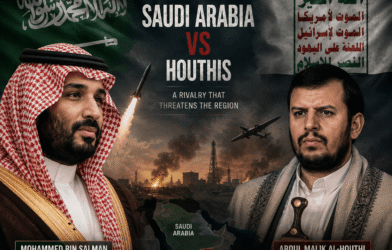
The most consequential regional development has been the Houthi movement’s renewed confrontation with Saudi Arabia.
Houthi military spokesperson Yahya Saree said the group targeted Abha International Airport in southern Saudi Arabia after Saudi action prevented an Iranian aircraft from landing at Sanaa airport. The missile attacks marked the first major claimed Houthi strikes against Saudi territory since the informal truce that began in 2022.
The Houthis subsequently announced a naval blockade against Saudi Arabia, presenting it as retaliation under an “eye for an eye” formula.
The group then claimed missile and drone attacks against the Saudi-linked tankers Encelia and Layla in the Red Sea. Maritime authorities reported that at least one tanker was struck and caught fire, although no casualties or major environmental damage were initially reported.
By attacking Saudi shipping, the Houthis are attempting to pressure Riyadh economically while linking the Yemen front to the Iran–US war. Their message is that Saudi Arabia cannot support, facilitate or benefit from pressure on Iran without facing consequences in the Red Sea.
The Houthis are aligned with Iran, but they retain their own political agenda, particularly regarding Saudi restrictions, Yemen’s airports and the unresolved civil war.
Their intervention should therefore not be understood solely as an Iranian order. Nevertheless, reports that Tehran urged the Houthis to prepare to disrupt Bab el-Mandeb if the United States struck Iran’s power network reinforce suspicions of operational coordination.
Pakistan Condemns Threats to Saudi Arabia and International Shipping
Pakistan has condemned the Houthi threats and attacks against Saudi Arabia and commercial navigation in the Red Sea.
Islamabad described threats to international maritime routes as violations of international law and indicated that challenges to Pakistani maritime interests would be treated as a serious national-security matter.
Pakistan’s position reflects several overlapping priorities. It maintains close strategic and economic relations with Saudi Arabia, has a substantial population working in Gulf countries and depends heavily on stable energy imports and maritime trade.
At the same time, Islamabad has sought to preserve relations with neighboring Iran and has participated in efforts to mediate between Tehran and Washington.
Pakistan therefore faces an increasingly difficult diplomatic balance: it can support Iran’s right to sovereignty and oppose attacks on Iranian territory while also condemning Iranian-aligned attacks on Saudi Arabia, Gulf States and commercial vessels.
As the war expands, Pakistan’s mediation role becomes harder to sustain. Every additional strike reduces the political space for compromise and increases pressure on Islamabad to demonstrate solidarity with Saudi Arabia and the Gulf monarchies.
The Future of the War: Three Interconnected Battlefields
The expanding conflict now contains three interconnected theaters.
The first is the direct US–Iran battlefield, where American airstrikes are intended to destroy Iran’s missile, naval and nuclear-related capabilities while Iran retaliates against US personnel and regional installations.
The second is the Strait of Hormuz, where Iran seeks to demonstrate that it can impose economic costs on the United States and its partners by threatening global energy traffic.
The third is the Red Sea and Yemen, where the Houthis are challenging Saudi shipping and potentially forcing Washington to divide military resources between Iran and Yemen.
The greatest danger is that escalation in one theater automatically produces retaliation in another. A US strike on an Iranian power facility could lead to a Houthi attempt to disrupt Bab el-Mandeb. A Houthi attack that kills
Saudi civilians could trigger Saudi strikes in Yemen. An Iranian missile that causes heavy American casualties could lead Trump to authorize attacks on wider Iranian infrastructure.
The war is therefore approaching a stage where political leaders may lose control of the escalation ladder.
As this story continues to develop, The Variant will provide updates, analysis, and key insights to keep readers informed.