


Courtesy: Reporting Contribution by Ghulam Murtaza [A Senior Journalist I Islamabad, Pakistan]
Rochester, NY: One way to evaluate diplomacy is by looking at who was there while history was being made, rather than just at what was said behind closed doors.
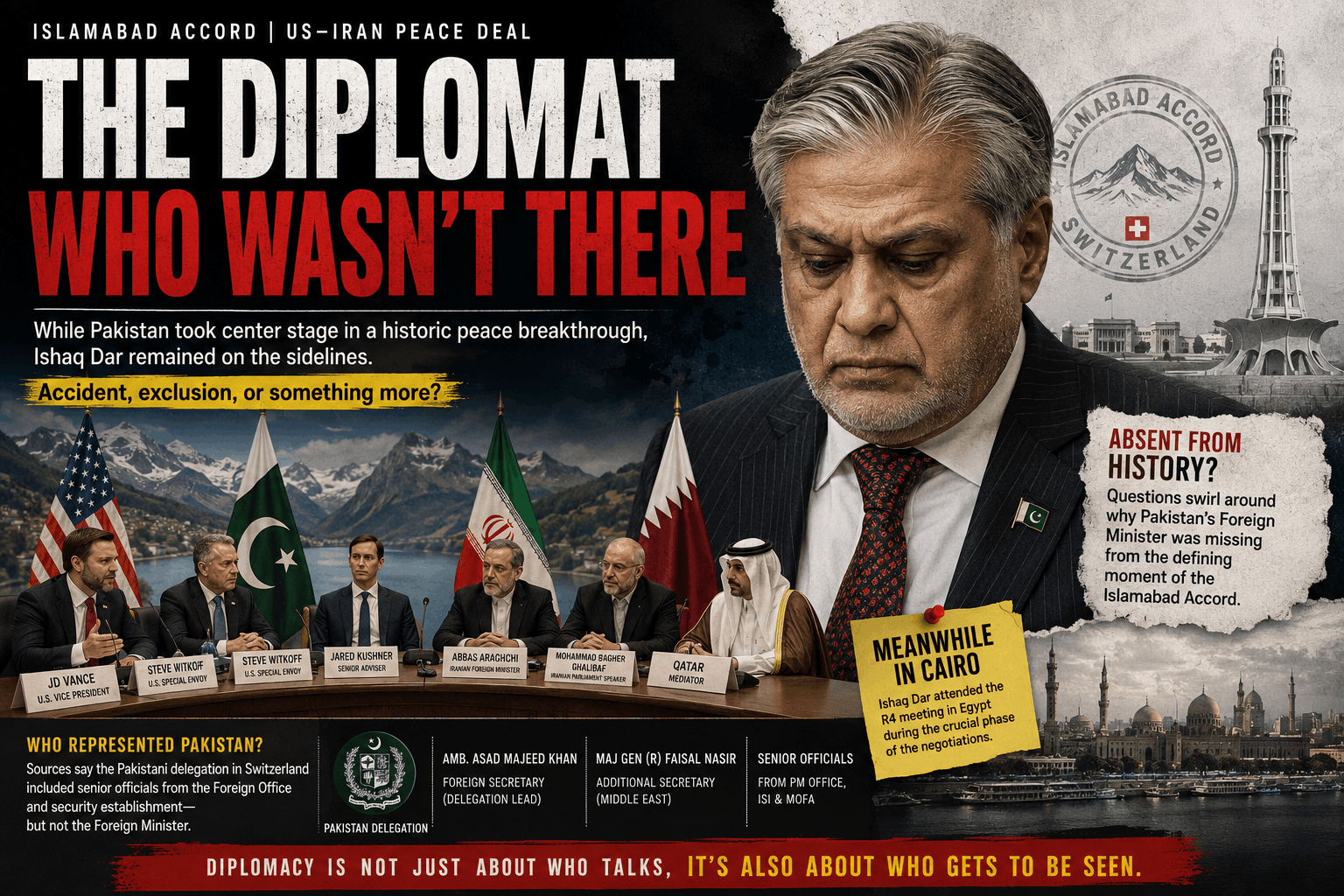
Many regional commentators have referred to the recent US-Iran peace process as the “Islamabad Accord” in Switzerland, but according to diplomatic observers and officials familiar with Pakistan’s foreign policy apparatus, one of the most intriguing aspects was the limited visibility of Pakistan’s chief diplomat, Deputy Prime Minister and Foreign Minister Ishaq Dar, during the most important phase of negotiations.
Although Pakistan’s mediation role garnered a lot of attention from around the world, the focus of political discourse in Islamabad began to change to another question: why wasn’t the foreign minister there for the most important diplomatic event related to Pakistan’s mediation efforts?
According to multiple sources and officials who spoke with The Variant, there is a pattern in Pakistan’s decision-making process regarding national security. When it comes to major security issues, the military leadership, intelligence institutions, and some civilian officials work together closely.
In this context, the latest round of negotiations in Switzerland seemed to highlight the role of Pakistan’s security apparatus rather than the more conventional civilian diplomatic apparatus.
The Surprising Role of Pakistan as a Mediator
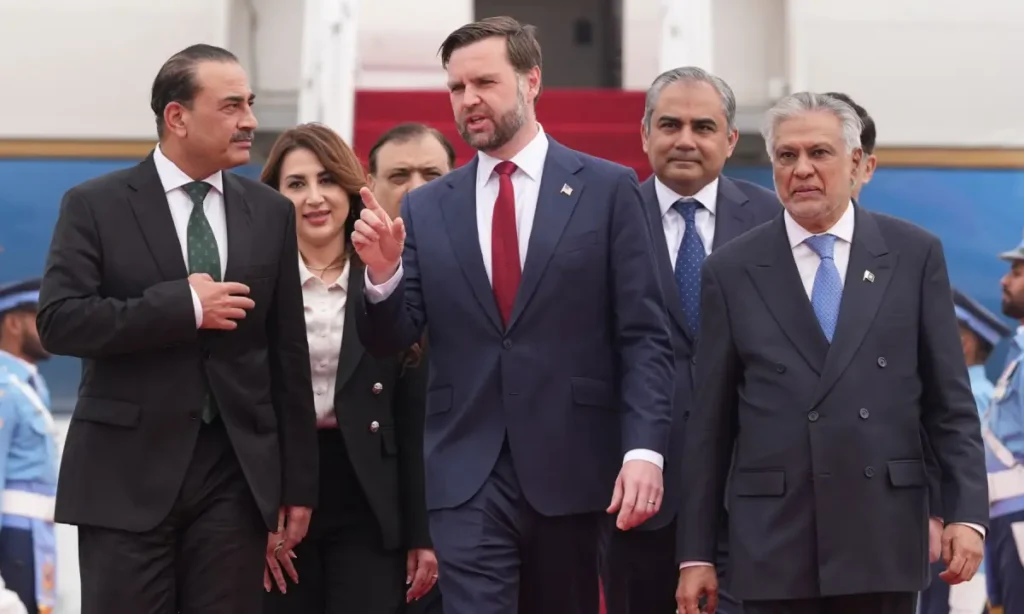
Many outside observers were taken aback by Pakistan’s sudden role as a go-between for Washington and Tehran. Foreign Minister Abbas Araghchi and parliamentary speaker Mohammad Bagher Ghalibaf represented Iran, while US Vice President JD Vance, Steve Witkoff, and Jared Kushner headed the American group in direct meetings held in Islamabad, marking the beginning of the diplomatic process.
Foreign Minister Ishaq Dar, Field Marshal Asim Munir, and Prime Minister Shehbaz Sharif were all members of Pakistan’s mediation team.
The first round of discussions in Islamabad did not result in a final agreement, but they did open a diplomatic conduit that led to further rounds in Switzerland. Meetings between top Iranian and American officials followed, with Pakistan and Qatar maintaining their mediation roles.
US Vice President JD Vance, Iranian Foreign Minister Abbas Araghchi, Qatari mediators, and Pakistan’s general facilitation role were the main subjects of international media reporting from Switzerland. But there was less evidence in the public record that Ishaq Dar was particularly involved in the Swiss round of discussions.
A Look into Exclusionary Optics
Impressions are almost as important as results when it comes to diplomacy. When other delegates, such as foreign secretaries or security officials, are present at a major international event in the absence of a foreign minister, concerns arise.
There has been conjecture among Islamabad’s diplomatic elite on whether the Foreign Office lost control of decision-making during the peace process’s latter phases to a more intimate group of security and strategic officials.
There has been no official confirmation of such rumors. But the military’s outsized role in the mediation process only served to further cement the impression that Pakistan’s security establishment was at the helm of the initiative’s development.
Government opponents saw Dar’s low profile as emblematic of a larger truth: that entities outside of Pakistan’s traditional diplomatic apparatus continue to influence the country’s most important foreign policy choices.
An Alternate Diplomatic Arena: Cairo
Ishaq Dar was busy with diplomatic pursuits abroad, including attending high-level meetings in Cairo, while the world was fixated on Switzerland. Public statements released by the Pakistani government drew attention to these interactions while also highlighting the country’s extensive diplomatic efforts in the area.
Foreign policy, according to the minister’s defenders, is too complex to be boiled down to a single incident, and Pakistan was juggling many regional dossiers at once.
On the other hand, others argue that other diplomatic engagements were eclipsed by the historic importance of the US-Iran discussions, which led to comparisons about their political impact and relevance.
Dar took part in many media appearances after the Swiss meetings, when he spoke on regional diplomacy and Pakistan’s role in promoting dialogue. Diverse audiences have various impressions of these visits.
Proponents saw it as an attempt to highlight Pakistan’s diplomatic successes, while detractors wondered whether public statements could make up for the impression of Pakistan’s lack of engagement in the pivotal phases of the discussions.
Inquiries Regarding the UAE Factor and Its Influence
The long-rumored economic interests and assets of Ishaq Dar in the UAE are another topic that sometimes rises in Pakistani political debate.
Several media outlets have covered Dar and his family’s Dubai residences, assets, and financial interests during accountability hearings and public political discussions throughout the last decade.
Nonetheless, there has been ongoing political and legal discussion about these matters. Dar and his cronies have denied the allegations, but their supporters say their political opponents have exploited the issue of foreign holdings for years.
Although media stories and public documents do touch on assets tied to the UAE, there is no concrete proof that these interests impacted Pakistan’s stance in the US-Iran diplomatic process.
The Negotiations That Influenced the Agreement
Some of the most powerful politicians from the member nations convened for the larger diplomatic endeavor. Vice President JD Vance, together with senior advisors Steve Witkoff and Jared Kushner, spearheaded the American delegation.
Foreign Minister Abbas Araghchi and Parliament Speaker Mohammad Bagher Ghalibaf were part of Iran’s delegation. Several high-ranking Pakistani officials, including Foreign Minister Ishaq Dar, Field Marshal Asim Munir, Prime Minister Shehbaz Sharif, and others, were openly linked to the country’s mediation attempt.
The spotlight turned squarely on the major negotiators and security guarantors as the talks progressed from Islamabad to Switzerland.
Some have speculated that this change has helped shift diplomatic attention from the larger institutions of foreign ministries to a more intimate group of senior officials responsible for making long-term policy decisions.
In sum: a diplomatic triumph and a political conundrum
One of the most significant diplomatic events in Pakistan’s recent past was the US-Iran peace effort. It boosted Islamabad’s prestige abroad; proved Islamabad could mediate in a dangerous area, and solidified Pakistan’s position as a key player in Middle Eastern diplomacy.
Still, several long-standing concerns with Pakistan’s internal foreign policy processes were brought to light during the process. Beyond the formal communiqués and signing ceremonies, a controversy arose about the disparity between Pakistan’s diplomatic achievements and the low profile of its foreign minister.
It is unclear whether Ishaq Dar was sidelined, sent to other diplomatic tasks, or perhaps eclipsed by more powerful geopolitical players. In addition to opening a new chapter in regional diplomacy, the Islamabad Accord sparked a new discussion over authority, sway, and decision-making within Pakistan’s diplomatic community.
Absence is often more powerful than presence when it comes to diplomacy. After months of secret talks between Iran and the US, aided by Pakistan and Qatar, this finding has taken on more significance after the Islamabad Accord, an accord that was hosted by Switzerland and came from months of backchannel communications.
Perception often turns into reality in the merciless realm of diplomacy.
Stay engaged with the issues shaping our future through comprehensive reporting and informed commentary from The Variant.


