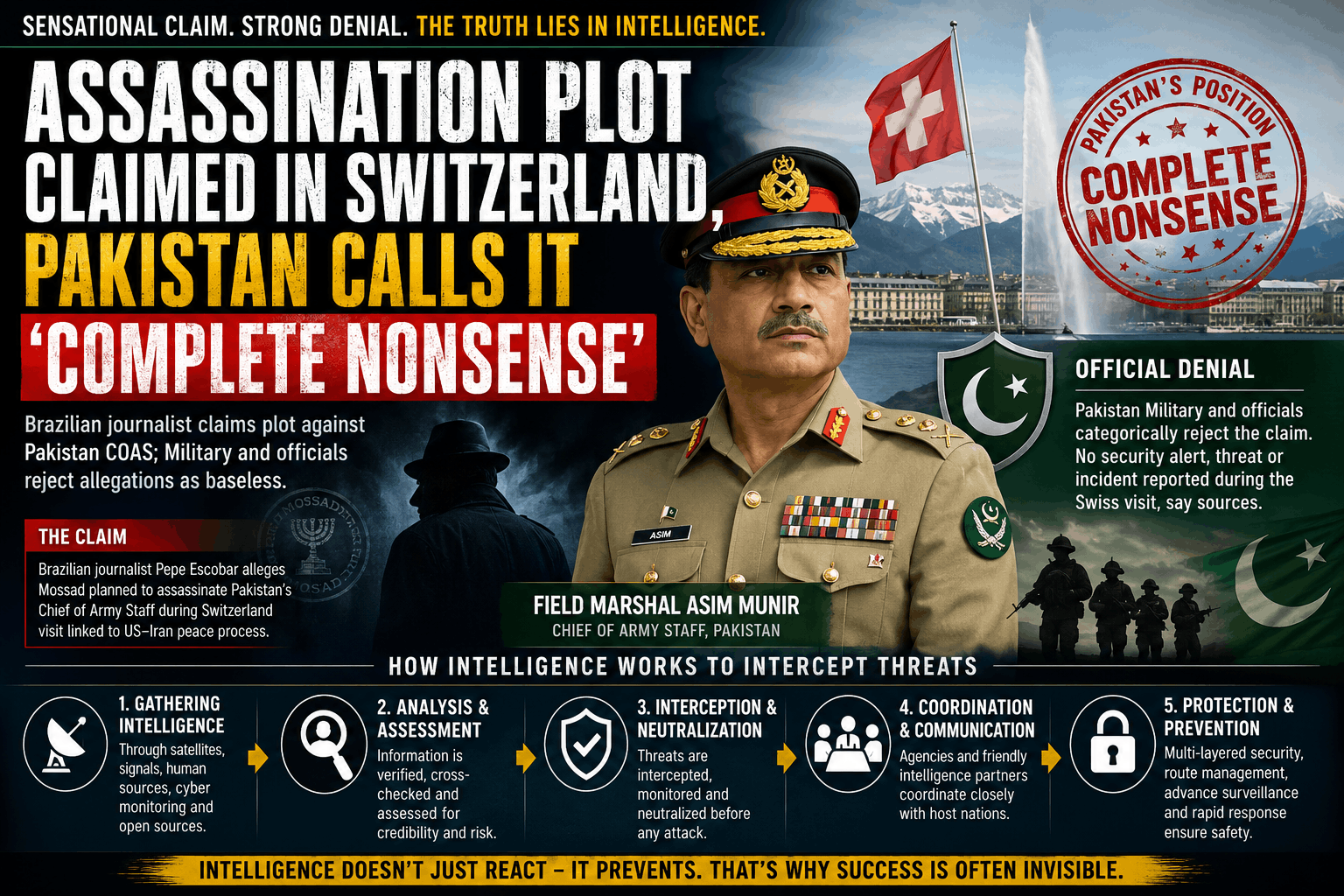
Rochester, NY: A fresh controversy has emerged following claims by Brazilian journalist and geopolitical commentator Pepe Escobar, who alleged that Israeli intelligence agency Mossad had prepared an assassination plot targeting Pakistan’s military chief, Field Marshal Syed Asim Munir, during diplomatic engagements in Switzerland connected to the recent United States-Iran peace process.
According to the allegation, Pakistani military intelligence intercepted what was described as “ultra-credible information” regarding an alleged threat and conveyed a warning to Israel through intermediaries.
However, Pakistan’s military establishment and senior security officials have categorically rejected the allegation.
Officials described the report as “complete nonsense,” insisting that the Swiss visit proceeded without any extraordinary security alert or disruption. Pakistani journalists with access to official sources also reported that neither Swiss security agencies nor U.S. protective teams detected any credible threat during the visit.
At the time of writing, no government in Pakistan, Israel, Switzerland or the United States has publicly produced evidence supporting the assassination allegation.
Why Intelligence Stories Are Rarely Black and White
The controversy nevertheless highlights an important reality of international diplomacy: high-profile state visits involving military chiefs, heads of government and strategic negotiations always trigger extensive intelligence activity.
Intelligence agencies continuously monitor potential risks, whether they originate from hostile states, terrorist organizations, lone actors, cyber networks or disinformation campaigns.
Modern intelligence work extends far beyond espionage. It combines satellite surveillance, electronic signal interception, cyber intelligence, human intelligence (HUMINT), open-source intelligence (OSINT), diplomatic reporting and continuous coordination between host-country security services and visiting delegations.
The overwhelming majority of potential threats identified during such events never become public because they are either disproved during assessment or neutralized before they evolve into operational risks.
How Intelligence Services Prevent Assassination Attempts
Protection of senior military and political leaders follows several defensive layers. Intelligence agencies constantly evaluate online threats, monitor extremist communications, intercept suspicious electronic signals and exchange classified information with friendly intelligence partners.
Advance security teams inspect venues, establish secure transportation routes, prepare contingency plans and coordinate with local police and intelligence organizations.
If intelligence agencies receive credible information suggesting a possible attack, standard practice involves verifying the source, measuring its reliability, assessing the adversary’s capability and intent, and implementing preventive measures.
These may include route changes, increased protective security, electronic counter-surveillance, diplomatic communication with relevant governments and, in exceptional circumstances, cancellation or relocation of meetings.
Most intelligence warnings never become public because revealing them could expose sources, methods or ongoing investigations.
The Challenge of Separating Intelligence from Information Warfare
In today’s geopolitical environment, intelligence is increasingly accompanied by information warfare. Claims appearing on podcasts, social media platforms or independent commentary channels can spread globally within minutes despite lacking official confirmation.
Governments therefore distinguish between three categories of information: verified intelligence supported by multiple independent sources; preliminary intelligence requiring further assessment; and unverified claims circulating in the public domain.
Responsible security institutions rarely validate sensational allegations unless doing so serves a clear operational or diplomatic purpose.
This distinction matters because adversaries may deliberately circulate dramatic narratives to influence public opinion, create diplomatic friction or exaggerate geopolitical tensions.
Pakistan’s Official Position
Pakistan’s official position remains unequivocal. Security officials have dismissed the assassination allegation as baseless and stated that the delegation’s visit to Switzerland concluded normally without any reported security incident.
Public reporting indicates there were no emergency alerts from Swiss authorities or U.S. security personnel associated with the visit. Likewise, Israel has not publicly responded to the allegation, and no independent evidence has been presented to substantiate the claim.
Strategic Implications beyond the Allegation
Whether or not such claims ultimately prove true, the episode underscores the increasingly sensitive security environment surrounding international diplomacy.
Pakistan’s growing diplomatic engagement in regional security discussions, Israel’s security concerns, the United States-Iran negotiations and broader Middle Eastern instability have all elevated the strategic significance of senior political and military leadership.
Intelligence services are designed precisely to identify and mitigate such risks before they materialize. Success is often measured not by dramatic public revelations but by the absence of incidents. Effective intelligence work remains largely invisible, operating through prevention rather than reaction.
Conclusion
At present, the alleged assassination plot against Pakistan’s Chief of Army Staff remains an unverified public claim rather than an established fact.
Pakistan has officially rejected the allegation as “complete nonsense,” and no corroborating evidence has been released by any government involved.
The episode nevertheless illustrates the central role intelligence services play in safeguarding national leaders during periods of heightened geopolitical tension.
As international diplomacy becomes increasingly intertwined with strategic competition and information warfare, distinguishing verified intelligence from unsubstantiated claims remains essential for responsible analysis and informed public understanding.
Follow our latest coverage for deeper insights into the policies, trends, and developments influencing today’s world. Click here