


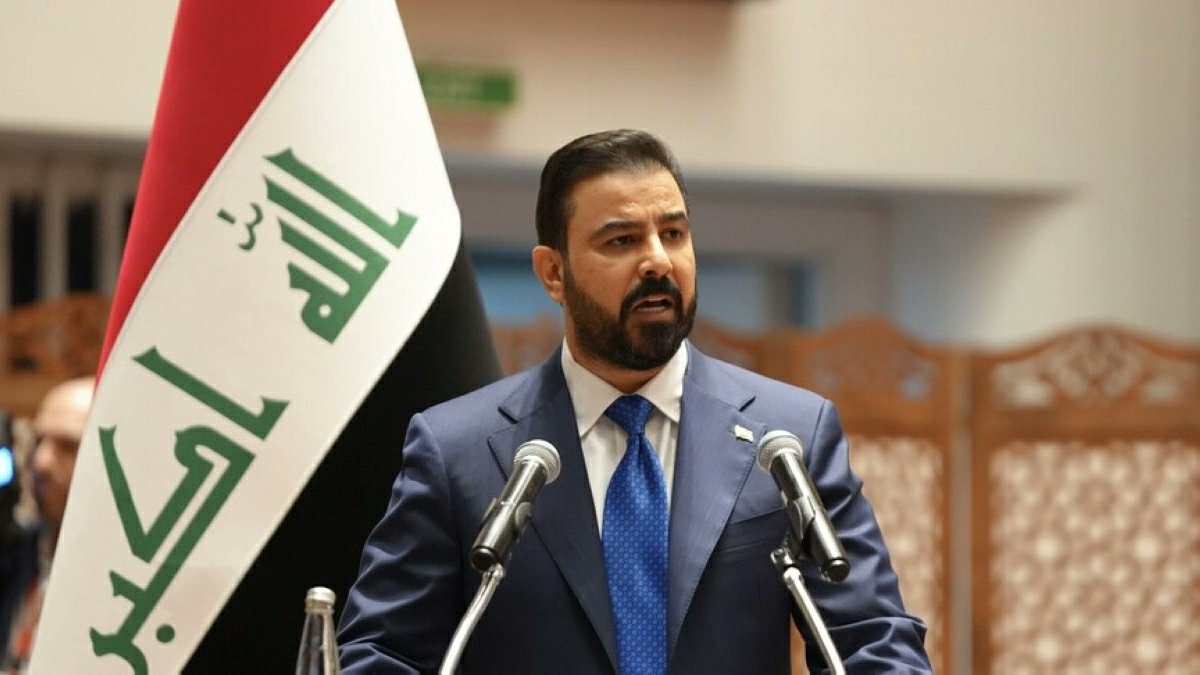
Co-Authors: Salman-Bin-Kareem/Shadab-al-Azmir
Rochester, NY/Doha, QR/Baghdad, IR: Ali al-Zaidi Iraq Prime Minister marks one of the most significant political developments in Baghdad since the defeat of ISIS and the weakening of Iraq’s post-2003 political leadership.
His appointment comes at a moment when Iraq stands trapped between competing centers of power: American strategic pressure, Iranian influence, internal sectarian fragmentation, economic fragility, and the persistent threat of insurgency.
Zaidi’s rise is not merely a routine parliamentary transition. It is a negotiated geopolitical compromise. Washington views him as a potentially manageable figure capable of limiting Tehran-backed militias, while Iran’s aligned Shiite Coordination Framework accepted him as a safer alternative than a direct confrontation with the United States after the collapse of other pro-Iran candidacies.
The Biography of Ali al-Zaidi: Businessman before Statesman
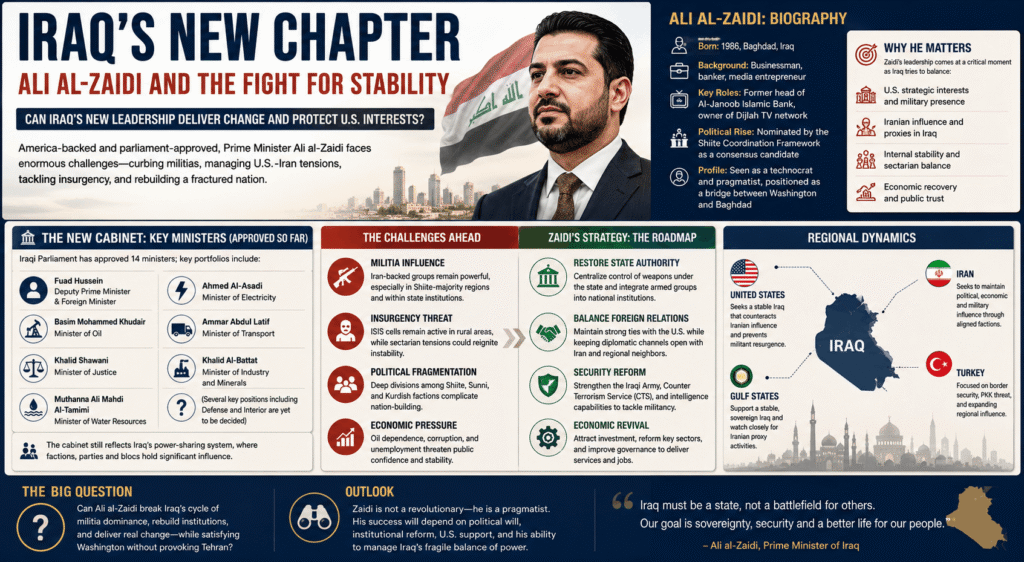
Unlike Iraq’s traditional political class dominated by former exiles, militia commanders, or long-serving Islamist politicians, Ali al-Zaidi comes from the world of banking, commerce, and media.
Born in Baghdad in 1986 and originally tied to a prominent family from Dhi Qar province, Zaidi built his career through banking and state-linked commercial ventures before entering politics.
He managed extensive business interests connected to Iraq’s government food supply system and banking sector, particularly Al-Janoob Islamic Bank and the media network Dijlah TV. However, his background is controversial.
Iraqi and international reports noted that his banking operations faced scrutiny from Iraqi and American regulators over concerns related to illicit dollar transfers and alleged indirect links to Iran-connected financial networks.
This contradiction defines Zaidi’s political identity. He is simultaneously marketed as an “independent technocrat” and criticized as a compromise businessman produced by the same post-2003 political structure that has long dominated Iraq.
Critics inside Iraq argue that Zaidi lacks a genuine political ideology or reformist movement. Some regional observers describe him less as a transformational leader and more as a crisis manager chosen to preserve the current political order without provoking either Washington or Tehran.
America’s Backing and the Strategic Calculation
The United States did not openly install Zaidi, but American influence clearly shaped the political environment that enabled his rise. Washington reportedly opposed the return of former Prime Minister Nouri al-Maliki because of his close ties with Iran and fears that his return would deepen militia control over Iraq.
Zaidi emerged as the compromise candidate acceptable to both Washington and the Shiite Coordination Framework. The Trump administration signaled support for him on the condition that he reduce militia influence, prevent attacks on U.S. interests, and stabilize Iraq’s oil sector during heightened regional tensions.
For Washington, Iraq remains strategically critical for several reasons. Iraq sits between Iran, Syria, Turkey, and the Gulf. It hosts American military advisers and remains essential for counterterrorism operations against ISIS remnants.
It is also central to global oil markets. The United States wants an Iraqi government that can prevent Iran-backed militias from transforming Iraq into a permanent anti-American operational zone.
Zaidi’s promises to centralize weapons under state authority directly address this American concern.
The Newly Formed Cabinet and Parliamentary Dynamics
Zaidi’s government entered office with only a partially approved cabinet after Iraqi parliament confirmed 14 ministers while several sensitive portfolios remained unresolved, including defense and interior ministries.
Among the key confirmed figures were:
- Fuad Hussein remaining as foreign minister
- Basim Mohammed Khudair taking the oil portfolio
- Khalid Shawani continuing as justice minister
- Muthanna Ali Mahdi al-Tamimi associated with the Badr Organization receiving the water resources ministry
The partial nature of the cabinet itself reflects Iraq’s fragmented power-sharing system. Every major ministry in Iraq represents a battlefield of sectarian bargaining, militia influence, tribal pressure, and foreign interference.
This means Zaidi may formally lead the government, but he does not fully control the Iraqi state apparatus.
Can Zaidi Avoid Iranian Proxies in Shiite Areas?
This may become the defining question of his premiership.
Zaidi belongs to Iraq’s Shiite political environment and was nominated by the Coordination Framework, a coalition deeply connected to Iran-aligned factions. Yet Washington supported his appointment precisely because he appeared less ideologically aligned with Tehran than several alternative candidates.
The problem for Zaidi is structural rather than personal.
Iranian-backed militias are not simply armed groups operating outside the state. Many are embedded within Iraq’s official security architecture through the Popular Mobilization Forces (PMF).
They possess parliamentary allies, economic empires, intelligence structures, and territorial influence, especially in southern Shiite regions and Baghdad.
Zaidi may attempt three strategies simultaneously.
- First, he is likely to pursue gradual institutional absorption rather than direct confrontation. Instead of dismantling militias immediately, he may seek to integrate them more deeply under state military command structures while limiting their independent operations.
- Second, he may try selective containment by targeting only the most internationally problematic militia activities, particularly attacks on U.S. facilities and unauthorized cross-border operations.
- Third, he will probably pursue economic leverage by restricting militia access to state contracts, customs networks, and illicit dollar flows under American financial pressure.
However, completely removing Iranian influence from Iraq’s Shiite regions is highly unlikely. Tehran’s influence in Iraq is political, religious, economic, and security-based. Any aggressive attempt to eliminate these networks could trigger internal Shiite fragmentation or even armed confrontation.
This explains why many analysts believe Zaidi’s anti-militia rhetoric may remain partly symbolic.
The Saddam Hussein Legacy and Zaidi’s Strategic Position
Although Zaidi does not belong to Saddam Hussein’s former Baathist system, Iraq’s current political crisis cannot be understood without comparing it to Saddam-era state structures.
Under Saddam Hussein, Iraq functioned through centralized authoritarian control. The state monopolized force, tribal structures were manipulated by Baghdad, and militias outside state authority were largely eliminated.
Post-2003 Iraq moved in the opposite direction. American intervention dismantled the Baathist military and administrative system without creating an equally powerful replacement. This vacuum enabled sectarian militias, insurgent groups, and foreign actors to penetrate Iraqi institutions.
Zaidi appears to understand that Iraq cannot survive indefinitely as a fragmented federation of armed political factions. His emphasis on restoring state monopoly over weapons reflects an indirect recognition that post-Saddam decentralization of armed power became unsustainable.
Yet Zaidi cannot recreate Saddam-era centralized authority. Iraq today is politically fragmented, economically dependent, and internationally constrained. Any attempt to centralize power too aggressively could provoke Sunni unrest, Kurdish resistance, or Shiite militia rebellion.
Therefore, Zaidi’s likely model is not a return to Saddam-style authoritarianism but rather a hybrid system: centralized security coordination combined with negotiated militia coexistence.
Tackling Insurgency and Militancy
Iraq’s insurgency threat has evolved significantly since the territorial defeat of ISIS.
Today, Iraq faces three overlapping security threats:
Residual ISIS cells operating in rural Sunni areas, Iran-backed militias acting independently of the state, and potential sectarian instability resulting from regional U.S.-Iran tensions.
Zaidi’s counterinsurgency strategy will likely focus on intelligence modernization, coordination between Iraqi army units and tribal networks, and expanded cooperation with American military advisers.
Unlike previous Iraqi leaders who relied heavily on militia mobilization against ISIS, Zaidi may attempt to strengthen formal state institutions such as the Counter Terrorism Service (CTS), which remains one of Iraq’s most respected security bodies.
At the same time, he faces enormous constraints. Iraq’s security apparatus remains deeply infiltrated by political factions. Corruption weakens operational effectiveness, and sectarian distrust continues to undermine national cohesion.
If the U.S.-Iran confrontation escalates further, Iraq could again become a battleground for proxy warfare, making Zaidi’s security agenda extremely difficult to sustain.
The Real Test Ahead
Ali al-Zaidi’s government may ultimately become a defining experiment in whether Iraq can produce a post-sectarian managerial leadership class capable of balancing competing powers without collapsing into civil conflict.
But the obstacles are immense.
He lacks a strong independent political base. He depends on factions he may eventually need to restrain. He enjoys American support while simultaneously operating inside an Iranian-influenced political system. He promises state authority while governing a fragmented state.
His success will depend not on rhetoric but on whether he can gradually rebuild Iraqi institutions without triggering open confrontation with militias or foreign powers.
For now, Zaidi appears less like a revolutionary reformer and more like a pragmatic balancing figure attempting to prevent Iraq from becoming the next front line in the broader U.S.-Iran regional struggle.


