Rochester, NY: The latest policy guidance issued by the Department of Homeland Security (DHS) to U.S. Citizenship and Immigration Services (USCIS) officers represents one of the most consequential changes to the American immigration system in recent years.
Although the memorandum does not formally amend U.S. immigration law, it fundamentally changes how immigration officers are instructed to evaluate Adjustment of Status (AOS) applications filed by individuals who entered the United States on temporary non-immigrant visas and later sought permanent residence without leaving the country.
For decades, Adjustment of Status has served as one of the most important pathways through which eligible immigrants could obtain lawful permanent residence while remaining inside the United States.
Whether through marriage to a U.S. citizen, employer sponsorship, family petitions, or certain humanitarian categories, the process allowed applicants to transition from temporary status to permanent residency without the disruption, expense, and uncertainty associated with overseas consular processing.
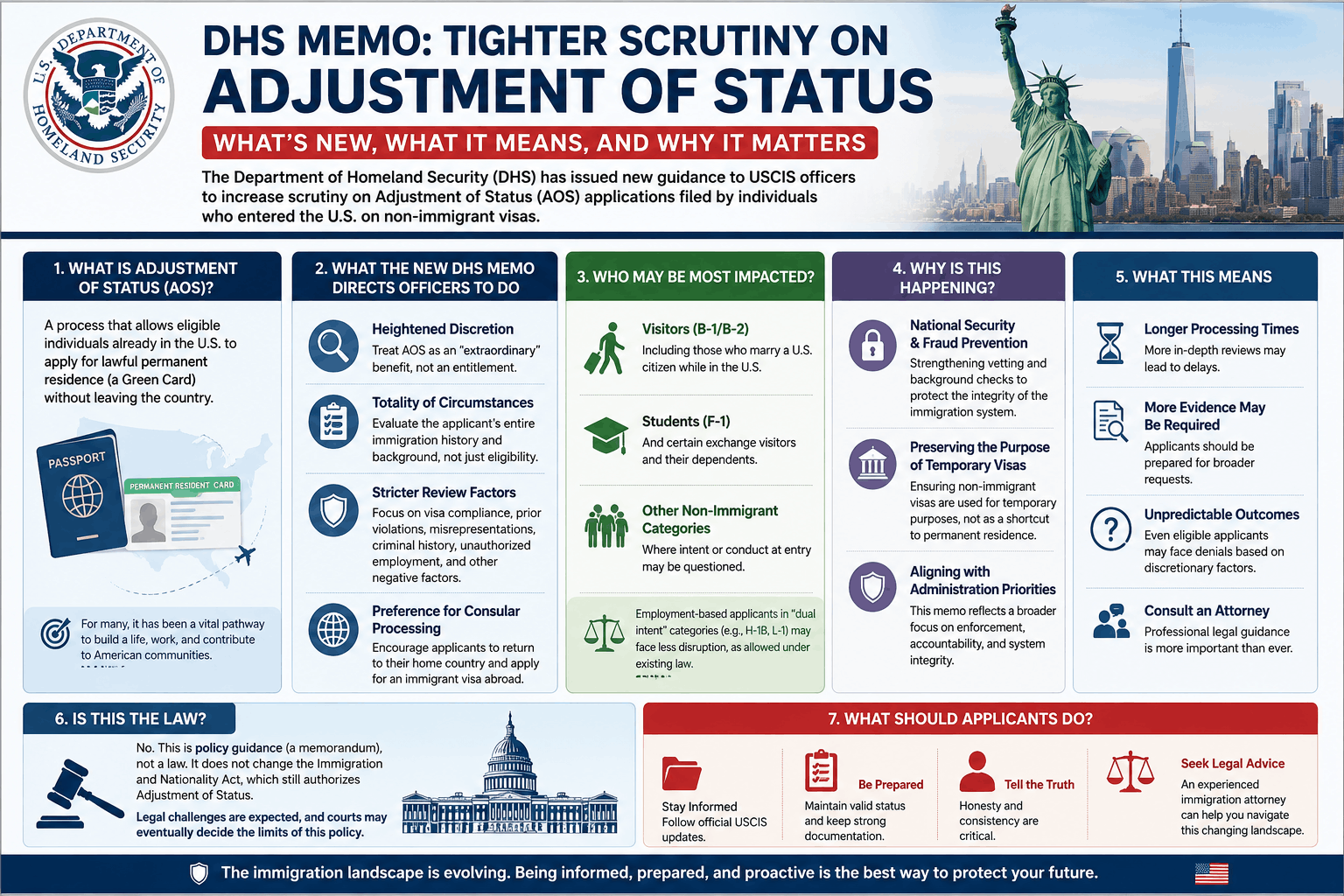
The new DHS-backed USCIS memorandum changes the philosophical foundation of that process. Rather than viewing Adjustment of Status as a routine administrative mechanism available to eligible applicants, officers are now instructed to regard it as an “extraordinary” and discretionary form of relief.
The memo emphasizes that individuals admitted to the United States on non-immigrant visas are generally expected to depart the country upon completion of their authorized stay rather than use their temporary entry as a pathway toward permanent residence.
This shift may appear technical on paper, but its practical implications could be profound for hundreds of thousands of immigrants currently residing in the United States.
The policy arrives during a period when immigration enforcement and border security remain central priorities of the Trump administration. DHS officials argue that the original purpose of non-immigrant visas was to facilitate temporary visits for tourism, business, study, or employment rather than serve as the first step toward permanent immigration.
According to the administration’s interpretation, the widespread use of Adjustment of Status over the years has gradually transformed a temporary admission system into an indirect immigration pathway that Congress never intended to become the norm.
Under the new guidance, USCIS officers are directed to conduct far more extensive discretionary reviews of Adjustment of Status applications. Instead of merely determining whether an applicant satisfies statutory eligibility requirements, officers are encouraged to evaluate the totality of circumstances surrounding the individual’s immigration history.
Factors such as visa compliance, prior immigration violations, unauthorized employment, and previous misrepresentations to immigration authorities, criminal history, and conduct inconsistent with the original purpose of admission may receive greater scrutiny than in previous years. Even applicants who technically satisfy eligibility requirements could face additional examination if officers conclude that discretionary factors weigh against approval.
Perhaps the most significant aspect of the memorandum is its apparent preference for consular processing abroad. The policy repeatedly reinforces the concept that obtaining an immigrant visa through a U.S. consulate in one’s home country should be considered the ordinary path to permanent residence.
Adjustment of Status inside the United States is increasingly portrayed as an exception rather than the preferred method. Critics argue that this approach effectively discourages applicants from pursuing green cards while physically present in the United States, even when immigration laws continue to permit such applications.
The implications are particularly important for individuals who entered the United States on visitor visas, student visas, exchange visitor programs, or other categories traditionally associated with temporary intent.
In marriage-based immigration cases, for example, USCIS officers may pay closer attention to whether an individual entered the country with a genuine temporary purpose or possessed immigrant intent at the time of entry. Such questions have always existed within immigration law, but the memorandum signals that officers may now approach them with heightened skepticism.
At the same time, the impact may not be uniform across all visa categories. Certain employment-based visa classifications, particularly those recognized under U.S. immigration law as “dual intent” categories, may experience less disruption.
Dual-intent visas such as H-1B and L-1 have long allowed individuals to maintain temporary status while simultaneously pursuing permanent residency. Legal analysts note that the memorandum itself acknowledges the distinction between traditional temporary visas and dual-intent classifications, suggesting that these applicants may retain stronger protections under existing law.
Another important dimension of the policy involves national security and fraud prevention. The memorandum follows earlier directives expanding background investigations and enhanced vetting procedures across multiple immigration categories.
DHS officials have increasingly emphasized fraud detection, criminal background reviews, and security screening as core components of immigration adjudications. Supporters of the policy argue that stricter scrutiny helps preserve the integrity of the immigration system by ensuring that only qualified applicants receive permanent residency benefits.
Opponents contend that the measures risk creating unnecessary barriers for law-abiding immigrants who have complied with legal requirements and contributed positively to American society.
The policy is also expected to generate significant legal challenges. Immigration attorneys and advocacy organizations argue that Adjustment of Status remains expressly authorized by Congress through the Immigration and Nationality Act.
Because the memorandum constitutes agency guidance rather than formal legislation or regulation, critics maintain that DHS cannot fundamentally rewrite statutory eligibility standards through internal policy directives alone. Several legal experts anticipate litigation that may ultimately determine the limits of USCIS discretion under the new framework.
Beyond the legal debate lies a broader political reality. The memorandum reflects a growing effort by the administration to redefine the relationship between temporary immigration and permanent residency.
Rather than treating the two systems as interconnected pathways, DHS appears intent on restoring a sharper distinction between temporary visitors and prospective immigrants. Whether this approach survives judicial scrutiny remains uncertain, but its immediate effect is already clear: USCIS officers have been instructed to apply a far more cautious and restrictive lens when reviewing Adjustment of Status applications filed by non-immigrants inside the United States.
For immigrants, employers, attorneys, and policymakers alike, the new guidance signals that the Adjustment of Status process is entering a period of heightened uncertainty.
The coming months will reveal whether the memorandum merely increases procedural scrutiny or fundamentally reshapes one of the most important immigration pathways in the United States. The answer will likely determine the future of thousands of pending applications and influence the broader direction of American immigration policy for years to come.