


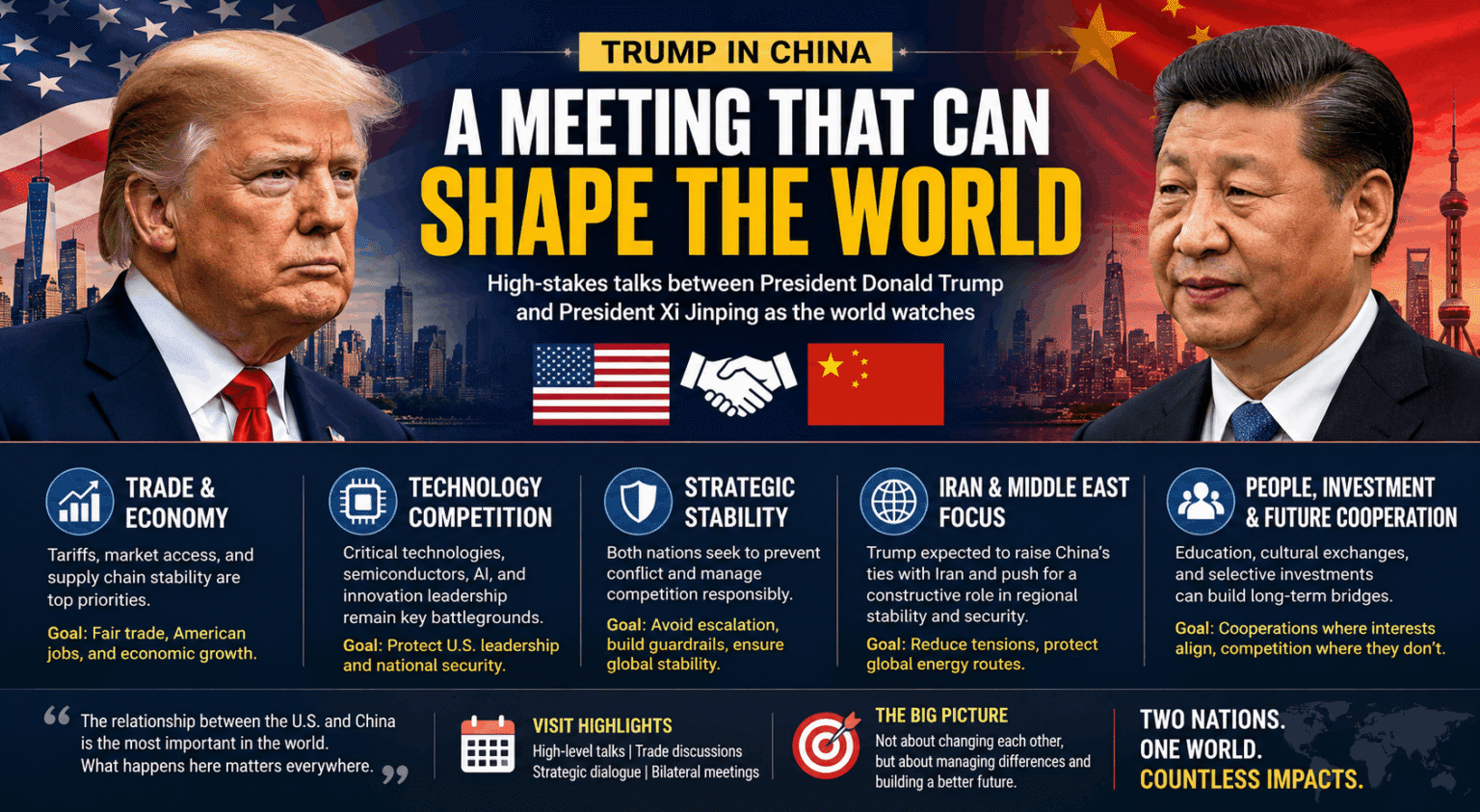
Washington, D.C/Rochester, NY: Trump in China – President Donald Trump’s visit to China is shaping up to be one of the most consequential diplomatic engagements of his second term.
At a time when the global economy is under pressure, tensions in the Middle East remain volatile, and the strategic rivalry between Washington and Beijing continues to define international politics, the visit carries far greater significance than a ceremonial state meeting.
It is expected to test whether the United States and China can move from confrontation toward controlled competition while protecting American strategic and economic interests.
For the Trump administration, the visit is not merely about rebuilding ties with Beijing. It is about reasserting American leverage after years of economic friction, tariff battles, technological restrictions, and geopolitical competition.
Trump enters the talks from a position of strength, particularly because his administration’s aggressive tariff and trade policies forced China to recognize the economic costs of prolonged confrontation with the United States.
While critics once questioned the effectiveness of Trump’s economic pressure campaign, the reality is that Beijing has increasingly sought stability in relations with Washington to protect its export-driven economy and avoid further disruptions in global markets.
One of the central outcomes of the visit could be the beginning of a limited economic normalization between the world’s two largest economies. Complete trust is unlikely because strategic competition remains deeply rooted in technology, military influence, and supply chains.
However, both governments understand that uncontrolled escalation benefits neither side. American businesses want greater market access and supply-chain predictability, while China seeks relief from economic uncertainty and declining investor confidence.
Analysts already suggest that the summit may focus on trade adjustments, industrial cooperation, and mechanisms to avoid another destructive tariff escalation.
From the American perspective, even partial normalization would represent a political and strategic success for Trump. It would allow Washington to maintain pressure on Beijing while reducing inflationary and manufacturing shocks at home.
Trump’s approach appears increasingly focused on securing practical economic gains for the United States rather than pursuing ideological confrontation.
At the same time, the issue of Iran is expected to loom heavily over the discussions. China’s relationship with Tehran has become a growing concern for Washington, particularly because Beijing remains one of Iran’s most important economic and energy partners.
Reports indicate that Trump is likely to press Chinese President Xi Jinping to use Beijing’s influence to restrain Iran and help stabilize the Gulf region, especially amid tensions surrounding the Strait of Hormuz.
The Trump administration views China’s backing of Iran not only as a Middle Eastern issue but also as a challenge to broader American strategic interests. Washington believes that any long-term regional stability requires limiting Tehran’s ability to project power through proxies and military partnerships.
Trump is therefore expected to demand greater Chinese cooperation in preventing further escalation. Whether Beijing fully agrees is another matter.
China depends heavily on Middle Eastern energy routes and prefers maintaining balanced ties with Iran, while avoiding direct confrontation with the United States.
Still, the visit could produce quiet diplomatic understandings rather than public breakthroughs. Trump may seek assurances that China will discourage Iranian escalation and support efforts to keep vital shipping lanes open.
Even limited Chinese cooperation on this front would be presented in Washington as a diplomatic achievement because it would demonstrate that Beijing recognizes American leadership in maintaining global stability.
The broader significance of the visit lies in the fact that both powers are beginning to understand the dangers of uncontrolled hostility.
The economic war between Washington and Beijing exposed vulnerabilities on both sides, but it also proved that the United States retains unmatched leverage in finance, technology, and global trade influence.
Trump’s strategy appears aimed at converting that leverage into negotiated advantages instead of endless confrontation.
However, normalization does not mean friendship. The United States will continue to challenge China on technology, military expansion, cyber security, and Indo-Pacific security issues. Likewise, China will continue attempting to expand its global influence.
The likely outcome is not a strategic alliance but a managed rivalry where both sides avoid direct economic warfare while competing for global leadership.
For Trump politically, a successful China visit could strengthen his image as a leader capable of negotiating with America’s strongest competitors from a position of authority.
If he secures trade concessions, investment agreements, or even limited Chinese cooperation on Iran, the visit may be portrayed domestically as proof that firm American pressure works better than passive diplomacy.
In the end, the summit is unlikely to erase years of mistrust, but it could reduce tensions and establish a more stable framework for US-China relations. The visit represents an opportunity for Washington to shape the next phase of global politics on American terms while ensuring that strategic competition with China remains controlled rather than chaotic.
Book Mark www.thevariant.us for further news updates!


