


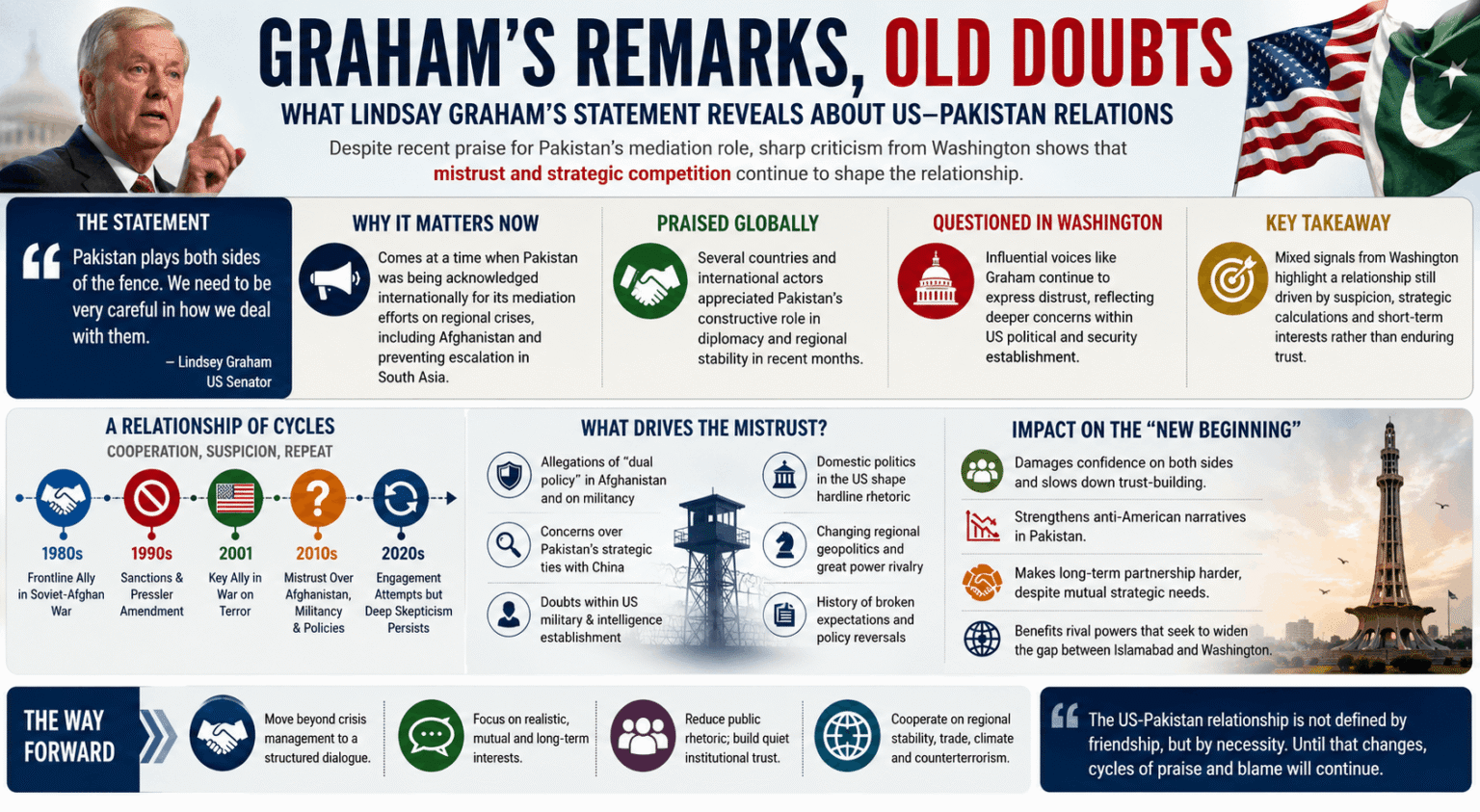
Rochester, NY: The recent remarks by Lindsey Graham regarding Pakistan once again exposed the fragile and often contradictory nature of relations between Pakistan and the United States.
While diplomatic interactions between the two countries have recently shown signs of cautious improvement, statements emerging from influential American political circles continue to revive old questions about mistrust, strategic dependency, and the uneven character of this relationship.
The controversy surrounding Graham’s statement is therefore not simply about one senator’s opinion; it reflects a deeper historical pattern that has shaped Washington’s engagement with Islamabad for decades.
Pakistan’s role in regional diplomacy during recent months had earned visible acknowledgment from several international actors.
Western officials, Gulf States, and even segments of the American foreign policy establishment had quietly appreciated Islamabad’s mediation efforts on regional security issues, particularly US-Iran conflict, concerning Afghanistan, counterterrorism coordination, and communication channels involving sensitive geopolitical crises.
Pakistan’s military and diplomatic establishment projected this renewed engagement as evidence that relations with Washington were entering a more pragmatic and less confrontational phase after years of strain following the Afghanistan withdrawal.
However, the abrupt emergence of harsh rhetoric from Lindsey Graham demonstrates how quickly the atmosphere can change in Washington. This is not unusual in the history of Pakistan-US relations.
Since the Cold War era, the relationship has often oscillated between strategic partnership and strategic suspicion. Pakistan was treated as a frontline ally during the Soviet-Afghan war, later sanctioned under the Pressler Amendment, then embraced again after the September 11 attacks, only to face accusations and mistrust during the later years of the War on Terror.
This cycle has created a deep perception within Pakistan that the United States approaches Islamabad through the lens of temporary utility rather than long-term partnership.
At the same time, many voices in Washington argue that American mistrust did not emerge without cause. Sections of the US political and security establishment have historically accused Pakistan of maintaining what they describe as a “dual-track” regional policy, especially in Afghanistan and in relation to militant networks operating in South Asia.
Whether these accusations are entirely fair or politically exaggerated remains debated, but they continue to influence American policymaking circles. Graham’s statement appears to emerge from this longstanding school of thought within the US security narrative.
The critical question is whether Graham’s remarks represent merely an individual political position or a broader signal from the American establishment.
In the US political system, senators often make strong foreign policy statements to appeal to domestic audiences, strengthen their image on national security, or align themselves with dominant ideological trends within Washington.
Lindsey Graham, known for his hawkish foreign policy views, has frequently adopted aggressive rhetoric on issues involving national security, military alliances, and global conflicts.
Therefore, his statement should not automatically be interpreted as a formal declaration of the White House or the State Department.
Yet in Washington, influential senators do not operate in a political vacuum. Their statements often reflect ongoing debates inside America’s strategic institutions, including parts of the defense establishment, intelligence community, and congressional foreign affairs circles.
This is why many observers in Pakistan view such remarks as indirect indicators of underlying skepticism that still exists within sections of the American “deep state” or security establishment. Even when official diplomacy appears warm, institutional mistrust can continue beneath the surface.
The timing of the statement is equally important. The geopolitical environment today is extremely sensitive. The United States is recalibrating its strategy in Asia amid tensions involving China, instability in Afghanistan, competition in the Middle East, and emerging regional alignments.
Pakistan’s growing strategic and economic partnership with China through the China-Pakistan Economic Corridor remains a major factor influencing American perceptions.
Washington understands that Islamabad is no longer entirely dependent on the United States as it once was during the Cold War or early post-9/11 period. This strategic diversification has changed the balance of the relationship.
Some analysts therefore interpret Graham’s remarks as part of broader pressure tactics designed to remind Pakistan that Washington still expects alignment on critical regional security priorities.
Others believe the statement may also be linked to internal American political calculations rather than any immediate shift in policy toward Pakistan.
In the United States, foreign policy rhetoric often intensifies during periods of domestic political polarization, and politicians sometimes adopt hardline international positions to project strength.
The impact on the recently improving atmosphere between Islamabad and Washington could be significant, though probably not catastrophic. Relations between the two states are no longer based on emotional trust or ideological alliance; they are driven primarily by transactional interests.
Pakistan needs diplomatic space, economic stability, and international legitimacy, while the United States still requires regional intelligence cooperation, counterterrorism coordination, and strategic access in South Asia. Because of these mutual interests, one controversial statement alone is unlikely to derail the relationship completely.
Nevertheless, such rhetoric damages confidence-building efforts. In Pakistan, anti-American sentiment has historically intensified whenever American officials are perceived as disrespectful or threatening toward Pakistani sovereignty.
Statements like Graham’s reinforce the narrative among Pakistani political and military circles that Washington cannot be fully trusted even during periods of cooperation. On the American side, recurring doubts about Pakistan’s strategic intentions continue to prevent the development of a genuinely stable partnership.
Ultimately, the controversy surrounding Lindsey Graham’s remarks reveals an uncomfortable truth about Pakistan-US relations: despite occasional diplomatic warmth, the relationship still lacks deep strategic trust.
It remains shaped by history, security anxieties, shifting alliances, and mutual suspicions accumulated over decades.
The so-called “love story” between Islamabad and Washington has always been fragile, defined more by geopolitical necessity than genuine confidence. That is why moments of praise can rapidly transform into moments of criticism.
The future direction of the relationship will depend not on isolated political statements but on whether both countries can redefine their engagement beyond crisis management and short-term strategic bargains. Without that transformation, cycles of cooperation followed by mistrust are likely to continue, regardless of temporary diplomatic improvements.


