Brooklyn, NY: The latest Iranian proposal to reopen the Strait of Hormuz in exchange for the lifting of the U.S. blockade and an end to hostilities represents not a breakthrough, but a tactical pause in a deeply entrenched geopolitical confrontation.
At the center of this crisis is a fundamental clash of strategic objectives between the administration of Donald Trump and Iran’s leadership, represented diplomatically by Foreign Minister Abbas Araghchi.
What appears outwardly as a negotiation over maritime access is, in reality, a broader struggle over regional dominance, nuclear policy, and economic survival.
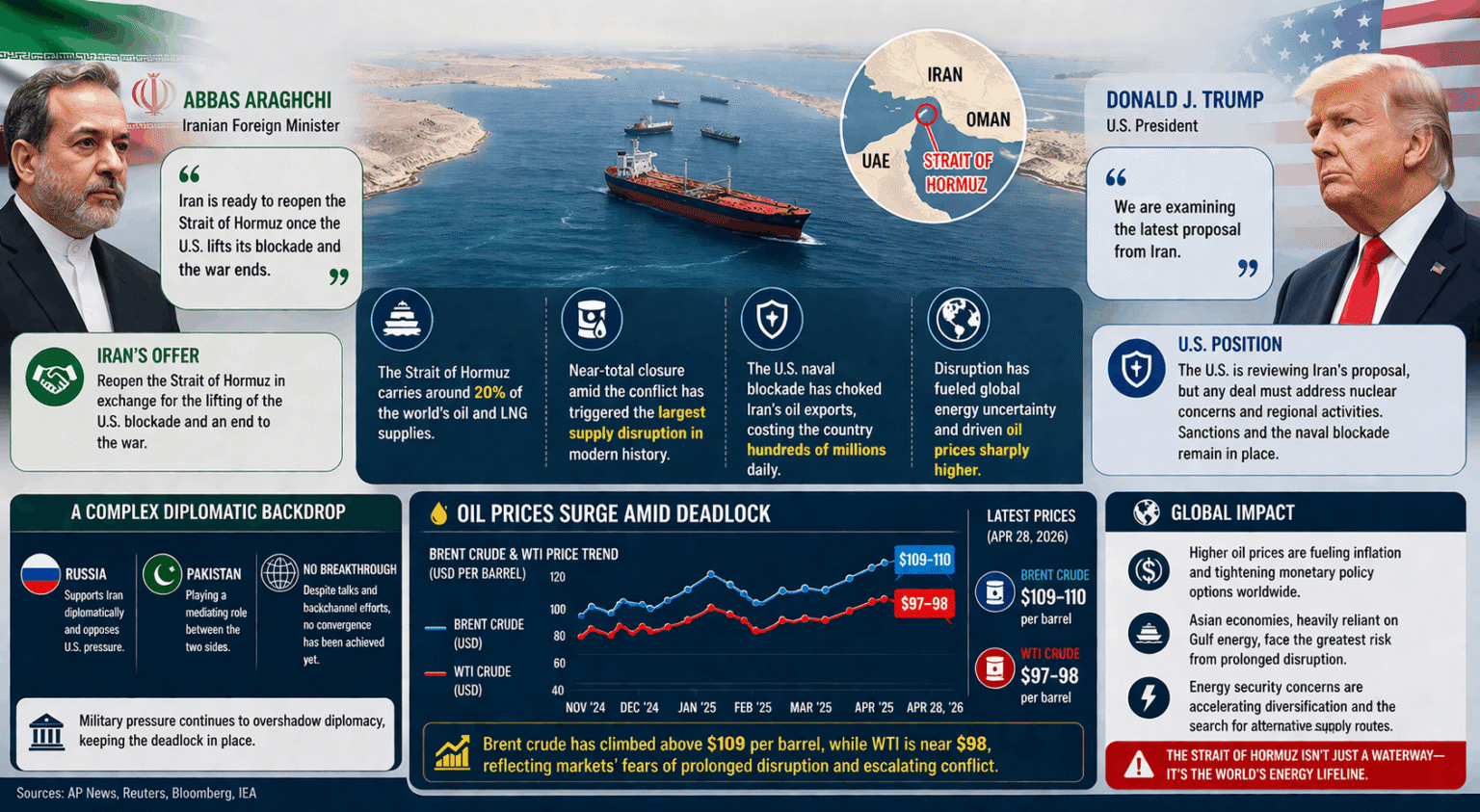
The Strait of Hormuz remains the most critical energy chokepoint in the world, historically carrying roughly 20% of global oil and LNG flows. Its near-total closure amid the ongoing conflict has triggered what analysts describe as the largest supply disruption in modern oil market history.
Iran’s offer to reopen the waterway is therefore not merely a goodwill gesture—it is a calculated attempt to leverage its geographic advantage to extract concessions from Washington.
Tehran’s condition that the U.S. must first lift its naval blockade reflects the economic strain Iran faces. The blockade, ordered under President Trump following failed negotiations in Islamabad, has severely curtailed Iran’s oil exports and reportedly costs the country hundreds of millions of dollars daily.
At the same time, Iran has demonstrated its ability to disrupt global trade by reducing tanker traffic through Hormuz to near zero, effectively holding international energy markets hostage.
Washington’s Calculated Hesitation
The U.S. response—“examining” the proposal—signals caution rather than openness. For the Trump administration, any agreement that does not address Iran’s nuclear ambitions or its broader regional activities is strategically insufficient.
This explains why previous diplomatic efforts collapsed: Tehran seeks sanctions relief and maritime normalization, while Washington insists on structural concessions that would limit Iran’s long-term strategic capabilities.
This deadlock is further complicated by the involvement of external actors. Russia, under President Vladimir Putin, has emerged as a key diplomatic backer for Iran, while Pakistan continues to play a mediating role.
Yet these parallel diplomatic tracks have failed to produce convergence, reinforcing a cycle in which military pressure substitutes for political compromise.
Oil Markets in a State of Geopolitical Pricing
The most immediate and measurable consequence of this standoff is visible in global oil markets. Prices have surged sharply, driven less by traditional supply-demand fundamentals and more by geopolitical risk premiums.
According to the latest data, Brent crude has climbed to approximately $109–110 per barrel, while U.S. West Texas Intermediate (WTI) is trading near $97–98 per barrel.
This upward trajectory reflects a market increasingly conditioned by uncertainty. The closure of Hormuz has removed a substantial portion of seaborne oil supply, forcing traders to price in worst-case scenarios, including prolonged disruption or further military escalation.
Even limited movements of tankers through alternative routes are treated as exceptions rather than indicators of normalization.
Notably, oil prices have shown resilience even in the face of intermittent diplomatic signals. Brent crude has repeatedly crossed the $100 threshold in recent weeks, with spikes above $106 reported amid renewed tensions.
This suggests that markets are discounting the likelihood of a near-term resolution and are instead preparing for sustained volatility.
Structural Implications for the Global Economy
Beyond immediate price spikes, the crisis is reshaping the structural dynamics of the global energy system. Prolonged disruption in Hormuz threatens to accelerate shifts toward alternative supply routes and energy diversification, particularly in major Asian economies that depend heavily on Gulf Oil exports.
At the same time, higher oil prices are feeding into inflationary pressures worldwide, complicating monetary policy decisions in advanced economies.
The International Energy Agency has already characterized the current disruption as one of the most severe energy security challenges in history, underscoring the systemic risks posed by the conflict.
If the deadlock persists, the global economy could face a dual shock: constrained energy supply coupled with heightened geopolitical instability.
A Diplomatic Opening or Strategic Stalemate
Iran’s proposal to reopen the Strait of Hormuz introduces a potential pathway to de-escalation, but it remains constrained by incompatible strategic objectives.
For Tehran, reopening the strait without securing relief from U.S. pressure would undermine its leverage. For Washington, accepting Iran’s terms without addressing nuclear and security concerns would represent a strategic concession.
As a result, the current moment is less a turning point than a reflection of the broader impasse. Oil markets, acting as the most immediate barometer of global anxiety, continue to climb not because of actual shortages alone, but because of the absence of trust and the persistence of risk.
In this environment, the Strait of Hormuz is no longer just a waterway—it is the epicenter of a geopolitical contest whose outcome will shape not only regional power dynamics but the future stability of global energy markets.
Keep reading world’s latest news here.