Courtesy: Reporting Contribution by Ghulam Murtaza [A Senior Journalist I Islamabad, Pakistan]
Rochester, NY/Islamabad, PK: The diplomatic corridors of Switzerland became the center of global attention as world powers gathered to advance what has increasingly become known as the Islamabad Accord process—a fragile yet ambitious effort aimed at preventing a wider Middle East conflict and rebuilding channels of communication between Washington and Tehran.
While official discussions focused on regional security, maritime stability, sanctions relief, and the future of Iran’s nuclear program, it was the dramatic diplomatic optics surrounding the summit that captured international headlines.
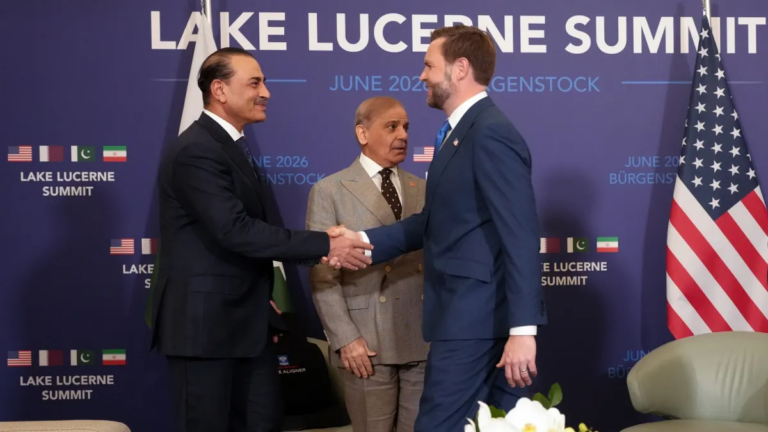
Reports of tense encounters between American and Iranian officials, the widely discussed protocol moments involving Qatar’s Prime Minister and U.S. Vice President JD Vance, and the prominent role played by Pakistan’s military leadership transformed the gathering into far more than a routine diplomatic meeting.
At the heart of the negotiations stood Pakistan’s Chief of Army Staff, Field Marshal Syed Asim Munir, whose growing profile as a regional mediator highlighted Islamabad’s emergence as an increasingly influential diplomatic actor.
The Switzerland talks not only tested the viability of the Islamabad Accord but also revealed the complex interplay of power, prestige, and personal diplomacy shaping the future of U.S.-Iran relations.
As competing narratives emerged from the summit halls, the event underscored a critical reality: in today’s geopolitics, symbolic gestures, strategic mediation, and political messaging can carry as much weight as the agreements signed behind closed doors.
From Islamabad to Bürgenstock: The Evolution of a Fragile Peace Process
The Switzerland gathering at Bürgenstock represented the most significant follow-up to the Islamabad peace initiative that emerged after months of confrontation between the United States and Iran.
The process, commonly referred to as the “Islamabad Accord” or “Islamabad Process,” was initially facilitated by Pakistan with the objective of preventing a wider regional war, reopening diplomatic channels, stabilizing the Strait of Hormuz, and creating a framework for future negotiations on sanctions, regional security, and the Iranian nuclear issue.
The principal participants in the Switzerland talks included Pakistan’s Prime Minister Shehbaz Sharif, Field Marshal Syed Asim Munir, U.S. Vice President JD Vance, Iranian Foreign Minister Abbas Araghchi, and Qatar’s Prime Minister and Foreign Minister Sheikh Mohammed bin Abdul Rahman-Al-Thani.
Senior diplomatic and security officials from all sides also attended the discussions.
Although the negotiations did not produce a final comprehensive settlement, participants described the discussions as an important step toward a broader agreement. JD Vance later stated that the talks had laid a “very good foundation” for a future deal, while Abbas Araghchi acknowledged progress despite continuing disagreements.
The Core Elements of the Islamabad Accord
The Islamabad framework revolves around several major objectives that have repeatedly surfaced throughout the negotiation process.
These include maintaining the ceasefire environment, reopening and securing the Strait of Hormuz, establishing freedom of navigation guarantees, addressing sanctions relief, discussing the release of frozen Iranian assets, preventing nuclear escalation, and reducing proxy conflicts across the Middle East.
The accord also seeks broader regional de-escalation rather than limiting negotiations solely to U.S.-Iran disputes.
The most contentious issues remain Iran’s nuclear program and the sequencing of sanctions relief.
Washington continues to seek stronger assurances regarding nuclear activities, while Tehran insists that sanctions relief and economic normalization cannot remain indefinitely conditional.
These unresolved questions prevented an earlier breakthrough in Islamabad and continue to dominate negotiations in Switzerland.
The Diplomatic Drama: Protocol, Perceptions and Political Messaging
One of the most discussed aspects of the Switzerland meeting was not what happened at the negotiating table but what occurred around it.
Viral videos circulated globally showing Qatar’s Prime Minister warmly greeting Prime Minister Shehbaz Sharif while JD Vance appeared to be left outside the immediate exchange.
This generated widespread speculation that Vance had been deliberately ignored. However, no official Qatari or American statement has confirmed that interpretation, and U.S. officials have downplayed suggestions of a diplomatic snub.
Similarly, reports emerged that the Iranian delegation briefly distanced itself from parts of the diplomatic program following renewed American rhetoric toward Tehran.
Some reports indicate that Iranian officials temporarily withdrew from portions of the proceedings after being angered by statements from Washington. Nevertheless, official Iranian accounts focused primarily on policy disagreements rather than personal confrontations.
These incidents nevertheless reveal a deeper reality: personal chemistry and diplomatic symbolism now play a major role in Middle Eastern negotiations. Every handshake, photograph, and public gesture is interpreted as a signal of trust, distrust, leverage, or dissatisfaction.
Pakistan’s Military Diplomacy and the Rise of Asim Munir
Perhaps the most striking feature of the Switzerland talks was the visibility of Pakistan’s military leadership. Field Marshal Syed Asim Munir was not merely a security representative; he emerged as one of the principal facilitators of communication between Washington and Tehran. Multiple reports indicate that Pakistan’s mediation efforts were publicly acknowledged by both American and regional officials. JD Vance himself praised Pakistan’s role in helping advance the negotiations.
The prominence of Asim Munir reflects a broader transformation in Pakistan’s foreign policy architecture.
Traditionally, diplomatic mediation would have been conducted primarily through the Foreign Office.
In contrast, the current process demonstrates the growing influence of Pakistan’s military establishment in regional diplomacy, particularly on issues involving security, strategic stability, and crisis management.
For Islamabad, successful mediation offers several strategic benefits. It improves Pakistan’s standing in Washington, strengthens relations with Gulf partners, enhances its international diplomatic profile, and positions the country as a credible crisis manager at a time when many regional powers remain deeply polarized.
JD Vance’s Performance: Strengths and Vulnerabilities
JD Vance entered the Switzerland talks carrying the burden of representing the Trump administration’s dual-track strategy of pressure and diplomacy. His public messaging attempted to reassure allies while maintaining leverage over Tehran. Following the negotiations, Vance described the talks as constructive and praised Pakistan’s efforts.
However, Vance also faced a communications challenge. The Trump administration’s messaging on Iran has often alternated between threats of military action and calls for diplomacy.
This inconsistency complicates negotiations because Tehran remains highly sensitive to perceived coercion. Reports of Iranian frustration and temporary walkouts illustrate how quickly rhetoric can undermine diplomatic momentum.
From a media perspective, Vance’s performance demonstrated both confidence and limitations.
He appeared comfortable engaging allies and acknowledging Pakistan’s role, but viral diplomatic moments overshadowed substantive achievements. In modern diplomacy, optics can become as influential as policy outcomes.
The Switzerland summit illustrated how a few seconds of video footage can dominate international headlines more effectively than hours of negotiations.
The Road Ahead
The Switzerland talks suggest that the Islamabad Process remains alive despite significant obstacles. The fact that American, Iranian, Pakistani, and Qatari officials continue meeting is itself a diplomatic achievement given the history of mistrust between Washington and Tehran. Yet the hardest questions remain unresolved.
The future of the process will depend on whether the United States can offer credible sanctions relief, whether Iran is willing to accept enhanced transparency measures regarding its nuclear activities, and whether regional actors can maintain a broader environment of de-escalation.
Qatar is expected to remain an important facilitator, while Pakistan’s role as mediator is likely to expand if both Washington and Tehran continue to view Islamabad as a trusted intermediary.
The most significant outcome of the Switzerland meeting may not be a signed document but the emergence of Pakistan as a central diplomatic bridge between rival powers.
If future negotiations ultimately produce a comprehensive settlement, historians may view the Islamabad Accord not as a single agreement, but as the beginning of a longer diplomatic process that reshaped regional politics across the Middle East and South Asia.
For more news, expert commentary, and strategic analysis, explore the latest reports and features published by The Variant.