


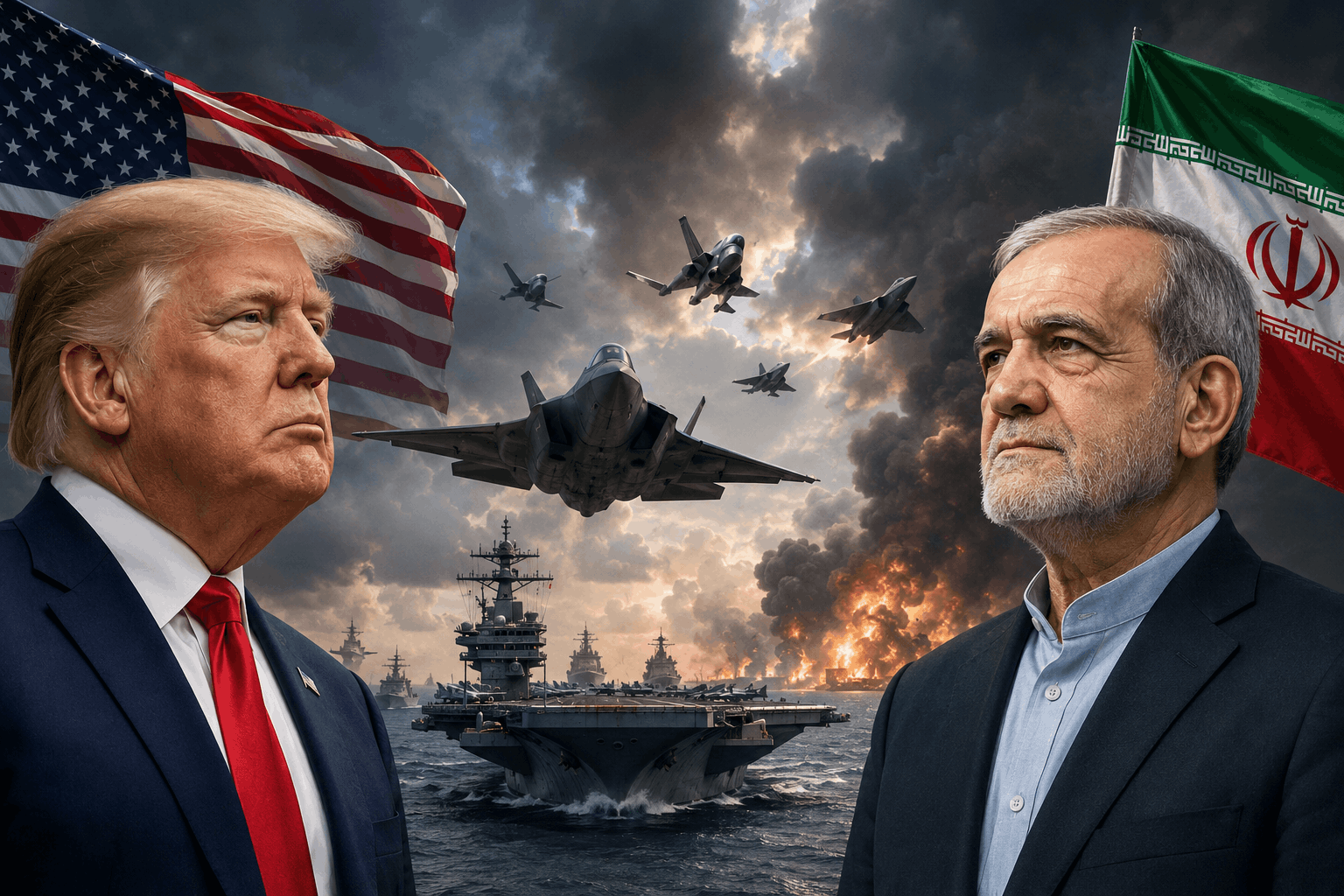
Washington D.C: The United States has significantly reinforced its military presence across the Middle East, deploying additional fighter aircraft, special operations personnel, air-defense assets, medical teams, and logistical support units.
The buildup reflects an effort by the Trump administration to increase operational flexibility rather than signal an inevitable decision to launch a broader war against Iran.
Senior U.S. defense officials have described the deployments as measures designed to provide President Donald Trump with multiple military options should Iranian attacks continue against American forces, regional partners, or international shipping lanes.
Reports indicate that the Pentagon has positioned forces to respond rapidly across the Persian Gulf, Red Sea, and surrounding theaters while maintaining readiness for defensive and offensive operations.
The deployments come after months of escalating confrontation in which Iranian-backed groups, maritime attacks, and direct exchanges between U.S. and Iranian forces have pushed the region closer to a wider conflict.
While Washington has temporarily paused some planned strikes to create space for diplomacy, the expanded military posture demonstrates that the United States intends to preserve credible military leverage should negotiations fail.
Trump’s Public Messaging: Pressure Coupled With Negotiation
President Donald Trump has repeatedly defended the military campaign by arguing that Iran must not be allowed to threaten American personnel, allies, or freedom of navigation through strategic waterways.
Through speeches and posts on Truth Social, Trump has emphasized that the United States possesses overwhelming military capability while also insisting that Tehran still has an opportunity to choose diplomacy over continued confrontation.
In recent public remarks, Trump maintained that the United States is prepared to respond forcefully to any further attacks on American interests, while simultaneously indicating that negotiations remain possible if Iran alters its behavior.
His administration has presented the military buildup as a deterrent rather than a declaration of unlimited war, although critics argue that such deployments inherently increase the possibility of escalation through miscalculation.
Iran’s Leadership Rejects Military Pressure
Iranian officials have responded by portraying the American military buildup as another attempt to coerce Tehran into accepting unfavorable political conditions. Foreign Minister Abbas Araghchi has continued to argue that diplomacy cannot succeed while military pressure remains in place, insisting that Iran will defend its sovereignty against external attacks.
President Masoud Pezeshkian has similarly emphasized that Iran seeks negotiations based on mutual respect rather than threats, while officials within the Islamic Revolutionary Guard Corps have maintained that any expansion of American military operations would trigger additional retaliation throughout the region.
Analysts note, however, that divisions have become increasingly visible within Iran’s political system, where civilian leaders generally appear more supportive of diplomacy while hardline military factions continue advocating stronger resistance against Washington and its allies.
America’s Expanding Military Commitment Carries a Growing Financial Burden
Beyond battlefield considerations, the conflict has become increasingly expensive for the United States.
Congressional testimony and defense assessments indicate that the renewed military campaign has already cost more than $37 billion, covering combat operations, deployment of additional forces, air-defense systems, naval operations, intelligence support, logistics, and humanitarian medical preparations.
Continued operations would require sustained funding for precision-guided munitions, aircraft maintenance, fuel, troop rotations, and regional force protection.
Military planners are also confronting concerns regarding the consumption of advanced missile-defense interceptors and precision weapons.
Several reports indicate that the pace of operations has prompted discussions within Washington about preserving strategic stockpiles while balancing commitments in other regions, including Europe and the Indo-Pacific.
These logistical realities partly explain why the administration has temporarily paused broader offensive operations despite maintaining substantial military capabilities in theater.
Iran’s Economy Faces Severe Long-Term Damage
Iran’s economy has experienced even deeper structural damage from the prolonged confrontation.
Years of sanctions had already constrained investment and industrial growth, but the latest conflict has intensified financial pressure through disruptions to oil exports, maritime trade, transportation infrastructure, insurance costs, and foreign investment.
The repeated security incidents around the Strait of Hormuz have complicated energy exports and increased shipping risks, reducing government revenue at a time when military expenditures continue rising.
Inflation remains elevated, the national currency has weakened further, and businesses dependent upon international trade face mounting uncertainty. Damage to infrastructure, higher defense spending, and declining investor confidence are expected to prolong Iran’s economic difficulties even if active hostilities eventually decline.
Regional Security Risks Extend Beyond Iran and the United States
The military confrontation increasingly involves actors well beyond Washington and Tehran.
Houthi attacks against Saudi energy infrastructure, threats to Red Sea shipping, and continued instability around the Strait of Hormuz demonstrate how quickly localized military actions can disrupt global energy markets and international commerce.
American allies throughout the Gulf remain concerned that additional escalation could expose critical oil facilities, commercial ports, and civilian infrastructure to further attacks.
Even countries attempting to maintain neutrality recognize that prolonged instability could affect global supply chains, energy prices, inflation, and international financial markets.
Strategic Calculations on Both Sides
The current military buildup reflects competing strategic calculations rather than an inevitable march toward full-scale war.
Washington seeks to maintain sufficient military strength to deter further Iranian attacks while preserving negotiating leverage.
Tehran, meanwhile, appears determined to demonstrate that sustained external pressure will not force unilateral concessions, even as economic hardship continues to mount.
For the Trump administration, expanding military options strengthens deterrence but also increases political responsibility for managing escalation.
Any broader offensive campaign would require balancing military objectives with domestic political considerations, alliance management, and the economic consequences of a prolonged regional conflict.
For Iran, continued resistance may reinforce domestic narratives of national sovereignty, but the cumulative economic costs, declining investment, and continued isolation present long-term challenges that military resilience alone cannot resolve.
Conclusion
The latest American force surge represents one of the most significant military reinforcements in the Middle East during the current phase of the conflict.
While it provides President Donald Trump with broader military options, it does not necessarily indicate that Washington has decided to pursue a larger war. Instead, the deployments strengthen deterrence while leaving diplomatic channels open.
At the same time, both nations are paying substantial costs. The United States faces mounting defense expenditures exceeding $37 billion, increased operational demands, and pressure on military resources.
Iran continues to endure severe economic disruption, weakened investment, constrained energy exports, and growing financial hardship.
Whether the current military posture ultimately strengthens diplomacy or leads to another cycle of escalation will depend on political decisions in Washington and Tehran rather than military capability alone.
Keep following The Variant as we continue to monitor developments and provide informed perspectives on this evolving situation.


