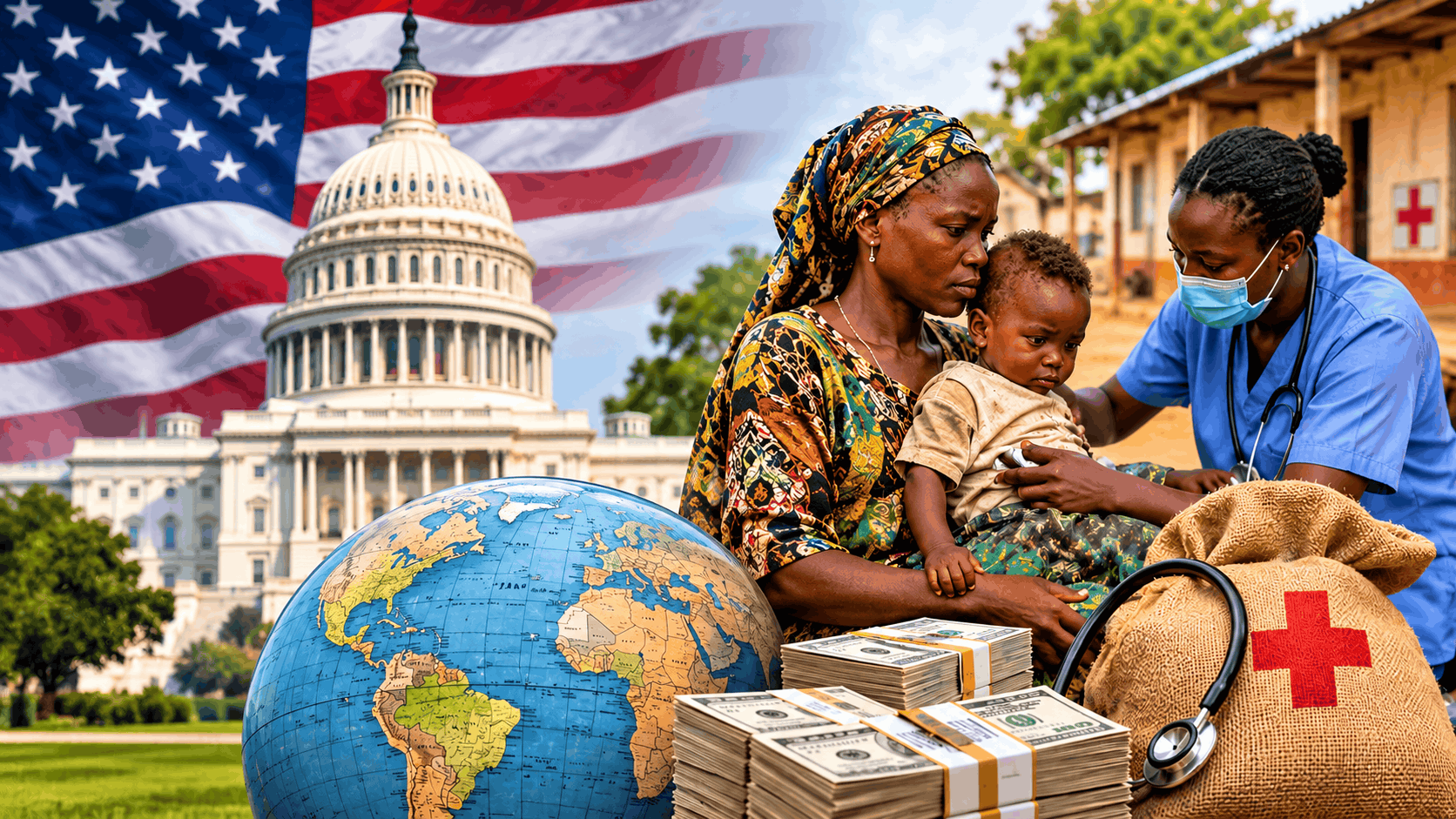
Rochester, NY: The Trump administration’s decision to redirect billions of dollars in international health assistance represents far more than another controversial adjustment to American foreign policy. It signals a fundamental transformation in how Washington exercises its economic influence, manages humanitarian commitments, and interprets the constitutional limits of presidential authority.
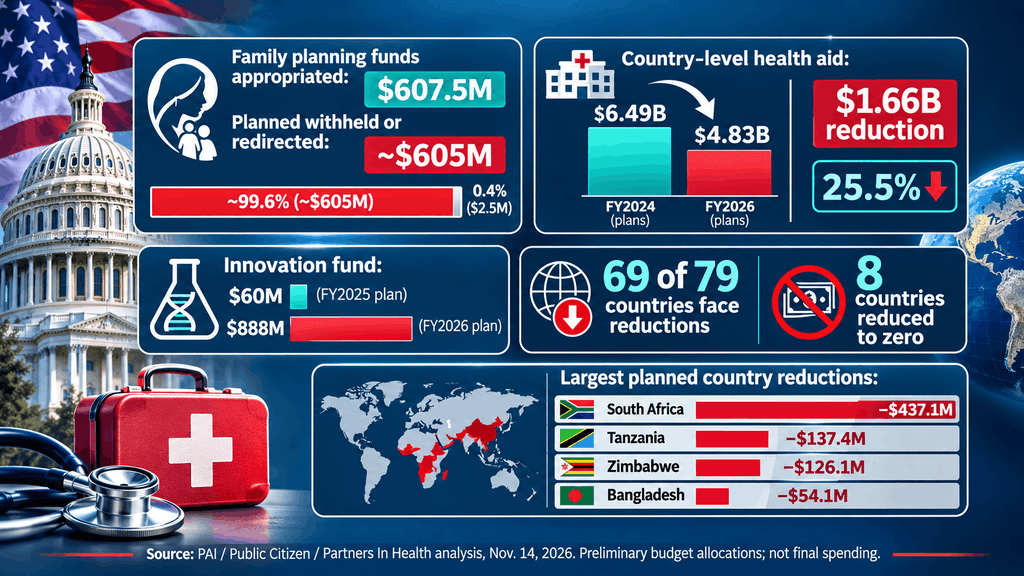
According to a November 14 CNN investigation, internal State Department budget documents reveal plans to withhold or redirect approximately $605 million of the $607.5 million Congress appropriated for international family planning and reproductive health programs.
The administration is also proposing substantial reductions in country-level health assistance while expanding a nearly $900 million innovation fund that critics argue could disproportionately benefit American corporations.
The controversy exposes a growing contradiction within American governance: Congress determines federal spending priorities, yet the executive branch exercises considerable operational control over how appropriated resources are distributed.
For millions of vulnerable people across Africa, Asia, and the Middle East, the consequences extend beyond Washington’s institutional disputes.
They potentially involve interrupted medical treatment, reduced access to contraception, weakened disease surveillance, and diminished maternal healthcare.
Congress Allocated the Money. The White House Has Different Priorities.
The constitutional foundation of the dispute lies in Congress’s power of the purse. Under Article I of the U.S. Constitution, federal spending must be authorized through legislation, while the executive branch is responsible for implementing those laws.
The Trump administration argues that its approach reflects legitimate executive discretion and the need to respond to changing international circumstances.
A State Department spokesperson told CNN that foreign assistance is being continually evaluated to address critical needs, including unexpected emergencies arising from the global energy crisis. Officials also maintain that new bilateral health agreements will preserve essential services targeting HIV/AIDS, tuberculosis, malaria, and maternal and child health.
However, critics argue that administrative flexibility cannot justify effectively abandoning spending purposes explicitly approved by Congress.
The preliminary fiscal year 2026 allocation document reportedly places approximately $524 million in family planning funding in an unallocated category. Another $48.5 million is designated for energy security requirements, while $32.5 million originally intended for the United Nations Population Fund is being redirected.
These decisions raise serious questions about compliance with congressional appropriations, although their ultimate legality would depend on the precise statutory authorities involved and potentially judicial review.
The distinction is essential. Presidential authority to reprogram certain funds does exist under specified circumstances. But that authority is not unlimited, particularly when Congress establishes explicit conditions governing expenditures.
The controversy therefore represents a test of institutional checks and balances rather than merely a disagreement about foreign aid.
The Numbers Reveal a Dramatic Withdrawal
The scale of the proposed restructuring becomes clearer when examining country-specific allocations.
Research published by Public Citizen, Partners In Health, and PAI indicates that planned country-level global health assistance would decline from approximately $6.49 billion in fiscal year 2024 to $4.83 billion in fiscal year 2026.
That represents a reduction of approximately $1.66 billion, or 25.5%, across the 79 countries examined.
Of those countries, 69 face reductions compared with their earlier allocation plans. Eight have their listed funding reduced to zero.
South Africa faces the largest absolute decrease, with its allocation falling from approximately $437 million to zero. Tanzania faces a reduction of roughly $137 million, while Zimbabwe loses approximately $126 million. Bangladesh faces a decline of more than $54 million, representing nearly 68% of its earlier allocation.
Afghanistan, Sudan, Somalia, Yemen, the Central African Republic, Gambia, and Timor-Leste also appear among countries whose listed allocations fall to zero.
These figures compare allocation plans rather than final audited expenditures. They therefore demonstrate the administration’s intended redistribution of resources, not necessarily the precise amount already removed from healthcare facilities.
Nevertheless, the direction is unmistakable: Washington is moving away from broad country-based health assistance toward a more selective model.
For countries already struggling with poverty, conflict, infectious diseases, and fragile public institutions, even temporary funding uncertainty can undermine years of medical progress.
From Humanitarian Assistance to American Corporate Opportunity
Perhaps the most politically sensitive element of the restructuring involves the administration’s proposed $888 million global health innovation fund.
According to the budget analysis, the fund would expand dramatically from a previous planned allocation of approximately $60 million.
Supporters of commercially oriented development financing could argue that American medical technology, pharmaceutical innovation, diagnostics, and private-sector expertise offer more sustainable solutions than traditional assistance programs.
There is a legitimate policy debate about whether decades of foreign aid have always produced sufficient accountability, local ownership, or measurable results.
However, the central concern is whether a shift toward American corporate participation will prioritize commercial opportunities over immediate medical needs.
The innovation fund’s ultimate beneficiaries and results require greater transparency. Its expansion does not, by itself, establish corporate favoritism or misuse of public money.
Yet transferring resources from established health programs into a centrally managed innovation mechanism creates legitimate questions about procurement, oversight, competition, and public benefit.
If funding rewards commercially attractive projects while neglecting rural clinics, maternal health programs, and preventive services, the United States risks replacing a humanitarian framework with a transaction-driven development strategy.
Women and Children Could Bear the Greatest Burden
International family planning assistance has historically supported access to contraception, reproductive healthcare, pregnancy planning, and maternal health services.
These programs are particularly significant in communities where medical infrastructure is limited and preventable pregnancy-related complications remain a major public health challenge.
According to estimates from the Guttmacher Institute cited by CNN, American global family planning investments in fiscal year 2024 helped prevent approximately 34,000 maternal deaths.
This estimate demonstrates the potential significance of sustained reproductive healthcare assistance, although it should not be interpreted as a direct forecast of deaths resulting from the current proposed reductions.
The administration’s position also reflects a broader ideological disagreement over reproductive health policy.
Secretary of State Marco Rubio previously indicated that the United States would no longer pursue its traditional international family planning role.
Nevertheless, contraception, abortion, and maternal healthcare are medically and legally distinct issues. Treating them as interchangeable risks obscuring the practical consequences of withdrawing support for voluntary family planning services.
The economic implications are equally important. When women cannot reliably access reproductive healthcare, the consequences can extend to household finances, educational opportunities, workforce participation, and children’s well-being.
These are not simply ideological concerns. They are fundamental development challenges.
Africa and Asia Face a New Era of Uncertainty
The proposed reductions could prove particularly consequential across sub-Saharan Africa, where American assistance has historically supported HIV treatment, malaria prevention, tuberculosis control, and healthcare workforce development.
Zimbabwe illustrates the danger of interrupted support.
According to the nonprofit organizations’ November assessment, earlier aid disruptions affected HIV and malaria services, laboratory operations, and healthcare staffing. Their findings indicate that malaria cases and deaths during the first quarter of 2026 were nearly double the corresponding period in 2025.
Such figures warrant serious attention, although changes in disease incidence cannot automatically be attributed entirely to American funding decisions.
Across South Asia, Bangladesh’s substantial planned reduction raises questions about the continuity of services in vulnerable communities.
Afghanistan presents an especially difficult humanitarian dilemma. Its population faces severe economic hardship and restrictions affecting women’s access to education and employment. Reduced international healthcare assistance could intensify existing vulnerabilities.
In conflict-affected countries such as Sudan and Yemen, weakening health infrastructure may also complicate efforts to contain infectious diseases and provide emergency medical care.
Trump’s America First Strategy Meets Its Foreign Policy Contradictions
The administration’s approach is consistent with President Trump’s broader preference for transactional international relationships, reduced foreign assistance obligations, and greater emphasis on demonstrable American national interests.
From this perspective, overseas assistance should not be treated as a permanent entitlement. Recipient governments should gradually assume greater responsibility for their healthcare systems.
The administration has also promoted bilateral agreements intended to increase government ownership and improve accountability.
According to the Center for Global Development, the State Department has signed 36 bilateral health agreements involving more than $16.1 billion in commitments over five years. However, significant questions remain about implementation, transparency, and the pace at which resources will reach healthcare providers.
The difficulty lies in the transition.
Long-term self-reliance may be a defensible development objective, but reducing assistance before alternative systems are operational can produce immediate harm.
There is also a geopolitical contradiction.
As Washington reduces its humanitarian presence, competing powers may find opportunities to expand diplomatic and economic influence.
China, in particular, could benefit strategically if governments increasingly perceive American commitments as unpredictable.
Humanitarian assistance has never been entirely separate from national security. Disease surveillance, regional stability, diplomatic goodwill, and institutional partnerships all contribute to American influence.
Reducing these investments may produce short-term budgetary savings while creating longer-term strategic costs.
A New Congress Could Intensify the Confrontation
The political implications are particularly significant following the 2026 midterm elections.
Congressional oversight of executive spending decisions is likely to become a major arena of confrontation as lawmakers examine whether appropriated funds have been lawfully withheld or redirected.
Representative Lois Frankel, a Democrat serving on the House Appropriations Committee, has criticized the administration’s refusal to spend congressionally appropriated family planning funds.
Congress can respond through oversight hearings, document requests, revised appropriations conditions, and legislative restrictions.
However, effective intervention will depend on statutory language, political cooperation, and the ability to obtain detailed spending records.
The dispute could also generate litigation concerning the boundaries of executive discretion and congressional spending authority.
Importantly, disagreement with Congress’s spending priorities is not automatically a constitutional violation. The decisive legal question is whether the administration’s specific actions comply with the laws governing those appropriations.
The Real Cost of Redefining American Leadership
The global health funding controversy ultimately exposes a larger question about the future of American power.
For decades, the United States has combined military strength, economic influence, scientific research, and humanitarian assistance to sustain its international position.
Programs combating HIV/AIDS, malaria, tuberculosis, and maternal mortality have served both humanitarian objectives and broader diplomatic interests.
The Trump administration is attempting to redefine that model around narrower strategic priorities, bilateral negotiations, and greater American commercial participation.
Reform is not inherently harmful. Greater transparency, reduced waste, stronger local institutions, and measurable health outcomes are legitimate goals.
But successful reform requires continuity, evidence, and accountability.
A funding system that leaves hundreds of millions of dollars unallocated while established medical programs face reductions risks undermining those objectives.
The administration must demonstrate not only that its new approach is legally permissible, but also that it can deliver better public health outcomes.
Congress, meanwhile, must defend its constitutional responsibilities without treating every proposed administrative reform as illegitimate.
The ultimate judgment will not rest solely with politicians, corporations, or federal courts.
It will also be measured in functioning clinics, uninterrupted treatments, healthier mothers, and children who survive preventable diseases.
America may possess the financial and political power to withdraw from parts of the world’s healthcare system. The more consequential question is whether doing so strengthens its national interests—or weakens the very international influence it seeks to preserve.
Sources: CNN investigation, November 14, 2026; Public Citizen, Partners In Health and PAI fiscal year 2026 budget analysis; Center for Global Development, November 13, 2026; KFF global health policy research. The figures distinguish proposed allocations from confirmed expenditures.