


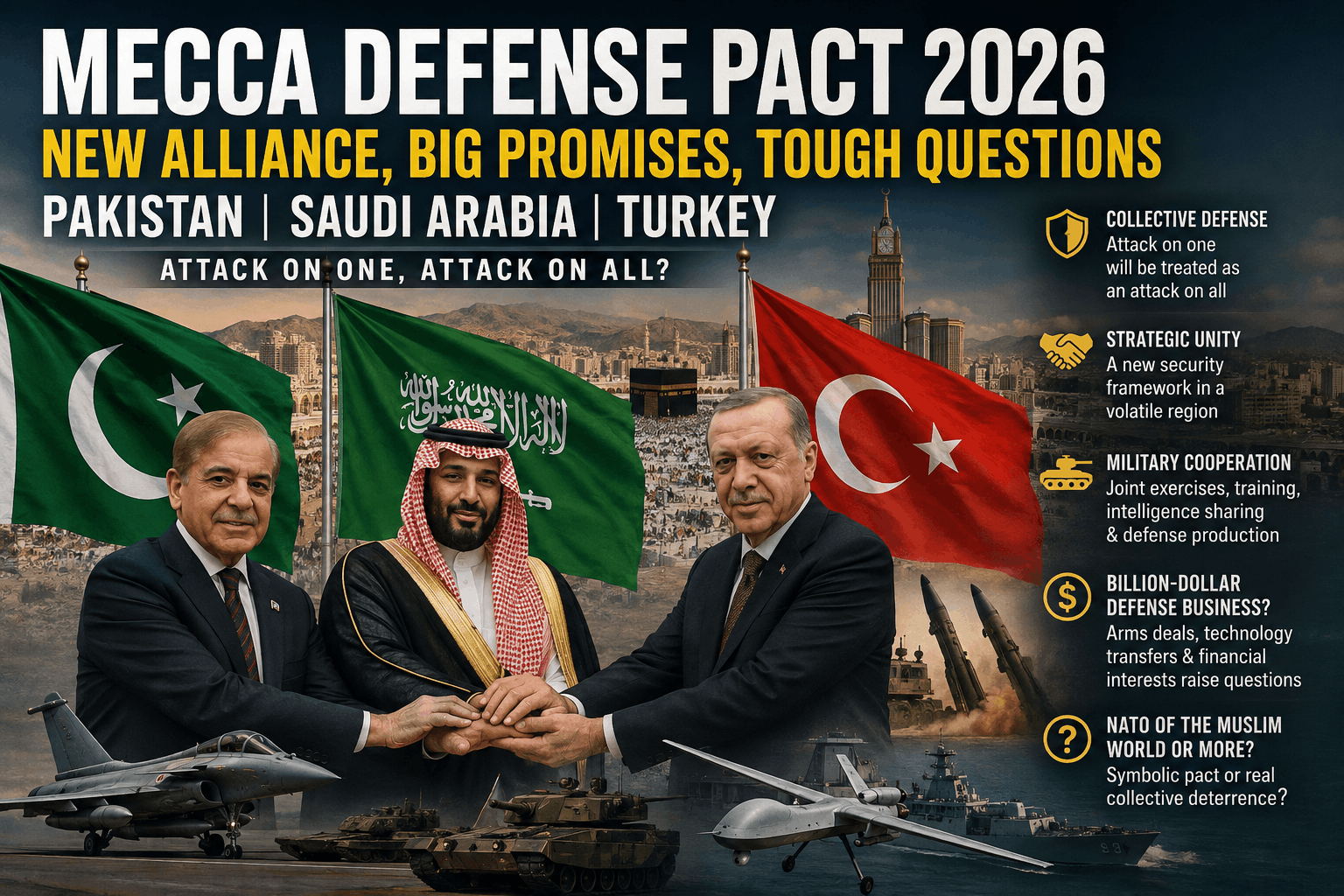
Rochester, NY: The Mecca Joint Defence Agreement signed on August 7, 2026, by Saudi Crown Prince Mohammed bin Salman, Turkish President Recep Tayyip Erdoğan and Pakistani Prime Minister Shehbaz Sharif has immediately invited comparisons with NATO.
Its central language is deliberately powerful: an armed attack against any one of the three states will be regarded as an attack against all three.
Yet behind that declaration lays a much more complicated question.
Do Riyadh, Islamabad and Ankara now possess a genuine collective-defence mechanism capable of fighting together, or has political symbolism been placed ahead of operational commitments while military weaponry exports, defense technology partnerships and financial interests quietly become equally important objectives?
The available evidence suggests that the agreement should not be dismissed as meaningless. But neither should it yet be described as a Muslim equivalent of NATO.
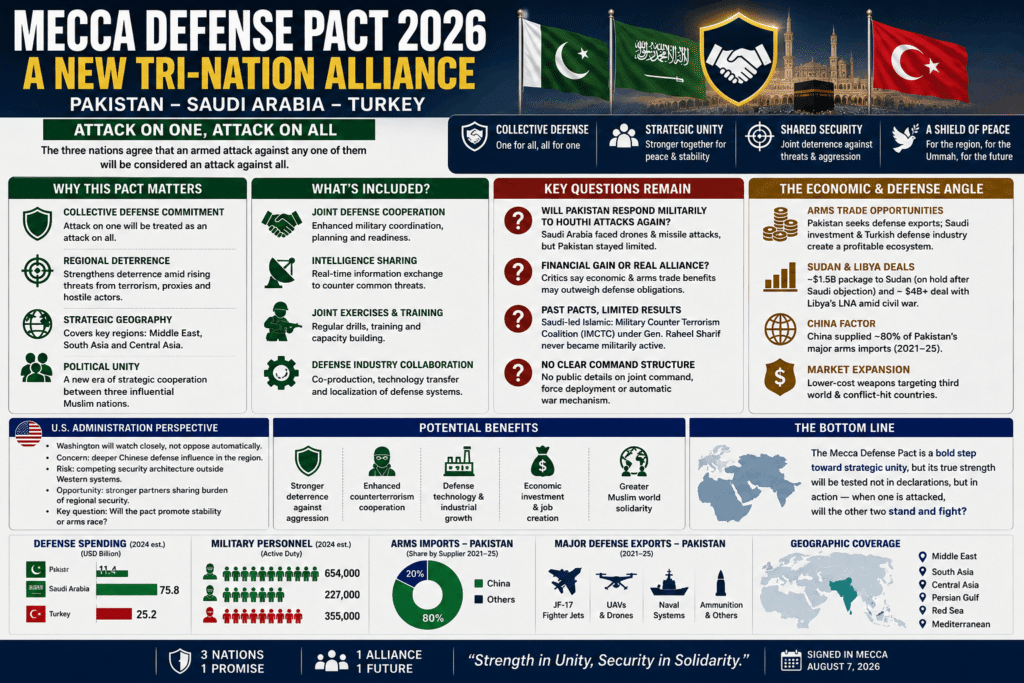
The joint declaration says the agreement is intended to strengthen “collective deterrence” and that an armed attack on one member would constitute an attack on all. However, the publicly released statement contains no detailed explanation of precisely what military obligations each country assumes after such an attack.
There is no publicly identified integrated command structure, troop commitment, automatic military-response mechanism or defined procedure comparable with decades of NATO operational planning.
That ambiguity may be intentional.
Turkey remains a NATO member. Saudi Arabia maintains extensive defence relationships with the United States and Western suppliers. Pakistan simultaneously maintains an exceptionally close strategic relationship with China while attempting to preserve ties with Washington, Riyadh, Tehran and Ankara.
Making every attack automatically produce a three-country war could therefore create strategic liabilities that none of the governments actually wants.
Turkish Vice President Cevdet Yılmaz stressed that the agreement was not directed against any particular country, while Saudi officials rejected interpretations that the arrangement represented either a military axis or a sectarian bloc.
Erdoğan similarly described the agreement as based on collective deterrence and consistent with the right to self-defence under Article 51 of the UN Charter.
Prime Minister Shehbaz Sharif called it a historic agreement and a “shield of peace.”
Those words are significant, but deliberately leave governments room for political interpretation.
The Saudi-Pakistan Precedent Shows the Limits — and Possibilities
A useful test is the Saudi-Pakistani Strategic Mutual Defence Agreement signed in September 2025. It contained almost identical language declaring aggression against either country to be aggression against both.
The historical Yemen experience nevertheless demonstrates why Islamabad is cautious.
When Saudi Arabia launched its intervention against the Houthis in Yemen in 2015, Pakistan’s parliament unanimously decided that the country should remain neutral rather than participate directly in the Saudi-led war.
Islamabad simultaneously promised support for Saudi territorial integrity and the protection of Islam’s holy sites.
Therefore, Pakistan’s failure to join the Yemen campaign cannot technically be described as a violation of the 2025 defence agreement—the Yemen decision preceded that treaty by ten years.
More importantly, the new bilateral agreement has not remained entirely dormant.
Saudi Arabia announced in April 2026 that Pakistani fighter jets and support aircraft had arrived at King Abdul-Aziz Air Base under the Strategic Mutual Defence Agreement to improve operational readiness and joint military coordination.
Pakistani and Saudi officials subsequently discussed responses to Iranian missile and drone attacks.
The unanswered question is different: would Pakistan actually attack Iran, the Houthis or another regional actor if Saudi territory were repeatedly struck?
That remains untested.
For Islamabad, entering an open war against Iran carries enormous consequences because the two countries share a long border, while Pakistan must simultaneously manage India, Afghanistan and domestic militancy.
Houthis Expose the Problem of “Attack on One, Attack on All”
Saudi Arabia has repeatedly suffered missile and drone attacks on airports, cities and energy infrastructure from Yemen’s Houthi movement, which receives extensive military and political support from Iran.
These types of attacks expose the fundamental weakness of loosely worded defence agreements.
Does a single Houthi drone hitting Saudi territory automatically require Pakistani and Turkish military retaliation? Would Ankara launch strikes on Yemen? Would Pakistan target Iranian infrastructure if intelligence indicated Tehran had supplied the weapon?
The public agreement provides no clear answer.
That is why the treaty may function primarily as deterrent ambiguity: adversaries cannot be certain how Pakistan and Turkey would respond, while Islamabad and Ankara retain freedom to decide how far their assistance should go.
Raheel Sharif’s Coalition Provides another Warning
There is already another Saudi-led multinational security framework: the Islamic Military Counter Terrorism Coalition created in 2015 and commanded by Pakistan’s former army chief General Raheel Sharif.
Yet despite its impressive membership, it never evolved into a NATO-like expeditionary combat alliance defending every member’s territory.
Its activities have concentrated heavily on counterterrorism cooperation, training, intelligence, ideological counter-extremism and capacity building.
Raheel Sharif himself stressed that the coalition was directed against terrorism rather than any country, religion or sect.
This history suggests that headline-generating Muslim defence structures can remain politically important without becoming automatic war-fighting alliances.
Defence Commerce Cannot Be Separated From the Mecca Pact
The economic dimension deserves far more attention.
Pakistan is increasingly seeking to transform its defence industry into an export sector. Its JF-17 fighter aircraft, drones, training aircraft, ammunition and other systems have attracted interest across Africa, Asia and the Middle East.
That creates an important connection between security diplomacy and commercial opportunity.
American think tank, Centre for Strategic and International Studies (CSIS) observed after the 2025 Saudi-Pakistan agreement that Pakistan could derive not merely strategic and political benefits but significant economic ones—including Saudi investment, loans, defence purchases and technology cooperation.
CSIS described those opportunities as potentially important to Islamabad during continuing economic difficulties.
The Middle East Institute in Washington was even more cautious about interpreting the original Saudi-Pakistan treaty as an automatic nuclear or military guarantee.
The F. Gregory Gause III argued that the reality was more modest than some “Islamic NATO” interpretations suggested and emphasized the practical complexity of extended deterrence.
Those assessments become even more relevant with Turkey now involved because Ankara possesses one of the fastest-growing defence industries in the world.
The triangle therefore creates three complementary assets: Saudi capital, Turkish defence technology and manufacturing, and Pakistani military experience plus a rapidly expanding lower-cost weapons-export industry.
The China Factor: Pakistan as Producer — but Also Customer
Any claim that Pakistan is simply becoming an independent global weapons supplier requires an important qualification.
According to Stockholm International Peace Research Institute (SIPRI), China supplied approximately 80 percent of Pakistan’s major arms imports during 2021–25. Pakistan’s arms imports increased 66 percent compared with the previous five-year period.
The JF-17 itself is a Pakistan-China jointly developed platform.
Pakistan therefore has genuine domestic manufacturing and integration capabilities, but part of its emerging export success is connected to a wider Chinese-origin defence ecosystem.
This creates a plausible commercial strategy: Pakistani production and combat experience can provide lower-cost access to technologies derived from, integrated with or jointly developed alongside Chinese systems for governments unable or unwilling to purchase expensive Western equipment.
But describing this as a deliberate Chinese scheme to use Pakistan to penetrate “third-world war-hit countries” would go beyond currently available evidence. Beijing may benefit strategically from wider adoption of Chinese-compatible systems, but it can also restrict sensitive exports.
Sudan and Libya Raise the Most Serious Ethical Questions
The strongest evidence supporting the financial-interest argument is Pakistan’s emerging African defence business.
Pakistan had been negotiating a roughly $1.5 billion package of weapons and aircraft for Sudan, where civil war has generated one of the world’s gravest humanitarian crises. Saudi Arabia had initially been associated with brokering or potentially financing the arrangement, but Riyadh subsequently withdrew support and asked Pakistan to terminate the deal. Pakistan placed it on hold.
Separately, Pakistani officials reported a defence agreement worth more than $4 billion with Khalifa Haftar’s Libyan National Army, despite Libya remaining subject to a United Nations arms embargo.
These two figures may explain references circulating to roughly $5 billion or more in African defence business. However, there is no reliable evidence I found of a single Saudi “$5 billion ban” that was later lifted. The Sudan and Libya cases should therefore not be merged into one transaction.
Nevertheless, they raise a legitimate policy question: if defence partnerships increasingly generate access to markets where governments or armed factions are already fighting civil wars, commercial interests could begin competing with the stated objective of regional stability.
Security Pact or Financial Gains? Probably Both
It would be too simplistic to conclude that the Mecca agreement exists purely for money.
Saudi Arabia has genuine security concerns. Pakistan gains strategic depth and diplomatic influence.
Turkey gains an opportunity to extend its defence-industrial footprint while reinforcing its role as an autonomous regional power.
But financial considerations are unquestionably part of the architecture.
The pact potentially creates a mutually reinforcing ecosystem in which Saudi financing supports procurement, Pakistan offers manpower, training and comparatively inexpensive weapons, while Turkey supplies drones, missiles, naval platforms, electronics and increasingly sophisticated indigenous systems.
That may ultimately prove more commercially productive than militarily integrated.
The real test will therefore not be another signing ceremony.
It will come when one member suffers an unmistakable armed attack and asks the other two to fight.
Until Pakistan, Saudi Arabia and Turkey publish operational protocols explaining when collective defence is triggered, who commands joint operations, what military assets are committed and what exceptions exist, the Mecca agreement should be regarded as a significant strategic framework—but not yet a proven three-nation defence shield.
It’s most immediate success may emerge not on the battlefield, but through defence manufacturing, technology transfers, Saudi capital, joint exercises and expansion into new weapons markets. That does not make the pact fraudulent. It does, however, mean that its economic dimension could become every bit as important as the promise that an attack on one is an attack on all.


