


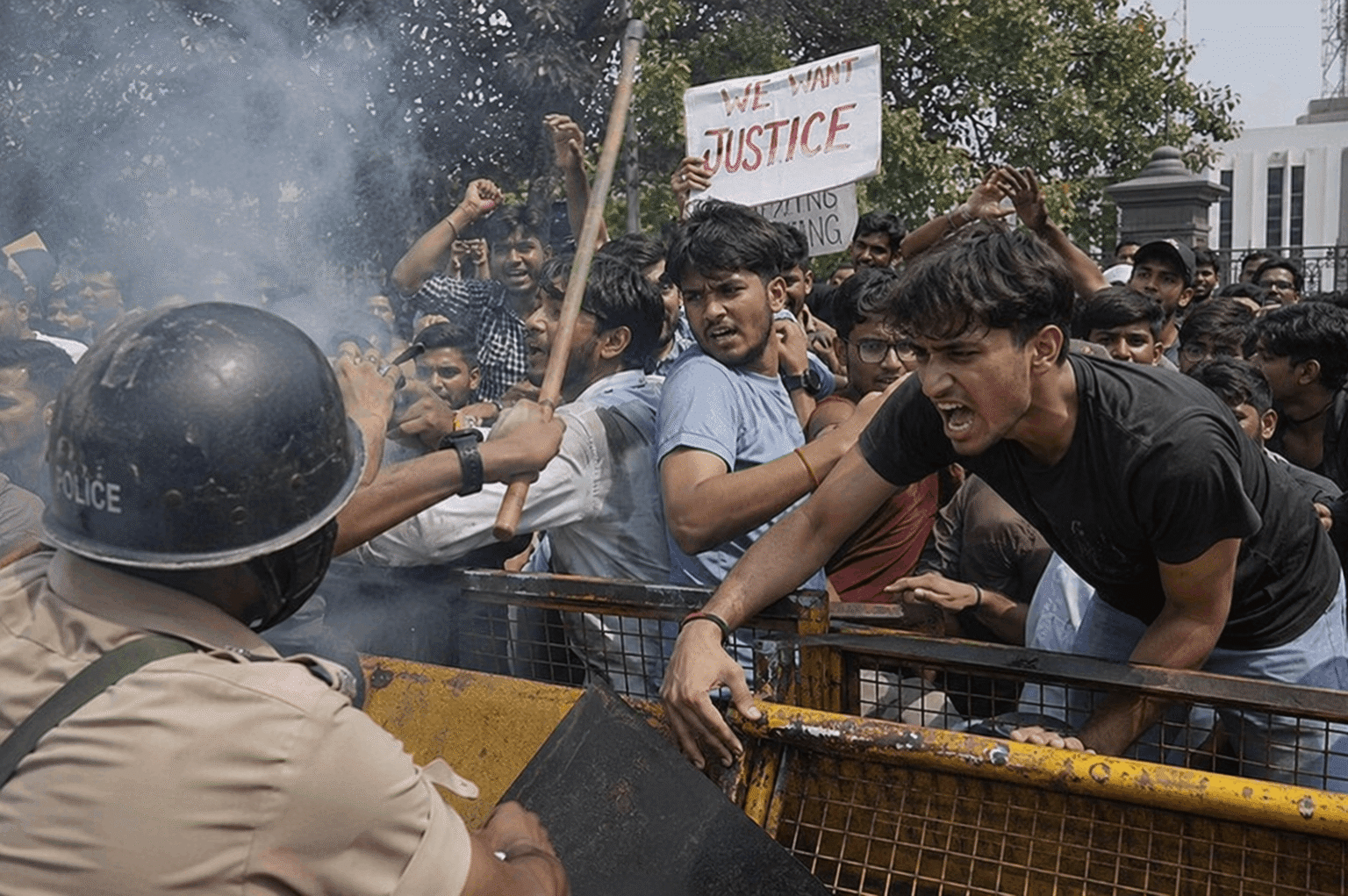
New Delhi, IN: India’s Gen Z protests are beginning to represent something larger than dissatisfaction with examination irregularities. What started with anger over alleged paper leaks and failures in competitive examinations has increasingly become a confrontation over employment, institutional credibility, policing and the ability of younger Indians to challenge political authority.
The movement associated with the so-called Cockroach Janta Party, or CJP, has demonstrated an unusual capacity to mobilize students outside conventional party structures.
It is reported that tens of thousands of young protesters have participated in demonstrations and that the movement has deliberately resisted pressure to transform itself immediately into an electoral party.
Its principal organizer, Abhijeet Dipke, has emphasized institutional accountability and youth concerns rather than formal alignment with either the ruling BJP or Congress.
That independence is politically crucial.
India has witnessed enormous demonstrations before, from farmers’ protests to anti-corruption movements. What distinguishes the current agitation is the demographic behind it and its digital character.
Young Indians have organized through Instagram, memes and decentralized online networks while linking examination failures to a much broader anxiety about employment and economic mobility.
The political analysts see the examination controversy as a trigger for deeper frustration involving jobs and fears about future employment, including the impact of artificial intelligence on sectors traditionally employing educated Indian youth.
The Modi government therefore faces not merely an education-policy problem but a potentially generational political challenge.
Pellets, Lathis (Sticks) and Tear Gas Change the Political Narrative
The most damaging development for the government has been the controversy surrounding police tactics.
During proceedings concerning the student protests, India’s Supreme Court recorded allegations that police had used lathi charges, pellet guns, tear gas, rubber bullets and electronic batons.
Petitioners also alleged the use of lathis (Sticks) containing nails and claimed that one young protester suffered severe eyesight damage from pellets. These remain allegations being judicially examined rather than final findings of police wrongdoing.
The government has strongly disputed the accusation that security forces acted excessively.
Solicitor General Tushar Mehta, representing the Union government and Delhi authorities, told the Supreme Court that the government had no objection to an independent investigation but firmly rejected allegations of police excess.
The government’s account was that violent or criminal elements had infiltrated demonstrations and attacked security personnel, leaving more than 280 officers seriously injured. Evidence alleging stone-throwing and attacks on police was also placed before the Court.
That competing account is important because the issue cannot fairly be reduced to peaceful students confronting an entirely unprovoked police force.
Police have a legitimate responsibility to protect Parliament, restricted government areas, officers and civilians when demonstrations become violent. Yet that authority is constrained by proportionality.
The political and constitutional controversy therefore revolves around whether the force used was necessary to contain genuinely violent participants or whether weapons capable of inflicting serious injuries were used too broadly against a predominantly student movement.
The Supreme Court considered the allegations serious enough to conclude that they prima facie presented a compelling case for an independent and impartial investigation, while simultaneously recognizing claims that protesters had injured police personnel.
It ordered preservation of CCTV footage, drone recordings, body-camera material and communications records and temporarily restricted coercive action against protesting students without criminal antecedents.
That judicial intervention has ensured that the policing controversy will not disappear easily.
Why Pellet Guns Carry Such Political Symbolism
Pellet weapons have an especially powerful political association in India because of their controversial history in Jammu and Kashmir.
Consequently, allegations that similar weapons were used against students in the national capital immediately carried symbolism extending far beyond conventional crowd control.
The Supreme Court later declined to impose a blanket prohibition on pellet guns, reasoning that exceptional security circumstances cannot automatically be eliminated from police consideration. But it continued examining the applicable procedures and ordered authorities to ensure medical care for injured students.
For the Modi government, this presents a communications problem.
Images of young protesters facing lathis, tear gas or suspected pellet injuries can rapidly overpower official explanations, particularly among generation consuming political information primarily through smart phones.
A security response designed to restore physical control of a street can therefore produce the opposite political consequence: loss of narrative control online.
The Government May Have Won the Street but Lost Part of the Narrative
The BJP became extraordinarily effective over the past decade at dominating digital political communication.
The Gen Z protests have challenged that advantage.
Reuters reported that Modi and the BJP have responded by intensifying their outreach toward younger Indians, including a stronger Instagram-oriented strategy.
The broader RSS ecosystem has also begun paying increased attention to Gen Z political attitudes.
That reaction itself reveals the political importance of the movement.
Governments normally do not dramatically adjust their communications strategy because of protests they consider electorally irrelevant.
The administration has already suffered another significant setback. The youth campaign contributed to sustained pressure around education policy and the eventual resignation of Education Minister Dharmendra Pradhan, according to AP and Reuters reporting.
That represented a rare political concession and demonstrated to protesters that sustained mobilization could produce tangible results.
Politically, that can be more important than the ministerial resignation itself.
Once a protest movement discovers that pressure produces concessions, participation becomes easier to sustain.
Rahul Gandhi Moves into the Political Space Created by the Crackdown
Congress understands the opportunity.
Rahul Gandhi has increasingly placed himself at the center of the opposition response to the student demonstrations.
On August 9, he accused Prime Minister Narendra Modi and Home Minister Amit Shah of responsibility for the treatment of protesters and demanded accountability over police actions.
After meeting injured students, Gandhi also alleged that protesters continued to face harassment and referred specifically to lathi charges and pellet injuries.
This strategy fits Rahul Gandhi’s broader political repositioning.
Rather than competing with Modi solely through traditional campaign rallies, Congress can attempt to associate itself with unemployment, examination integrity, constitutional protections and younger voters’ frustration with government institutions.
But there is an important distinction between supporting the movement and controlling it.
Congress does not own this rebellion.
Indeed, CJP leaders have deliberately resisted becoming an extension of conventional opposition politics. Reuters reported that the movement is resisting immediate electoral transformation despite the attention it has received.
That creates both an opportunity and a danger for Congress.
If Rahul Gandhi attempts to appropriate the movement too aggressively, young protesters may reject Congress along with the BJP.
If Congress maintains some distance while amplifying student demands in Parliament, however, it could gradually become the largest institutional beneficiary of anti-government sentiment.
Sonia Gandhi’s Congress: Influence without Direct Ownership
It is important to clarify Sonia Gandhi’s current role.
She is not the president of the Indian National Congress. Mallikarjun Kharge holds that position, while Rahul Gandhi serves as Leader of the Opposition in the Lok Sabha.
Sonia Gandhi nevertheless retains enormous influence within the party and remains an important figure in parliamentary and coalition strategy.
Her relevance to a possible political transition therefore lies less in leading street protests and more in helping Congress manage opposition unity.
That could become critical.
India’s opposition has repeatedly struggled not because anti-government votes do not exist, but because those votes are often divided among Congress, regional parties and emerging political organizations.
The Gen Z movement could worsen that problem rather than solve it.
If young voters abandon BJP but divide their support among Congress, regional parties, independent youth movements and new organizations, the BJP could remain the largest national force despite losing substantial popularity.
Congress therefore needs coalition mathematics as much as street momentum.
Does This Mean Regime Change Is Coming?
The phrase “regime change” should be used cautiously in the Indian context.
India remains an electoral parliamentary system. A transition away from Modi or the BJP would most plausibly occur through elections, coalition shifts or loss of parliamentary support, rather than through protesters overthrowing the government.
There is currently insufficient evidence to conclude that the Modi government faces imminent collapse.
But the political environment has unquestionably changed from the era of overwhelming BJP dominance.
The 2024 general election had already demonstrated this vulnerability when BJP failed to secure an outright parliamentary majority by itself and required its National Democratic Alliance partners to govern.
The present youth agitation introduces an additional strategic threat: generational erosion.
A ruling party can recover from losing individual constituencies.
Losing credibility among millions of first-time and young voters is far more dangerous because demographic political shifts can persist across several election cycles.
The demonstrations have already begun influencing regional political calculations.
Reporting from Haryana indicates that major political parties are reassessing their strategies toward Gen Z voters as youth activism becomes increasingly difficult to ignore.
Yet Congress should not mistake dissatisfaction with Modi for enthusiasm for Rahul Gandhi.
Recent political commentary has also highlighted difficulties Congress faces in translating youth discontent into direct loyalty toward Rahul.
That distinction may determine India’s political future.
2029 Could Become a Generational Election
The most important question is not whether Congress can exploit the protests tomorrow.
It is whether the grievances generating those protests survive until India’s next national electoral cycle.
Three issues could combine into something politically explosive: employment insecurity, distrust of educational institutions and anger over the state’s response to dissent.
If those concerns merge into a single generational narrative — that young Indians cannot trust examinations to provide opportunity, cannot find adequate employment afterward and cannot protest failures without facing force — then the BJP will confront a much deeper challenge than an ordinary anti-incumbency cycle.
Congress would then possess its strongest national opening in years.
But converting protest into power requires something very different from simply criticizing Modi.
Congress must convince young voters that it can reform examinations, expand employment, modernize institutions and govern differently rather than merely return a previous political dynasty to office.
Sonia Gandhi’s organizational experience, Mallikarjun Kharge’s party leadership, Priyanka Gandhi’s campaigning ability and Rahul Gandhi’s increasingly confrontational parliamentary role could collectively strengthen Congress.
But without a credible economic and institutional program, the movement may eventually produce a third political alternative instead.
The Bigger Threat to BJP Is Political Psychology
The greatest danger to Modi may therefore not be Congress itself.
It may be the disappearance of political inevitability.
For much of the past decade, BJP benefited from a perception that Modi remained politically dominant even when opposition existed.
Large-scale youth demonstrations challenge that psychological advantage.
The resignation of a minister, Supreme Court intervention, national discussion of alleged police excesses and increasingly aggressive opposition activity collectively demonstrate that government decisions can be contested.
The July confrontation could therefore become important even if the protests eventually diminish.
Pellet-gun allegations, tear gas and lathi charges have transformed what began as anger over examinations into a debate about the relationship between citizens and the state.
Rahul Gandhi and Congress now have an extraordinary opportunity, but a Congress revival and a youth revolution are not the same phenomenon.
India’s Gen Z protesters are demonstrating something potentially more disruptive: they may no longer accept the binary choice between Modi and the Gandhi family.
If Congress succeeds in earning their confidence rather than assuming it, the movement could contribute to a major electoral realignment by 2029.
If Congress fails, India could instead witness the emergence of an entirely new political constituency operating outside both traditional national parties.
That makes the present crisis less a simple battle between Modi and Congress and more a struggle over who will inherit India’s next political generation.
Follow our latest coverage for deeper insights into the policies, trends, and developments influencing today’s world.


