


Courtesy: Special Reporting Contribution by Sohail Chaudhary [A Senior Journalist I Social Activist I Toronto, Canada]
Rochester, NY/Toronto, CA/Islamabad, PK: Pakistan’s worsening security crisis in Khyber Pakhtunkhwa has revived one of the most difficult questions surrounding the country’s counterterrorism policy: is the state genuinely pursuing an uncompromising campaign against militant organizations, or has it simultaneously tolerated, negotiated with, or indirectly accommodated armed groups when doing so appeared useful for short-term stability?
The question has become particularly sensitive because of repeated statements by Jamiat Ullema-e-Islam (F) chief, Maulana Fazl-ur-Rehman regarding militant influence in Khyber Pakhtunkhwa. His allegations deserve serious examination, but they also require an important factual qualification.
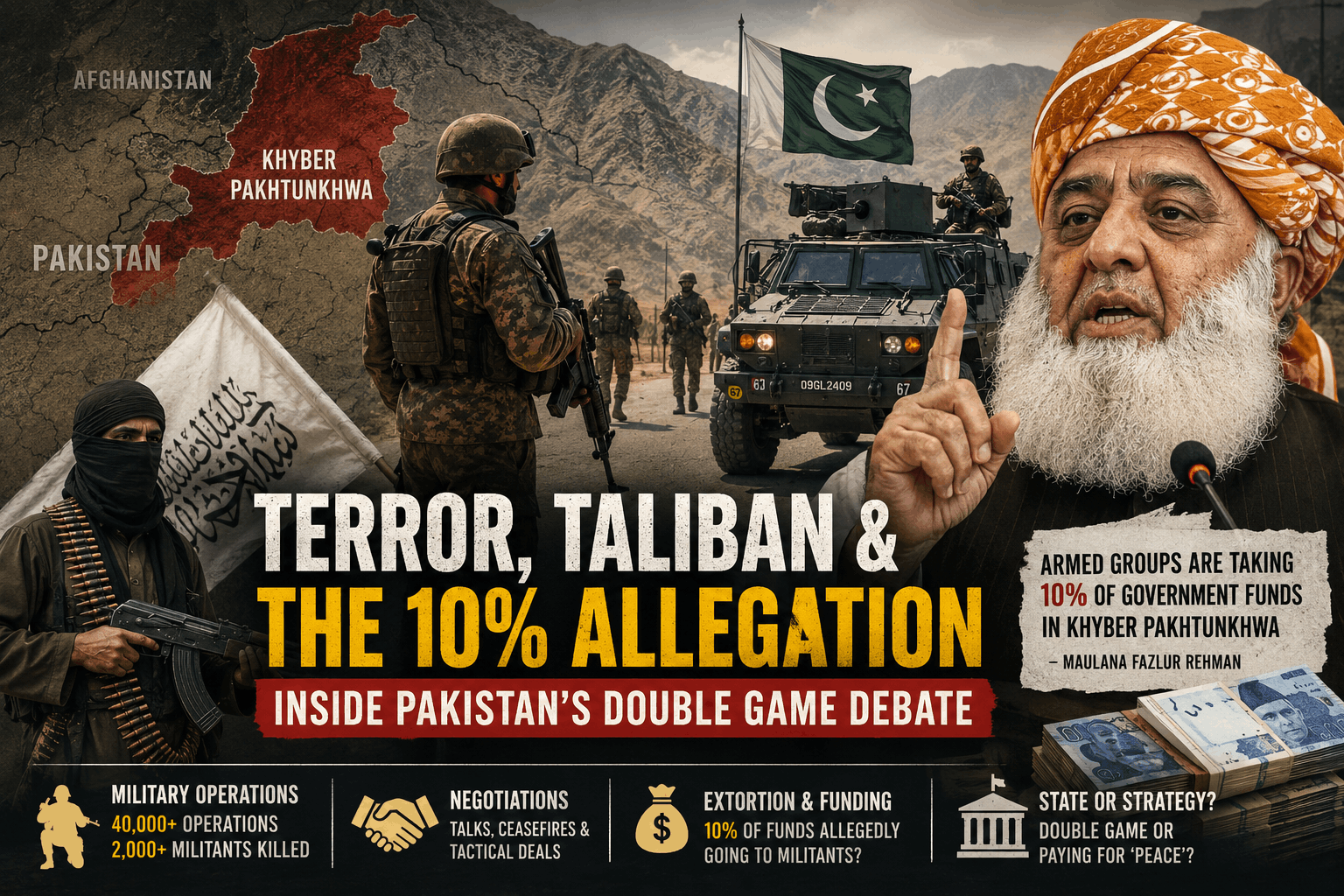
Fazl-ur-Rehman has indeed claimed that roughly 10 percent of government or development funds in parts of Khyber Pakhtunkhwa effectively end up with armed groups.
At an ANP-organized all-parties conference in August 2025, he said armed groups dominated parts of the tribal districts, businesses were forced to pay extortion and around 10 percent of government funds were being taken by such groups. Similar allegations had been made by him earlier, including in 2024.
In January 2026, Fazl-ur-Rehman went further, reportedly telling the National Assembly that Taliban influence was so extensive in his area that ordinary residents and even government officials had to pay them, and that approximately 10 percent had effectively to be accounted for when budgets were approved in order to maintain peace.
However, there is no publicly available audited evidence establishing that 10 percent of the entire annual Khyber Pakhtunkhwa provincial budget is officially transferred by the government or Pakistan Army to the Taliban, the TTP or militants in Afghanistan. The official KP budget documents do not identify such an allocation.
That distinction is crucial. There is a substantial difference between militants extracting money from contractors, officials and economic activity through extortion, local authorities informally paying protection money, and the Pakistani state formally financing a militant organization.
Fazl-ur-Rahman’s allegation raises serious questions about state control, but on the evidence presently available it cannot by itself prove a centrally directed policy of financing the TTP.
The contradiction at the heart of Pakistan’s security policy
The controversy becomes more significant because Pakistan’s official policy appears to leave virtually no room for accommodation with the militant group TTP.
The Revised National Action Plan explicitly calls for “intolerance for militancy,” action against terrorist financing, strengthening counterterrorism departments and preventing armed organizations from operating.
The federal government similarly describes Azm-e-Istehkam, announced in 2024, as a comprehensive counterterrorism strategy. Islamabad said it was not designed as another massive displacement-producing campaign comparable with Zarb-e-Azb but as a combination of intelligence-based operations, law enforcement, diplomacy, financial measures and action against the crime-terror nexus.
The present military position is even more uncompromising. Pakistan’s military says its operations are directed against TTP infrastructure and militants operating both inside Pakistan and from sanctuaries in Afghanistan.
In early August 2026, military spokesman Lt. Gen. Ahmed Sharif Chaudhary said Pakistan had conducted more than 40,000 intelligence-based operations since January and killed more than 2,000 militants.
Pakistan also continues to accuse the Afghan Taliban authorities of facilitating or sheltering the TTP, allegations Kabul rejects.
The August 2 suicide bombing in Kabal, Swat, illustrates why Islamabad argues that the threat remains acute. The attack killed civilians and police personnel during or near an anti-militancy rally, and the TTP claimed responsibility, according to Reuters.
At face value, therefore, a government secretly sponsoring the same organization that is killing its policemen and soldiers would appear strategically irrational.
Yet Pakistani counterterrorism history is considerably more complicated than that simple picture.
Pakistan has never dealt with all militant groups in exactly the same way
The origins of today’s mistrust go back decades.
Pakistan’s security establishment historically distinguished between militants threatening Pakistan itself and organizations believed to advance Pakistani strategic interests elsewhere.
During the Afghan conflict, Pakistan developed close relationships with the Afghan Taliban and associated networks because Islamabad viewed a friendly government in Kabul as strategically valuable against Indian influence and as a safeguard along Pakistan’s western frontier.
The Council on Foreign Relations has documented Pakistan’s extensive historical relationship with the Afghan Taliban, including support attributed to the Inter-Services Intelligence (ISI) agency.
At the same time, Pakistan eventually became one of the principal military opponents of the TTP, which sought to overthrow or weaken the Pakistani state itself.
This distinction produced what international critics frequently described as Pakistan’s “good Taliban, bad Taliban” problem.
The TTP and Afghan Taliban are separate organizations, but their ideological, historical and personal relationships are extensive. The U.S. Congressional Research Service describes the TTP as a distinct organization that emerged in Pakistan in 2007, ideologically aligned with the Afghan Taliban and committed to fighting the Pakistani state.
Washington’s terrorism reporting has likewise said that the TTP retained a significant presence in Afghanistan, particularly close to Pakistan, while questioning whether Afghanistan’s Taliban authorities were willing or capable of eliminating that sanctuary.
The result is one of the great strategic reversals of Pakistan’s Afghan policy: an Afghan political order once considered potentially beneficial to Pakistan has become the centre of Islamabad’s biggest national-security confrontation on its western border.
Protection money would represent state weakness, not necessarily strategic sponsorship
Suppose Fazl-ur-Rahman’s allegation is substantially correct and government contractors, officials or local administrations are surrendering approximately 10 percent of funds to militant networks.
There are two very different interpretations.
The first is deliberate patronage: elements of the state intentionally finance armed groups because they consider them useful strategic assets.
The second is coercive accommodation: militants have become powerful enough in certain districts to impose an unofficial tax, or “bhatha,” on contractors, businessmen, officials and development schemes, while authorities tolerate the payments because eliminating the militants immediately would create even greater violence.
Evidence publicly available today is considerably stronger for the existence of militant extortion and coercion than for the proposition that Pakistan’s central government command and military establishment have adopted a formal policy of allocating 10 percent of KP funds to the TTP.
Fazl-ur-Rahman’s own descriptions emphasize extortion. At the August 2025 APC, he said businessmen could not operate without paying armed groups and raised the issue as evidence of the erosion of government writ.
Imagine a contractor receives government money for building a road but militants demand a percentage before allowing construction to continue. The originating money is public money, but the transfer occurs because militants are extorting the contractor.
That is financially disastrous and indicates a severe security failure, but it is analytically different from a cabinet, intelligence service or military command deciding to finance militants.
Interestingly, the Pakistani governments own Azm-e-Istehkam policy explicitly identifies this nexus as something that must be dismantled.
Islamabad, Rawalpindi and Peshawar do not always operate as one policy centre
Another problem with the double-game theory is that it assumes a perfectly unified Pakistani state.
Pakistan’s security environment involves the federal government, Pakistan Army, ISI, Frontier Corps, provincial government, provincial police, Counter Terrorism Department, district administration, tribal elders and intelligence agencies. Their interests and approaches are not necessarily identical.
In some districts, security forces may be conducting lethal operations against a militant cell while elsewhere local officials or contractors negotiate informal arrangements simply to continue working.
Political differences deepen the problem. Khyber Pakhtunkhwa’s provincial leadership, the federal government and Pakistan’s military establishment have repeatedly disagreed over how counterterrorism operations should be conducted, particularly because large-scale military campaigns have historically produced displacement and political backlash among Pashtun communities.
That makes Pakistan’s policy appear contradictory even when there is no single secret strategy behind the contradiction.
The available evidence points more convincingly toward a mixture of extortion weakened state authority, historically inconsistent militant policies, failed reconciliation attempts, tactical accommodation and strategic blowback from Pakistan’s Afghan policy.
Pakistan can announce thousands of intelligence operations and report large numbers of militant casualties, but military statistics alone cannot establish state authority.
The decisive test is whether a shopkeeper in Waziristan, a contractor in Bajaur, a police officer in Lakki Marwat or a family in Swat believes that the Pakistani state—not an armed organization—ultimately determines the rules under which they live.
Stay informed with The Variant for in-depth analysis, breaking developments, and expert perspectives on the stories shaping our world.


