


Brussels, BE: Europe is approaching a decisive moment in its economic relationship with China. A trade partnership once built on the promise of mutual prosperity is increasingly being viewed in Brussels through the language of industrial vulnerability, strategic dependence and economic security.
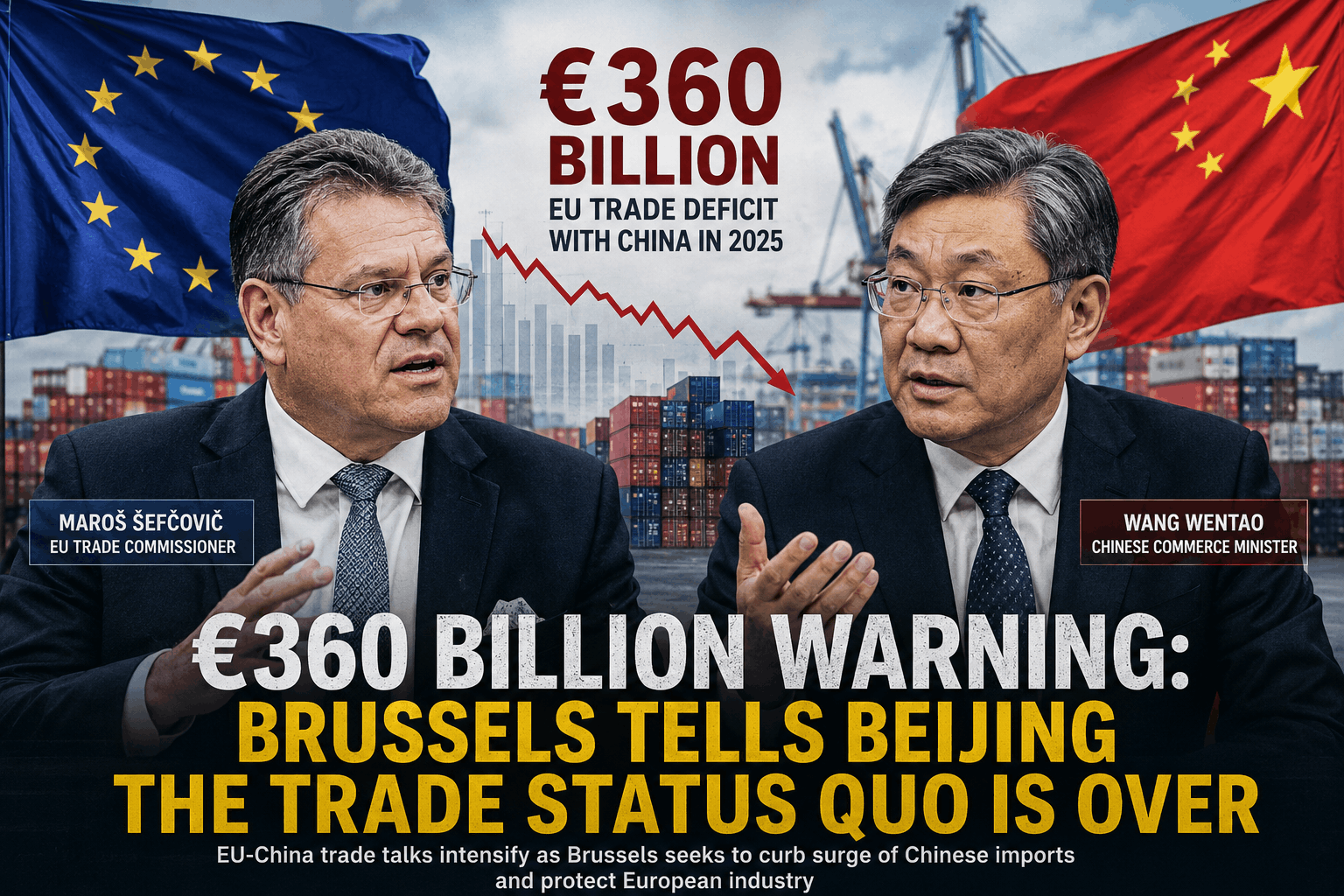
The latest talks between EU Trade Commissioner Maroš Šefčovič and Chinese Commerce Minister Wang Wentao exposed the widening distance between the two economic powers.
Europe is confronting a goods trade deficit with China of approximately €360.6 billion, while Chinese manufactured products continue to expand across European automobile, steel, technology and consumer markets.
“The status quo is not an option,” Šefčovič warned.
Beijing’s response is equally firm. Wang has urged Europe to view China’s economic development “rationally and objectively,” arguing that Chinese industrial competitiveness should not become a political excuse for protectionism.
Between those two positions lies a trade confrontation capable of reshaping Europe’s industrial future — and potentially opening another major front in the rapidly changing global economic order.
Europe’s €360 Billion China Problem
For European policymakers, the trade deficit is no longer simply an economic statistic. It has become a question of industrial security.
Brussels fears that China’s enormous manufacturing capacity, supported by extensive industrial investment and sophisticated supply chains, and is producing quantities of goods that cannot be fully absorbed by the Chinese domestic market.
European officials argue that surplus production is increasingly being redirected towards international markets.
The result, according to the European Commission’s analysis, is intense price pressure on European manufacturers.
The debate initially focused on Chinese electric vehicles but has rapidly expanded to steel, chemicals, machinery, batteries, solar technology and low-cost consumer products.
China strongly rejects the European interpretation of industrial “overcapacity.”
Beijing argues that Chinese companies are competitive because of manufacturing efficiency, technological investment and integrated supply chains.
Chinese officials have accused Western governments of using the overcapacity argument to justify protectionist policies against successful Chinese industries.
This disagreement defines the central dispute between Šefčovič and Wang.
Europe sees a structural market imbalance. China sees an attempt to politically restrict its industrial competitiveness.
Šefčovič Demands a More Balanced Economic Relationship
Šefčovič’s negotiating position reflects a significant transformation in European trade policy.
The European Union is gradually moving away from the assumption that deeper commercial engagement with China will automatically produce a more balanced economic relationship.
Brussels wants Beijing to provide greater market access for European companies, address industrial policies that the EU believes distort competition and ensure more predictable access to strategically important materials.
Rare earths have become particularly sensitive.
Europe remains heavily dependent on China for several critical minerals and components required by automobile, defence, renewable-energy and advanced technology industries.
Chinese export restrictions have reinforced concerns that strategic supply chains could become vulnerable during periods of geopolitical tension.
For the EU, the danger is a double dependency.
Europe fears becoming increasingly dependent on China for critical materials while simultaneously losing manufacturing capacity because domestic companies cannot compete with the price and volume of Chinese imports.
This concern is at the centre of Brussels’ emerging economic-security doctrine.
Wang Wentao: Europe Must Remove Its Own Trade Barriers
Chinese Commerce Minister Wang Wentao has presented a very different interpretation of the economic imbalance.
Wang has said China is willing to “actively” expand imports from the European Union, but Beijing argues that Europe cannot demand greater exports to China while restricting the sale of advanced technologies Chinese companies want to purchase.
The Chinese minister has urged the EU to relax restrictions on high-technology exports and avoid politicizing economic and trade relations.
Wang has also called on Europe to view China’s development “rationally and objectively” and properly manage economic disagreements.
Beijing’s argument exposes a fundamental contradiction in the European position.
Europe wants China to buy more European products. China responds that European governments restrict the export of some of their most advanced and valuable technologies.
Brussels argues that certain technologies must be protected because of national and economic security concerns.
The dispute therefore extends far beyond tariffs.
It increasingly involves technology, supply chains and geopolitical power.
Cheap Chinese Imports Transform Europe’s Consumer Market
The urgency surrounding the talks is also being driven by a dramatic increase in low-value Chinese goods entering Europe.
The number of low-value parcels arriving in the EU reportedly increased from approximately 1.3 billion in 2022 to 5.9 billion in 2025, with around 90 percent originating in China.
Chinese-linked e-commerce platforms have connected European consumers directly with enormous manufacturing networks, offering extremely low prices and extraordinary product variety.
For consumers facing high living costs, the attraction is obvious.
For European retailers and manufacturers, the consequences are increasingly serious.
The EU has introduced a €3 customs charge on small parcels valued below €150, responding to the rapid expansion of low-value imports and concerns about product compliance and unfair competition.
Although the measure is technically country-neutral, Chinese exporters are expected to feel much of its impact because of their dominance of the small-parcel market.
The decision illustrates how Europe’s trade policy is changing.
Brussels is increasingly willing to adopt measures that are formally global but disproportionately affect Chinese commercial flows.
Europe Is Avoiding Trump’s Tariff Strategy — But Moving Towards Greater Protection
The European Union continues to describe itself as a defender of the rules-based international trading system.
Its approach differs significantly from the aggressive tariff policies associated with US President Donald Trump.
Washington often uses tariffs as a direct instrument of economic and political pressure.
Brussels prefers investigations, subsidy assessments, quotas, customs reforms and regulatory mechanisms.
The methods are different, but the strategic direction is increasingly similar.
Both the United States and European Union are attempting to reduce their economic vulnerability to Chinese manufacturing dominance.
Europe describes its policy as “de-risking.”
Beijing increasingly views it as economic containment under another name.
The Šefčovič-Wang talks must therefore be understood within a larger global restructuring of relations between China and Western industrial economies.
October Could Determine the Next Phase of EU-China Trade Relations
The consultation mechanism agreed by Šefčovič and Wang provides additional space for diplomacy, but the October timeline is a political test rather than a realistic deadline for resolving decades of structural trade imbalance.
Europe wants evidence of movement.
That could include greater Chinese imports of European products, improved market access, progress on critical mineral export procedures or mechanisms to manage sudden increases in Chinese exports.
China will expect reciprocal concessions.
Beijing wants Europe to ease technology restrictions, avoid expanding trade barriers and recognize Chinese industrial competitiveness as legitimate.
The problem is that both sides believe the other must move first.
A Trade Relationship Moving From Engagement to Managed Rivalry
The most important development surrounding the latest talks is the transformation of European thinking about China.
Europe is no longer seriously debating whether economic dependence on China creates strategic risks. The debate now concerns how aggressively Brussels should respond.
A complete economic separation from China remains unrealistic. European supply chains are deeply connected with Chinese manufacturing, while European companies continue to depend on Chinese consumers.
But unrestricted exposure to China’s industrial capacity is increasingly viewed as a threat to Europe’s manufacturing future.
Šefčovič’s warning that “the status quo is not an option” captures Brussels’ new position.
Wang Wentao’s demand that Europe view China’s development “rationally and objectively” represents Beijing’s response.
Between those two statements lies the central conflict in the EU-China economic relationship.
Europe fears China’s export machine could weaken its industrial base. China believes Europe is transforming commercial competition into a political accusation.
The talks may produce compromises over specific products, market access or export licenses. But the larger structural rivalry will remain.
The real test is whether Brussels and Beijing can manage that rivalry through negotiation — or whether the world’s second-largest economic relationship is moving towards another major front in the global trade war.
Discover more perspectives, breaking news, and in-depth reports from around the world by visiting The Variant.


