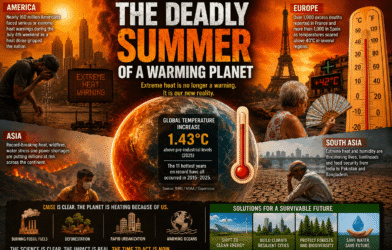
Brussels, BE: Europe’s deadly summer heat has transformed a long-running climate warning into an immediate public health emergency.
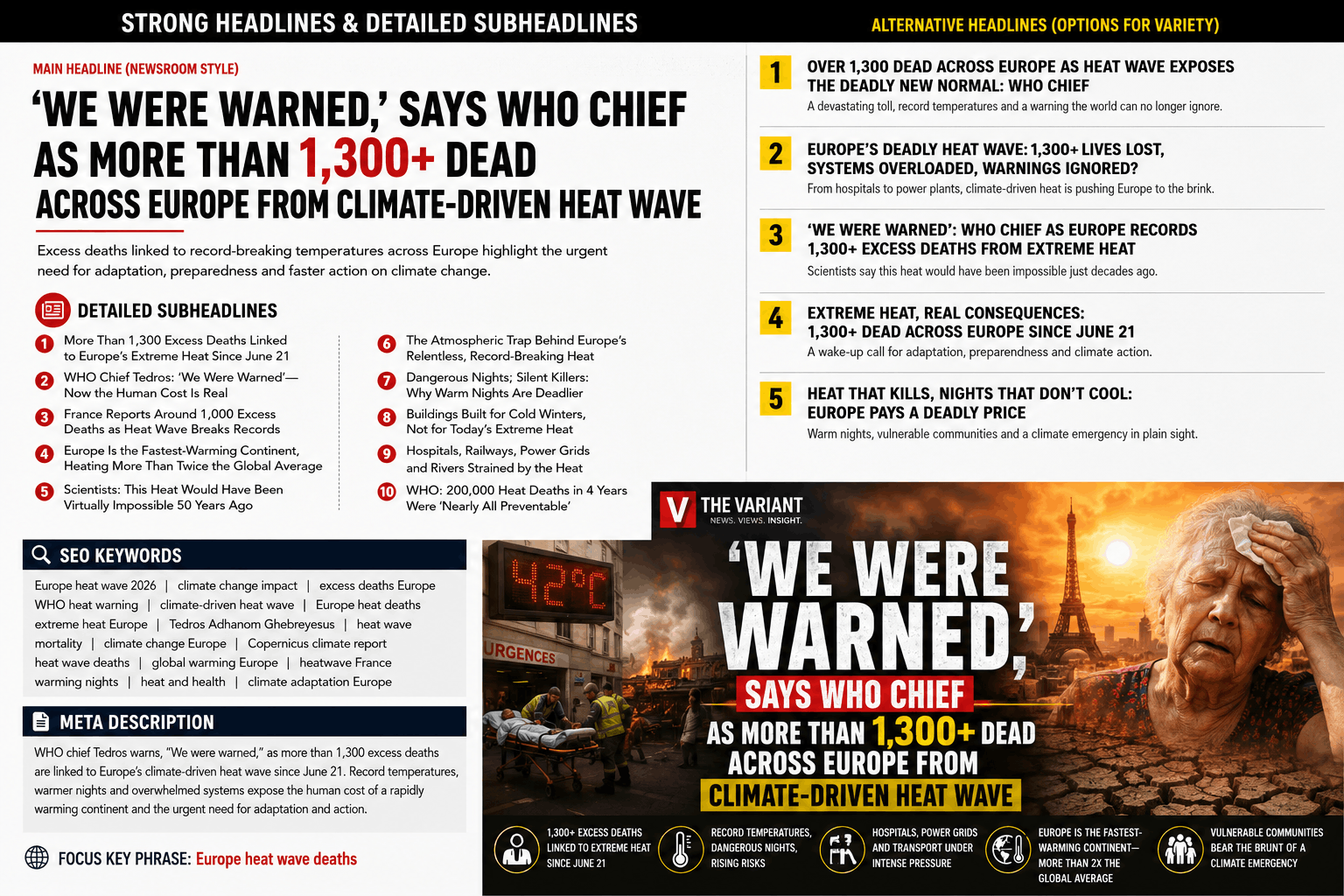
With more than 1,300 excess deaths linked to the extreme temperatures since June 21, according to figures cited by World Health Organization Director-General Dr Tedros Adhanom Ghebreyesus, the continent is confronting a difficult question: how many warnings are required before exceptional heat is treated as a recurring threat rather than an unusual weather event?
“We were warned,” Tedros said as he drew attention to the growing frequency of heat waves once described as “once-in-a-generation” events.
His message was striking not because climate scientists had discovered a new threat, but because the threat they have described for decades is increasingly visible in mortality statistics, overwhelmed health services and infrastructure designed for a cooler European climate.
The phrase also carries a wider political significance. Europe has some of the world’s most developed climate policies, advanced forecasting systems and strongest public institutions.
Yet the current crisis demonstrates that acknowledging climate change and being physically prepared for its consequences are two very different things.
A Death Toll That Requires Careful Interpretation
The figure of more than 1,300 should be understood as “excess deaths” associated with the period of extreme heat.
Excess mortality measures the number of deaths above the level statistically expected under normal conditions. It is therefore broader than a count of death certificates explicitly listing heatstroke as the cause of death.
This distinction is essential. Extreme heat often kills indirectly and quietly. A person with cardiovascular disease may suffer a fatal cardiac event. Kidney function can deteriorate through dehydration.
Respiratory illness may worsen. Certain medications can affect the body’s ability to regulate temperature.
For older people, those living alone and patients with chronic illnesses, prolonged heat can turn existing health vulnerability into a fatal emergency.
France reported about 1,000 excess deaths during the record-breaking episode, with older people representing a large share of the fatalities.
Authorities have cautioned that mortality assessments can change as more complete health data become available.
That is why the eventual human cost of a major heat wave is rarely known while the temperature is still breaking records.
Epidemiologists often require weeks or months to compare mortality patterns, examine regional data and determine how strongly extreme temperatures influenced deaths.
The current number, therefore, should neither be exaggerated nor dismissed. It is a preliminary measure of a potentially larger health disaster whose full scale remains under assessment.
Europe Is Heating Faster Than the Global Average
The broader climate context is increasingly difficult to separate from the immediate weather emergency.
Data from the Copernicus Climate Change Service show that Europe is the fastest-warming continent and is heating at more than twice the global average.
Europe has warmed by approximately 2.5 degrees Celsius compared with pre-industrial levels, while its temperature has risen at roughly 0.56 degrees Celsius per decade since the mid-1990s.
The reasons are complex. Human-generated greenhouse gas emissions provide the underlying warming trend, but Europe’s geography and changing atmospheric conditions can amplify regional temperature increases.
Reduced snow and ice cover, changes in weather circulation, variations in solar radiation and declining air pollution—which previously reflected some sunlight—are among the factors influencing the continent’s rapid warming.
Climate change does not mean that every hot day is created exclusively by global warming. Weather systems still determine when and where heat waves form.
The critical scientific point is different: global warming changes the background temperature upon which natural weather systems operate.
A powerful high-pressure pattern can still produce a heat wave. But when the atmosphere and land are already warmer because of accumulated greenhouse gases, the resulting temperatures can become considerably more extreme.
It is the difference between loading and firing a weapon. The weather pattern may pull the meteorological trigger, but long-term warming has increasingly loaded the climate system toward higher temperatures.
Scientists Say This Heat Would Have Been Virtually Impossible 50 Years Ago
A rapid analysis by World Weather Attribution concluded that temperatures of the severity observed during the June 2026 European heat wave would have been “virtually impossible” in the climate of 1976.
Researchers estimated that a comparable event occurring under 1976 climate conditions would have been around 3.5 degrees Celsius cooler.
Even in 2003—the year of one of Europe’s most notorious heat disasters—similar daytime temperatures would have been far less likely, while extreme nighttime heat of the type experienced in June 2026 would have been dramatically rarer.
The findings are significant because 50 years is not a distant geological timescale. Millions of Europeans alive today remember the summers of the 1970s.
Climate change is increasingly altering extreme temperatures within the span of a single human lifetime.
The analysis also challenges the argument that Europe is simply experiencing another version of historically familiar summer weather.
Heat waves occurred before industrial-era global warming, and no serious climate scientist argues otherwise. The scientific concern is that the probability, intensity and duration of extreme heat are changing.
A weather event does not need to be entirely “caused” by climate change for global warming to make it substantially more dangerous.
Follow our latest coverage for deeper insights into the policies, trends, and developments influencing today’s world. at The Variant US