


Brussels, BE: A prolonged crisis in the Middle East would represent one of the most serious economic challenges facing Europe since the energy shock triggered by Russia’s invasion of Ukraine.
While the European Union has significantly reduced its dependence on Russian energy over the past four years, it remains highly exposed to global oil and liquefied natural gas (LNG) markets, particularly those linked to the Persian Gulf.
Any sustained disruption in this region would inevitably translate into higher energy prices, rising inflation, slower economic growth, and renewed pressure on European industries.
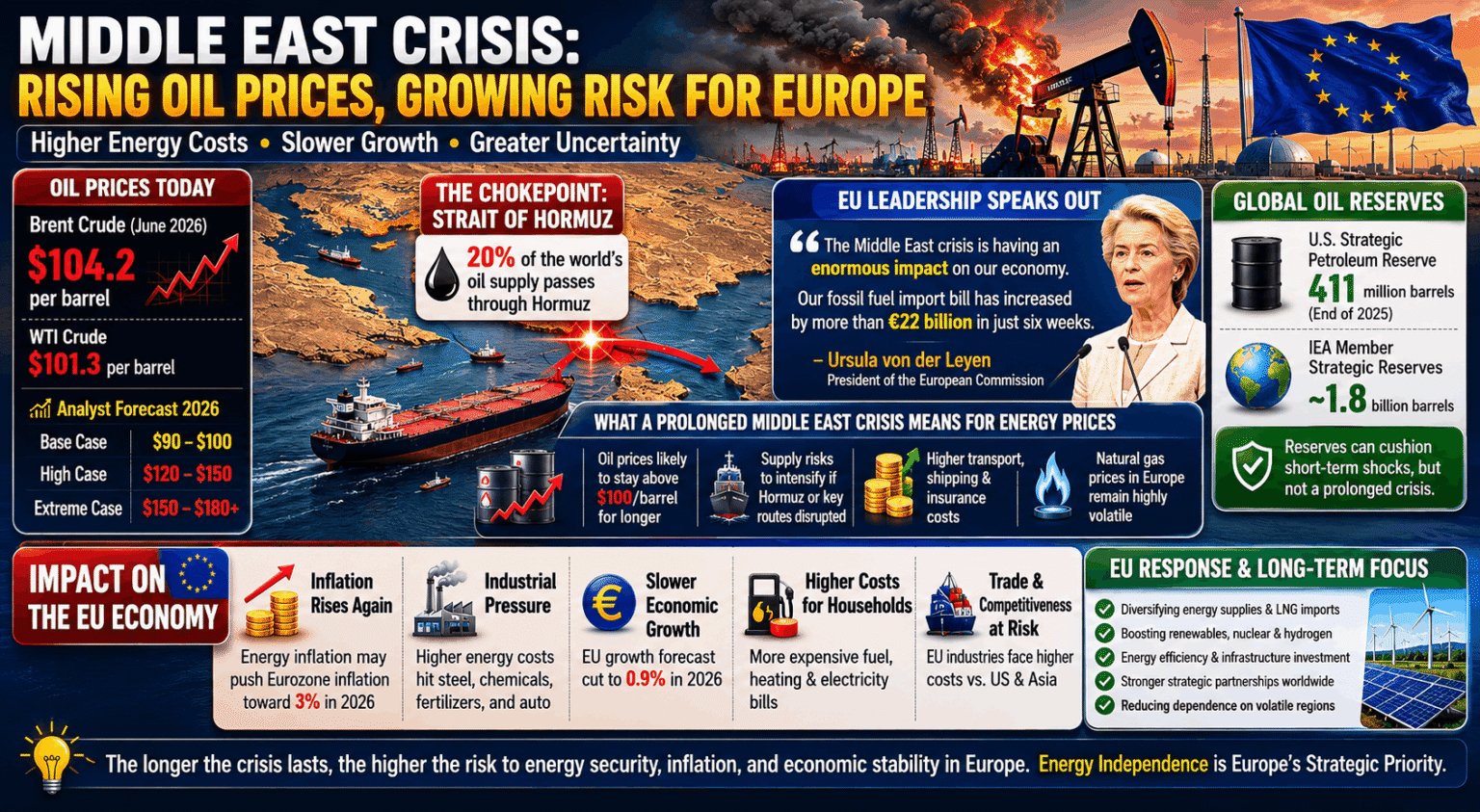
The strategic importance of the Middle East stems largely from the Strait of Hormuz, through which roughly one-fifth of the world’s oil supply normally passes.
Since the escalation of tensions involving Iran, global energy markets have experienced significant volatility.
Brent crude has repeatedly traded above the $100-per-barrel threshold during recent weeks, while several forecasts suggest that prices could remain elevated for an extended period if hostilities continue or maritime disruptions persist.
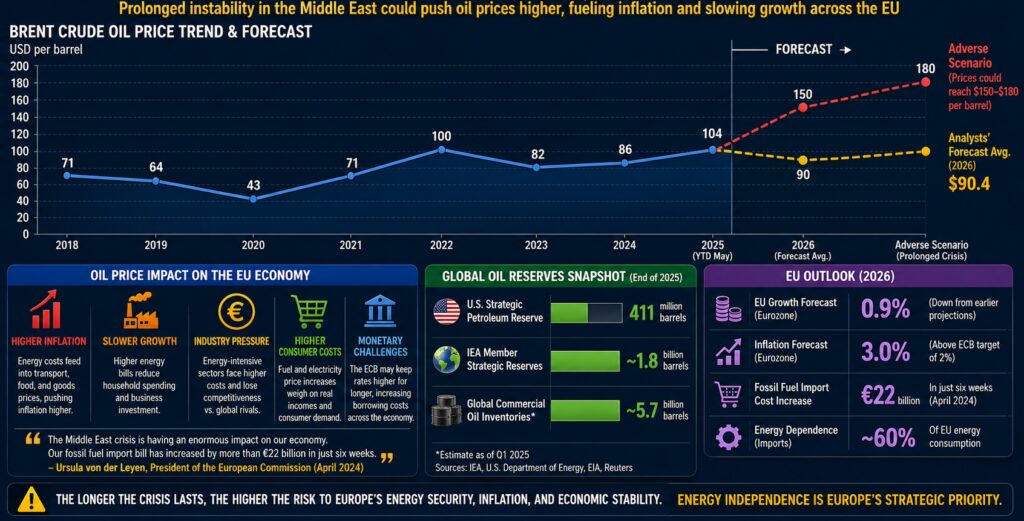
Reuters’ latest survey of energy analysts projects Brent crude to average around $90.44 per barrel in 2026, nearly 40 percent above pre-war expectations, while some adverse scenarios envision prices reaching $150 to $180 per barrel if supply disruptions intensify.
The impact on Europe would be immediate because energy remains a fundamental input for transportation, manufacturing, agriculture, chemicals, and household consumption.
Even though the EU has diversified its suppliers since 2022, higher global oil prices affect all importers regardless of where the fuel originates. European companies would face increased production costs, while consumers would encounter higher prices at fuel stations and through utility bills.
The Energy Price Shock and Inflationary Pressures
The first economic consequence of a prolonged Middle East conflict would be a new wave of inflation. Energy costs are transmitted rapidly throughout the economy. Airlines, shipping firms, trucking companies and industrial producers would all pass higher fuel expenses to consumers.
The European Commission has already warned that the current crisis is contributing to stronger inflationary pressures across the euro zone.
Recent Commission projections indicate that euro zone growth could slow to around 0.9 percent in 2026 while inflation may rise to approximately 3 percent, significantly above earlier expectations and above the European Central Bank’s target.
Higher inflation would place the European Central Bank in a difficult position. While many policymakers had hoped for a period of monetary easing after years of high interest rates, a renewed energy shock could force the ECB to maintain tighter financial conditions for longer.
This would increase borrowing costs for businesses and households, reducing investment and weakening consumer spending.
European Industry Faces another Competitiveness Crisis
Europe’s industrial sector remains particularly vulnerable to energy price fluctuations. Chemical manufacturers, steel producers, fertilizer plants, aluminum smelters, and automotive suppliers depend heavily on affordable energy.
Many European industries never fully recovered their international competitiveness after the energy crisis of 2022–2023. A prolonged Middle East conflict could deepen these challenges by widening the energy-cost gap between Europe and competing regions such as the United States and parts of Asia.
The fertilizer sector offers a particularly revealing example. Natural gas serves as a primary feedstock for fertilizer production. Rising gas prices would increase agricultural costs across Europe, ultimately affecting food prices and further contributing to inflation.
Manufacturing-heavy economies such as Germany, Italy, and Netherlands would likely bear a disproportionate share of the economic burden because of their large industrial bases and dependence on global trade.
EU Leaders Sound the Alarm
European leaders have increasingly acknowledged the economic risks posed by instability in the Middle East. Ursula von der Leyen has repeatedly warned that the conflict is imposing substantial costs on European economies.
In an April statement addressing the crisis, von der Leyen noted that the EU’s fossil-fuel import bill had risen by more than €22 billion within just six weeks of escalating tensions, despite receiving no additional energy supplies.
She argued that the figures demonstrated “the enormous impact this crisis has on our economy” and emphasized that energy market disruptions would continue affecting Europe even if hostilities were to end quickly.
The European Commission has also emphasized that Europe is better prepared than during previous energy crises because of increased LNG capacity, diversified supply chains, renewable energy investments, and coordinated energy purchasing mechanisms.
Nevertheless, Brussels acknowledges that prolonged geopolitical instability would continue to generate substantial economic costs.
Oil Inventories and Strategic Reserves Offer Only Temporary Relief
One factor preventing an even sharper rise in prices has been the use of strategic petroleum reserves and emergency stock releases by major economies.
The United States, working with members of the International Energy Agency, has announced significant releases and loans from strategic reserves to stabilize markets.
According to the U.S. Department of Energy, the Strategic Petroleum Reserve contained approximately 411 million barrels at the end of 2025, while broader coordinated releases among IEA members have involved hundreds of millions of barrels.
IEA member countries collectively maintain strategic reserves estimated at roughly 1.8 billion barrels.
However, these reserves are designed to cushion temporary disruptions rather than replace sustained Middle Eastern exports.
Energy analysts warn that global inventories are being drawn down rapidly and cannot indefinitely compensate for major supply losses from the Gulf region.
The International Energy Agency projects substantial inventory declines throughout 2026, reflecting the continuing strain on global supply chains.
Why Europe Could Be More Exposed Than the United States
Although higher oil prices affect all major economies, Europe faces unique vulnerabilities. The United States benefits from significant domestic oil and gas production, while many European countries remain net energy importers.
Consequently, every increase in global energy prices translates directly into a larger import bill and greater pressure on trade balances.
Furthermore, European consumers generally spend a higher proportion of household income on energy than their American counterparts.
Combined with slower economic growth and aging demographics, this creates conditions in which energy shocks can produce disproportionately large effects on consumer confidence and economic activity.
The Long-Term Strategic Consequences
A prolonged Middle East crisis would likely accelerate Europe’s broader energy transition agenda. Policymakers increasingly view renewable energy, nuclear power, hydrogen infrastructure, and electrification not merely as climate initiatives but as strategic security investments.
The current crisis reinforces a lesson Europe learned after the Russian energy shock: geopolitical dependence carries economic costs. For Brussels, reducing exposure to volatile hydrocarbon markets has become as much a matter of economic resilience as environmental policy.
If instability persists throughout 2026 and beyond, Europe could emerge from the crisis with an even stronger commitment to renewable energy deployment, energy efficiency, and domestic clean-energy production.
However, the transition itself requires substantial investment and time, meaning that the continent remains vulnerable to energy-market turbulence in the near term.
Conclusion
The longer the Middle East crisis continues, the greater the risk of sustained energy inflation, weaker industrial output, and slower economic growth across Europe.
Elevated oil prices above $90–$100 per barrel are already reshaping economic forecasts, while scenarios involving prices of $150 or more could push parts of the euro zone toward recession.
Strategic reserves and emergency stock releases provide valuable breathing room, but they cannot permanently replace disrupted Gulf exports.
For the European Union, the crisis is not simply a foreign-policy challenge. It is increasingly an economic test that will determine whether the bloc can maintain growth, protect industrial competitiveness, and accelerate its transition toward greater energy independence in an era of mounting geopolitical uncertainty.
Thank you for reading. Explore more exclusive news, analysis, and expert perspectives available across The Variant.


