


Courtesy: Reporting Contribution by Salman-Bin-Kareem [A Senior Journalist I Doha, Qatar]
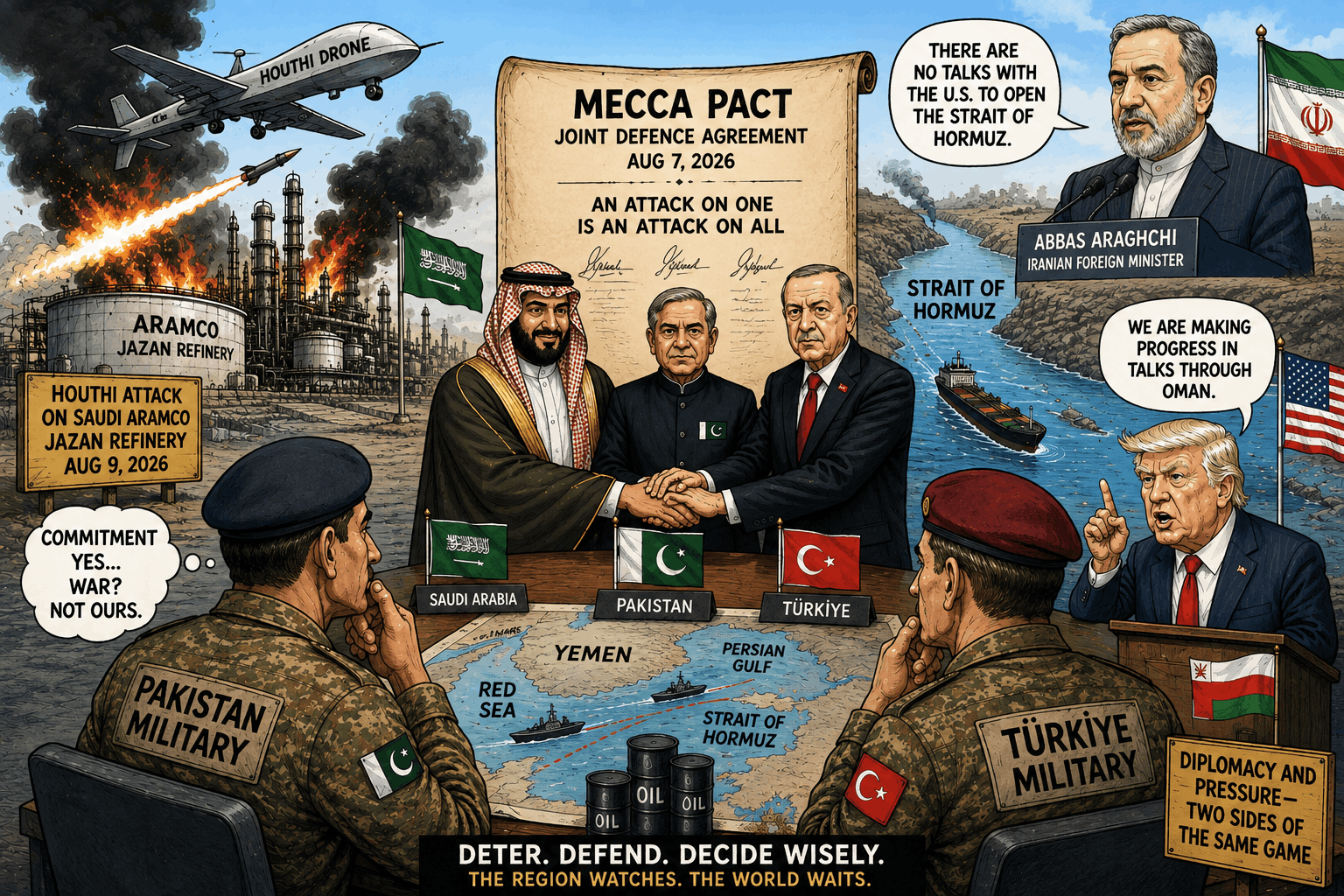
Rochester, NY/Doha, QA: The Houthi drone attack on Saudi Arabia’s Jazan oil-refining complex has created an unexpectedly early test for the newly signed Mecca Joint Defence Agreement between Saudi Arabia, Pakistan and Türkiye.
The agreement declares that an armed attack against one of the three states will be regarded as an attack against all, language deliberately reminiscent of NATO’s collective-defence principle.
Yet the first significant strike against Saudi territory following the agreement has so far produced caution rather than a visible joint military response.
That apparent contradiction is important. It suggests that the Mecca pact should initially be understood less as an automatic mechanism for entering wars and more as an emerging framework for deterrence, military coordination and strategic bargaining.
The development comes as another confrontation unfolds around the Strait of Hormuz.
Washington says diplomacy involving Iran and Oman has made progress, while Tehran continues to insist that negotiations with Oman should not be interpreted as direct negotiations with Washington or as an agreement to fully reopen the waterway.
Together, the two crises reveal a Middle East in which military pressure and diplomacy are increasingly being conducted simultaneously.
Jazan Attack Becomes the Pact’s First Practical Test
Saudi Arabia, Pakistan and Türkiye signed the Mecca Joint Defence Agreement on August 7. According to the joint formulation reported after the signing, the pact is intended to strengthen collective deterrence and treats an armed attack against one member as an attack against all three.
However, the publicly released statement did not specify what military action each country would be legally or operationally required to take.
That ambiguity became immediately relevant when Yemen’s Houthis said they attacked Saudi Aramco’s refinery at Jazan with a drone.
Houthi military spokesman Yahya Saree said the refinery had been targeted in response to what the movement described as Saudi drone violations of Yemeni airspace over Hajjah and Saada.
Saudi Arabia’s Energy Ministry confirmed that a fire occurred at a facility belonging to the Jazan refinery, saying it was extinguished and caused no casualties, although Riyadh did not publicly attribute the fire to the Houthi operation in its initial statement.
The Houthis also attacked the Yemeni government-held port of Mokha. Fayed al-Noman, an assistant undersecretary in Yemen’s Information Ministry, said missiles and drones caused severe damage to port infrastructure, commercial goods and food supplies.
Yemen’s government-allied National Resistance Forces reported that troops and civilians were killed in the attack.
The political significance therefore extends beyond damage to a refinery. The Houthis demonstrated that they were willing to strike Saudi energy infrastructure almost immediately after Riyadh publicly strengthened its defence relationship with two major Muslim military powers.
Why Pakistan and Türkiye Have Not Immediately Entered the Conflict?
The absence of Pakistani or Turkish strikes against Houthi positions does not necessarily mean that the Mecca pact has already failed. Rather, it exposes the difference between collective deterrence and automatic collective warfare.
The agreement states the political principle that an attack against one country will be regarded as an attack against all. But the public text does not establish an automatic military-response mechanism comparable to an integrated NATO command structure.
The Variant noted after the signing that the announced agreement contained no detailed explanation of individual defence obligations or precisely how far each government would be required to go militarily.
This distinction is crucial.
Pakistan could interpret assistance as intelligence sharing, air-defence deployment, training, logistics, naval protection or reinforcement of Saudi defensive positions without launching offensive operations inside Yemen.
Türkiye could similarly provide drones, air-defence systems, intelligence or maritime capabilities without directly attacking the Houthis.
That flexibility may be intentional.
For Saudi Crown Prince Mohammed bin Salman, the immediate objective is probably not to restart a large Saudi-Houthi war.
Riyadh has spent years attempting to reduce its exposure to the Yemen conflict while simultaneously pursuing enormous domestic investment and development projects.
A prolonged missile-and-drone war would threaten Saudi energy infrastructure, foreign investment and the economic transformation associated with Vision 2030.
Saudi Arabia has therefore reiterated its right to protect its sovereignty and security while continuing to support Yemen’s internationally recognized government. The language leaves military escalation available without making escalation inevitable.
The Houthi Strategy: Test the Pact without Triggering Full-Scale War
From the Houthi perspective, Jazan can be interpreted as a carefully calculated political and military signal.
By attacking Saudi energy infrastructure immediately after the Mecca agreement, the Houthis can test whether the pact represents an operational alliance or primarily a declaration of strategic solidarity.
If Pakistan and Türkiye remain militarily restrained, the Houthis can portray the agreement as lacking enforcement.
If they intervene directly, however, the conflict expands and potentially draws two major regional militaries into Yemen.
Either outcome can carry advantages for the Houthis.
The choice of energy infrastructure is particularly important because oil facilities connect battlefield pressure with international economics.
The Jazan refinery has capacity to process roughly 400,000 barrels of crude per day, making attacks on such infrastructure strategically more consequential than isolated attacks on remote military installations.
The Houthis have also declared a maritime blockade against Saudi Arabia in the Red Sea, while Riyadh rejects their justification for it. This means the confrontation increasingly links the Red Sea, Saudi oil infrastructure and the Strait of Hormuz into a wider contest over energy routes.
Iran and Hormuz: Negotiations without Calling Them U.S.-Iran Negotiations
The diplomatic picture surrounding Iran is equally complicated.
Iranian Foreign Minister Abbas Araghchi said negotiations with Oman concerning arrangements for the Strait of Hormuz were approaching their final stages, but emphasized that this did not mean the strait was being reopened.
Iran has repeatedly rejected the characterization that direct negotiations with Washington are underway. This differs sharply from the language coming from the Trump administration.
U.S. Secretary of State Marco Rubio said Washington was involved in the diplomatic process between Oman and Iran and that progress had been made, although there was “not finality yet.” Rubio described the immediate objective as facilitating safer shipping while maintaining the longer-term American objective concerning Iran’s nuclear program.
President Donald Trump, meanwhile, has shifted from threatening another major military escalation toward a strategy combining economic pressure and limited diplomacy. On August 9, Trump described Washington as only “semi-negotiating” with Iran and characterized the confrontation as resembling a chess game.
This is more than a disagreement over terminology. Washington wants to demonstrate that military and economic pressure forced Tehran toward negotiations. Iran, conversely, has a political interest in denying that it is negotiating directly under American coercion.
Iran’s security leadership has also raised the price for a comprehensive settlement. Then-Supreme National Security Council secretary Mohammad Bagher Zolghadr demanded, among other conditions, an end to U.S. threats, termination of the war against Iran and its allies, lifting of the naval blockade, withdrawal of U.S. forces around Iran, sanctions relief, release of frozen Iranian assets and compensation for war damage.
Those demands indicate that Tehran increasingly views control over Hormuz not merely as a military instrument but as negotiating leverage.
Pakistan’s Military Perspective: Deterrence without War with Iran
Pakistan occupies perhaps the most difficult position inside the Mecca arrangement.
Islamabad has decades of military cooperation with Saudi Arabia, including training, technical assistance and deployments. Pakistan has already deployed thousands of personnel as well as aircraft, drones and air-defence capabilities to Saudi Arabia, according to reporting surrounding the agreement.
Pakistan’s military has previously made its Saudi commitment explicit. In May, Director General ISPR Lt Gen Ahmed Sharif Chaudhary said that Pakistan considered a threat to Saudi Arabia’s national security a threat to Pakistan as well. That position demonstrates that the strategic commitment to Riyadh predates the new trilateral agreement.
Yet Pakistan has another imperative: avoiding war with neighboring Iran.
The Variant noted that despite the earlier bilateral Saudi-Pakistani mutual-defence agreement, Pakistan had not responded militarily to previous Iranian attacks against the kingdom of Saudi Arabia.
That history is essential for interpreting Islamabad’s current silence.
Pakistan’s military establishment is likely to view the Mecca pact principally as deterrence architecture rather than a standing authorization for expeditionary warfare.
Pakistan benefits strategically from deeper defence relations with Saudi Arabia and Türkiye, but direct attacks against the Houthis could expose Pakistan to retaliation, complicate relations with Iran and create serious domestic political consequences.
Pakistan also shares a long border with Iran. Saudi Arabia and Türkiye do not face that geographical vulnerability.
Consequently, Islamabad has considerably more incentive to distinguish between defending Saudi territory and participating in offensive operations against Iranian-aligned forces.
Why the Mecca Pact May Be About Deterrence More Than Immediate Retaliation
The Jazan attack exposes the central question surrounding the agreement: what actually qualifies as an attack serious enough to activate collective military action?
If every Houthi drone automatically required Pakistani and Turkish retaliation, all three governments could rapidly become trapped in an escalating regional war. Such an arrangement would reduce rather than increase their strategic freedom.
The absence of immediate joint retaliation may therefore be deliberate strategic ambiguity.
Saudi Arabia gains additional military backing. Pakistan gains political influence, defence cooperation and deeper Gulf strategic relevance. Türkiye strengthens its role as an independent security power connecting NATO, the Gulf and the Muslim world.
At the same time, all three retain flexibility over when collective defence becomes collective combat.
That may explain why the Houthis’ Jazan strike has not yet produced a dramatic trilateral military operation. The real first response to the attack could instead occur behind the scenes through intelligence coordination, air defence, naval deployments and military planning.
The Mecca pact therefore should not yet be declared either successful or failed. Its credibility will depend on what happens if attacks become larger, repeated and more destructive.
The Houthis have effectively asked the first question of the new alliance.
Saudi Arabia, Pakistan and Türkiye have not yet given their final answer.
Bookmark The Variant for trusted updates, informed analysis, and comprehensive coverage of the stories that matter most.


