


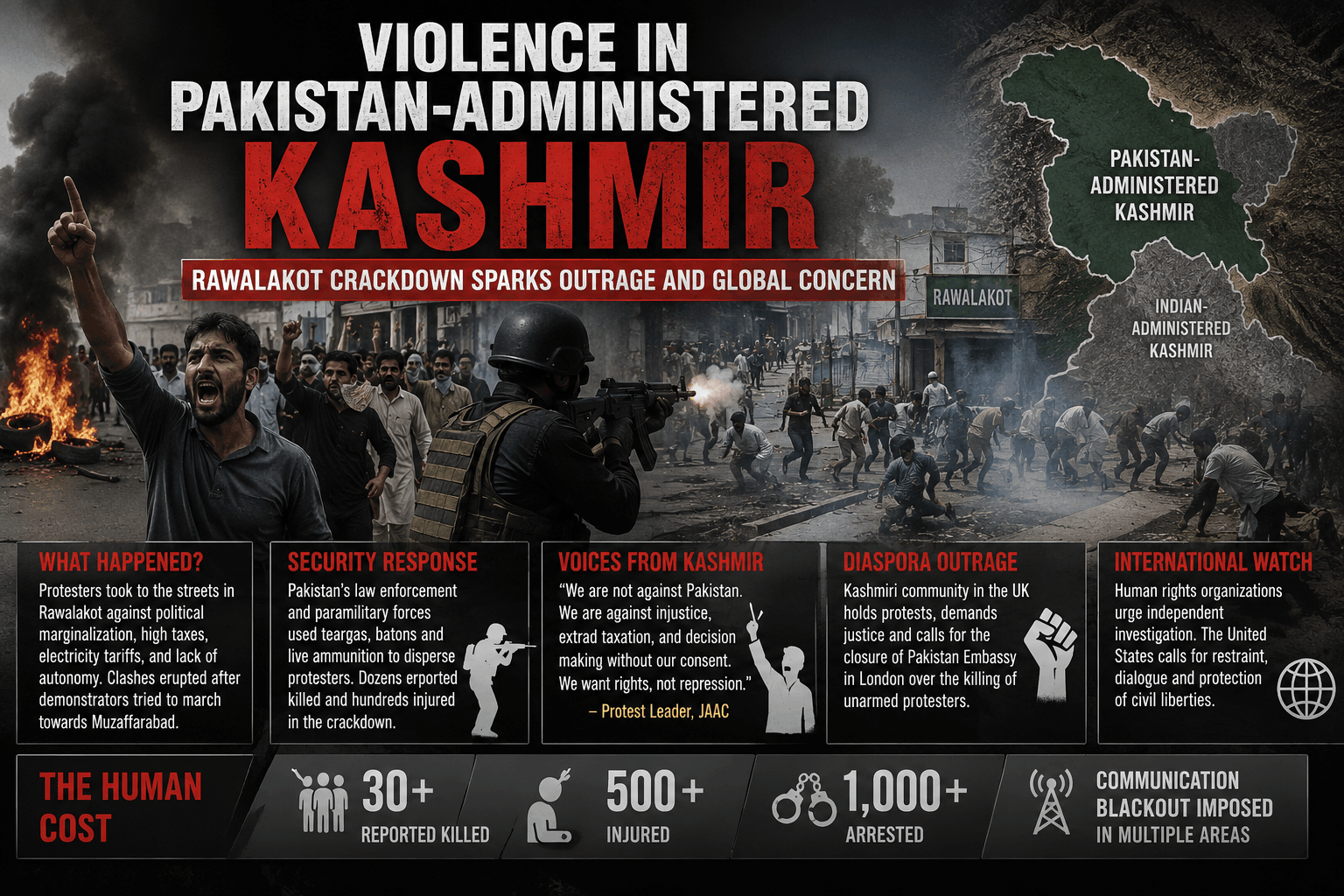
Muzafarabad, AJ&K/Islamabad, PK/: The latest violence in Rawalakot has become one of the most serious internal crises in Pakistan-administered Kashmir (Azad Jammu and Kashmir, AJK) in recent years.
The confrontation between protesters affiliated with the Joint Awami Action Committee (JAAC) and Pakistani law enforcement agencies, supported by paramilitary forces, has transformed what initially began as a movement over governance and political representation into a broader debate about civil liberties, democratic rights, and Islamabad’s relationship with the territory.
Reports indicate that security personnel opened fire after clashes escalated during attempts by protesters to march toward Muzafarabad.
Protest organizers have alleged that dozens of people were killed, while Pakistani authorities have reported significantly lower casualty figures and have stated that security personnel also suffered casualties during the violence.
The large gap between official and protest movement casualty claims has become one of the central controversies surrounding the incident.
The present unrest did not emerge overnight. Since mid-2026, demonstrations across Pakistan-administered Kashmir have reflected growing frustration over political representation, governance, economic conditions, and what many local activists describe as excessive federal influence in regional affairs.
The JAAC, which initially gained prominence through campaigns focused on electricity prices, taxation, and subsidies, gradually expanded its platform to include demands for broader political reforms.
After Pakistani authorities declared the organization unlawful, tensions escalated considerably, leading to repeated confrontations between protesters and security forces.
The latest clashes in Rawalakot occurred against the backdrop of regional elections that were already marked by political polarization, opposition boycotts, and allegations of electoral manipulation by several political actors.
Pakistan’s Security Response
The Pakistani government has defended the deployment of police and paramilitary personnel by arguing that authorities had a constitutional responsibility to maintain public order and protect government institutions.
Officials have maintained that protesters attacked security personnel, blocked highways, damaged public property, and disrupted essential services. Police have also alleged that some demonstrators were armed and initiated violence in certain confrontations.
From Islamabad’s perspective, the operation was presented as a law-and-order response rather than an attempt to suppress peaceful political dissent.
Pakistani officials have argued that the state cannot permit violent groups to challenge governmental authority, particularly during an election period when maintaining stability becomes a national security priority.
Nevertheless, critics argue that even if some protesters resorted to violence, the use of live ammunition raises serious questions regarding proportionality and compliance with international standards governing crowd control.
The Kashmiri Protesters’ Perspective
For many protesters, the movement has evolved beyond economic grievances into a struggle over political dignity and local autonomy.
Activists argue that Pakistan-administered Kashmir possesses constitutional institutions but remains heavily influenced by Islamabad in matters of governance, budgeting, security policy, and political decision-making.
Protest leaders contend that local governments exercise limited independent authority while major strategic decisions continue to originate from Pakistan’s federal establishment.
Many participants also claim that peaceful demonstrations have increasingly been met with arrests, communication restrictions, and aggressive policing, reinforcing perceptions that political space is shrinking rather than expanding.
The deaths reported during the Rawalakot clashes have further strengthened these grievances, with protest groups portraying those killed as victims of state repression rather than participants in unlawful violence.
Human Rights Concerns
International human rights organizations have reacted by calling for independent investigations into the reported use of lethal force.
Amnesty International has urged Pakistani authorities to restore communications, ensure transparency, and permit impartial investigations into allegations that security forces used excessive force against demonstrators.
The organization has also emphasized the importance of protecting freedom of assembly and expression during periods of political unrest.
Such calls do not determine legal responsibility but reflect growing international concern that the events in Rawalakot require independent scrutiny beyond competing official and protest narratives.
Political Fallout inside Pakistan
The violence presents multiple political challenges for Islamabad.
Domestically, opposition parties may use the unrest to criticize the federal government’s handling of Pakistan-administered Kashmir, while the administration faces pressure to demonstrate that elections remain credible despite allegations of intimidation and violence.
The crisis also risks undermining Pakistan’s long-standing diplomatic position on Kashmir.
Islamabad has consistently advocated internationally for the protection of civil liberties and political rights in Indian-administered Jammu and Kashmir.
Consequently, allegations of excessive force against protesters in territory administered by Pakistan invite scrutiny of Pakistan’s own governance practices.
This does not negate Pakistan’s broader diplomatic position on Kashmir, but it complicates its messaging by exposing it to accusations of applying different standards domestically and internationally.
The Kashmiri Diaspora in the United Kingdom
The political repercussions have extended beyond South Asia.
Sections of the Kashmiri diaspora in Britain have organized demonstrations condemning the Rawalakot crackdown.
Some activist groups have publicly demanded that the British government reassess its engagement with Pakistan and have even called for the closure of Pakistan’s High Commission in London.
These demands remain political campaigns rather than official British government policy. There has been no indication that the UK government intends to close Pakistan’s diplomatic mission.
However, the demonstrations illustrate growing divisions within diaspora communities regarding Islamabad’s administration of Azad Jammu and Kashmir.
Such activism could generate additional political pressure if the unrest continues or if further credible allegations of human rights abuses emerge.
How Washington Is Likely to View the Crisis
The United States has not fundamentally altered its longstanding position on Kashmir, which generally encourages peaceful dialogue while avoiding endorsement of either side’s sovereignty claims.
From Washington’s perspective, three issues are likely to dominate assessments of the Rawalakot unrest.
First, American policymakers will closely monitor allegations regarding the use of excessive force against civilians because protection of peaceful assembly and human rights remains a recurring element of U.S. foreign policy.
Second, Pakistan-administered Kashmir occupies strategic importance due to Pakistan’s role in regional security, counterterrorism cooperation, and broader South Asian stability.
Sustained instability in the region could become a concern if violence spreads or weakens governance.
Third, U.S. officials generally prefer that political grievances be resolved through dialogue, judicial processes, and accountable governance rather than prolonged confrontation between protesters and security forces.
Unless violence escalates dramatically or independent investigations establish widespread human rights violations, the United States is unlikely to fundamentally alter its strategic relationship with Pakistan solely because of the Rawalakot crisis.
Instead, Washington would likely encourage restraint, accountability, and respect for democratic freedoms while continuing broader security cooperation with Islamabad.
Implications for Pakistan’s International Image
The Rawalakot unrest has created a significant diplomatic challenge for Pakistan.
The country has historically emphasized alleged human rights violations across the Line of Control while advocating international attention to the Kashmir dispute.
Consequently, reports of protesters being killed by Pakistani security forces inevitably attract international scrutiny and invite comparisons that Islamabad would prefer to avoid.
International perceptions will depend heavily on whether Pakistan conducts transparent investigations, holds any officials accountable if misconduct is established, and creates political space for peaceful dissent.
Failure to do so risks reinforcing criticism from human rights organizations and providing additional material for Pakistan’s diplomatic critics.
The Road Ahead
The Rawalakot crisis represents more than an isolated confrontation between protesters and security forces.
It reflects deeper tensions regarding governance, political participation, and the evolving relationship between Pakistan’s federal institutions and Pakistan-administered Kashmir.
While Islamabad maintains that its actions were necessary to restore law and order and protect public institutions, many protesters view the crackdown as evidence of excessive central control and shrinking democratic space.
Independent human rights organizations have called for impartial investigations into allegations of excessive force, underscoring the need for credible accountability.
Whether the situation stabilizes will depend not only on security measures but also on meaningful political engagement.
Without credible dialogue addressing local grievances, electoral concerns, and questions of governance, the unrest in Pakistan-administered Kashmir may continue to challenge both Islamabad’s domestic stability and its international diplomatic narrative.
Discover more perspectives, breaking news, and in-depth reports from around the world by visiting The Variant.


