Rochester, NY: The military confrontation between the United States and Iran entered another dangerous phase after the U.S. Central Command (CENTCOM) announced that it had successfully thwarted what it described as an “attempted surprise attack” by Iran’s Islamic Revolutionary Guard Corps (IRGC).
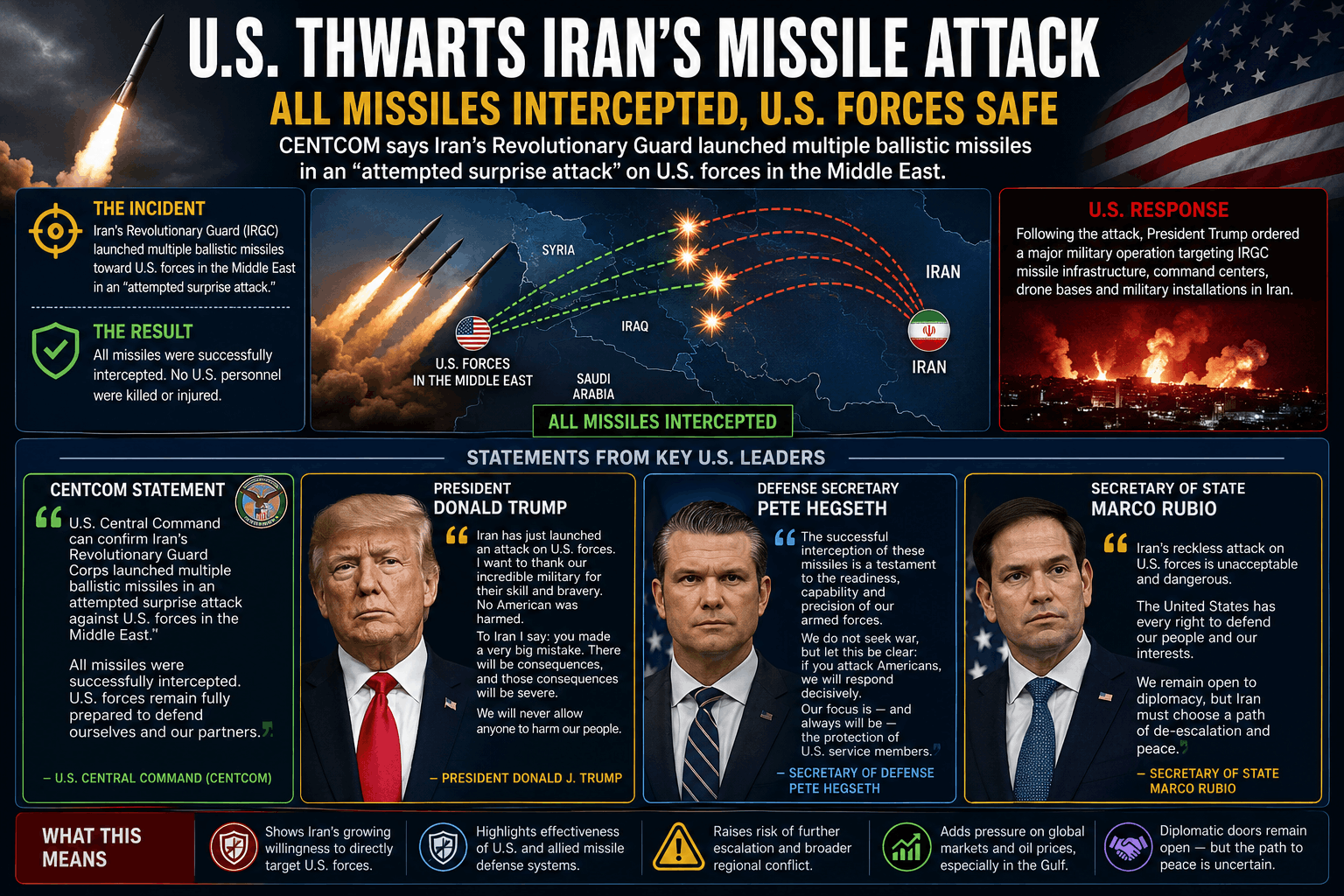
According to CENTCOM, Iran launched multiple ballistic missiles toward U.S. military installations in the Middle East, but every missile was intercepted before reaching its intended targets, preventing casualties and limiting the immediate military impact.
The incident represents one of the most significant direct missile exchanges between Washington and Tehran since the conflict intensified earlier this year.
Although no American personnel were reported killed or injured, the attack demonstrated Iran’s willingness to directly target U.S. forces while highlighting the growing importance of integrated missile-defense systems deployed across the Middle East.
In its official statement, U.S. Central Command said Iranian Revolutionary Guard forces launched multiple ballistic missiles in what it characterized as an “attempted surprise attack” against U.S. forces stationed in the region.
CENTCOM confirmed that all incoming missiles were successfully intercepted and emphasized that American and allied air-defense systems functioned exactly as designed.
The command further stated that U.S. forces remain fully prepared to defend themselves and America’s regional partners against any additional aggression.
Military officials described the interception as evidence of the effectiveness of the multi-layered missile-defense architecture developed over several years through cooperation among the United States and regional allies.
President Donald Trump reacted swiftly following confirmation of the Iranian missile launches. While thanking U.S. military personnel for protecting American forces, he warned Tehran that any attack against American service members would receive an overwhelming military response.
According to White House statements, Trump stressed that the United States would not tolerate attacks on its forces and declared that Iran would face severe consequences for what Washington views as an act of aggression.
Shortly afterward, U.S. forces launched a broad retaliatory operation targeting IRGC missile infrastructure, command facilities, drone bases and military installations inside Iran.
Trump’s response reflects his administration’s long-standing strategy of restoring deterrence through immediate and disproportionate retaliation rather than prolonged diplomatic warnings.
Defense Secretary Pete Hegseth praised the performance of American missile-defense units and described the successful interceptions as proof that U.S. forces remain fully capable of defeating sophisticated ballistic missile attacks.
Hegseth reiterated that the United States did not seek conflict but would decisively respond whenever American troops were threatened.
He emphasized that protecting U.S. service members remains the Pentagon’s highest priority and warned Iran that attacks on American personnel would invite powerful military consequences.
His remarks reinforced the Pentagon’s message that defensive success does not eliminate the possibility of offensive retaliation when deterrence is challenged.
Iran’s Strategic Calculation
From Tehran’s perspective, the missile attack appears intended to achieve several objectives simultaneously.
First, it allows Iranian leaders to demonstrate to domestic audiences that they are willing to respond directly to repeated U.S. and Israeli military operations.
Second, it signals to regional allies and proxy groups that Iran remains capable of challenging American military superiority.
Third, it attempts to impose strategic costs on Washington without necessarily provoking an uncontrollable regional war.
However, the complete interception of the missiles significantly reduced the military effectiveness of the operation.
Instead of demonstrating battlefield success, the attack primarily reinforced American claims regarding the effectiveness of regional missile-defense cooperation.
Iran nevertheless may calculate that repeated missile launches gradually increase political pressure by forcing Washington to maintain expensive military deployments and high operational readiness across the region.
Why Missile Defense Matters
The interception highlights the growing sophistication of America’s integrated air and missile-defense network across the Middle East.
Modern ballistic missile defense no longer relies on a single interceptor system. Instead, the United States combines multiple platforms capable of detecting, tracking and engaging incoming threats at different stages of flight.
These systems work alongside intelligence assets, radar networks and regional partners, creating overlapping defensive layers.
The successful interception therefore represents not merely a technological achievement but also years of operational integration between the United States and allied governments throughout the Gulf region.
Although the immediate attack caused no reported casualties, its broader implications are considerable.
The incident demonstrates that direct military confrontation between Washington and Tehran has become increasingly normalized.
Rather than relying exclusively on proxy organizations, Iran appears increasingly willing to conduct direct military operations against American targets.
This shift raises the possibility of rapid escalation.
Any future missile strike that successfully penetrates defensive systems and causes American casualties would likely trigger a far larger U.S. military response than witnessed thus far.
Meanwhile, Gulf States hosting American military facilities face growing security challenges as their territories become central theaters in the confrontation between Washington and Tehran.
Economic Consequences
Financial markets closely monitor every military development involving Iran because of the strategic importance of the Persian Gulf and the Strait of Hormuz.
Even unsuccessful missile attacks increase geopolitical uncertainty, contributing to volatility in global oil markets, higher maritime insurance costs and disruptions to commercial shipping.
Energy traders remain concerned that prolonged military exchanges could eventually threaten one of the world’s most important energy corridors.
For Iran, continued confrontation also risks additional economic isolation through expanded sanctions and further restrictions on international trade and investment.
The latest exchange illustrates that deterrence between the United States and Iran remains unstable.
Washington seeks to convince Tehran that attacks on American forces will always result in overwhelming retaliation.
Iran, meanwhile, appears determined to show that it retains the capability to threaten U.S. military interests despite years of sanctions and military pressure.
Neither side currently appears willing to accept strategic defeat, making continued military exchanges increasingly likely unless diplomatic channels regain momentum.
Conclusion
CENTCOM’s successful interception of Iran’s ballistic missile barrage prevented what could have become one of the deadliest direct attacks on American forces in recent years.
Operationally, the event demonstrated the effectiveness of U.S. missile-defense systems and the readiness of American forces deployed across the Middle East. Politically, however, it underscored the fragile state of regional security.
The statements issued by President Donald Trump, Defense Secretary Pete Hegseth, Secretary of State Marco Rubio and CENTCOM collectively conveyed a unified message: the United States considers attacks on its forces unacceptable and will continue responding with decisive military force while maintaining the option for diplomacy.
Whether this latest confrontation strengthens deterrence or accelerates the cycle of retaliation will depend on the strategic calculations made in both Washington and Tehran over the coming days.
For now, the successful interception represents a tactical victory for the United States, but it also highlights the increasingly dangerous trajectory of a conflict whose consequences extend far beyond the battlefield.
For ongoing coverage and detailed analysis of international affairs, visit The Variant regularly for the latest updates.