Courtesy: Reporting Contribution by Salman-Bin-Careem [A Special Correspondent I Doha, Qatar]
Toronto, ON/Doha, QR: The latest phase of the Middle East crisis has exposed a widening gap between Washington’s desire for de-escalation and growing Israeli demands for a decisive military outcome in Lebanon.
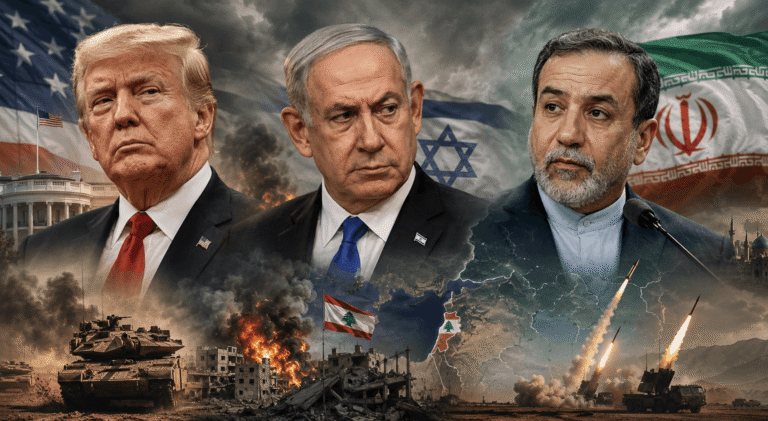
While U.S. President Donald Trump continues to publicly advocate an immediate ceasefire between Israel and Iran and urges all sides to “stop shooting,” many Israelis living near the northern border are pressing Prime Minister Benjamin Netanyahu to reject American pressure and continue military operations against Hezbollah in Lebanon.
The emerging tension is no longer merely about military operations in southern Lebanon. It has become a broader struggle over who will shape the post-war regional order: Washington through diplomacy, Jerusalem through military force, or Tehran through its network of regional allies.
Recent reporting indicates that many residents of northern Israel believe previous ceasefires failed to eliminate Hezbollah’s military capabilities and merely postponed future confrontations.
Their argument is rooted in decades of conflict and the belief that any premature ceasefire would allow Hezbollah to regroup and rearm.
As a result, domestic pressure on Netanyahu increasingly favors continued military action despite American efforts to stabilize the situation.
Trump’s Message: “Stop shooting” and Move toward Peace
President Trump has attempted to position himself as the principal broker of a regional settlement. In recent statements, he declared that both Israel and Iran were seeking “an immediate ceasefire” and suggested that final negotiations on peace were progressing despite numerous obstacles. Trump publicly stated:
“Both sides, Israel and Iran, are looking to do an immediate CEASEFIRE.”
At another critical moment, Trump reportedly instructed Netanyahu not to launch retaliatory strikes that could derail ongoing diplomatic efforts.
According to reports, Trump argued that diplomacy needed more time and that further escalation would jeopardize negotiations already underway between Washington and Tehran.
Trump has repeatedly presented himself as the leader capable of ending multiple conflicts simultaneously. He claimed that Israel, Hezbollah, and Iran were all moving toward de-escalation and even asserted that he had personally intervened to halt planned Israeli operations in Beirut.
However, the challenge facing Trump is that events on the battlefield continue to move faster than diplomacy.
Missile exchanges, cross-border attacks, and mutual accusations have repeatedly undermined ceasefire announcements, raising doubts about whether political declarations can be translated into realities on the ground.
Netanyahu’s Strategic Dilemma: Washington or Domestic Opinion?
For Netanyahu, the political landscape is exceptionally complicated. On one side stands Israel’s most important strategic ally, the United States, urging restraint and diplomatic engagement.
On the other side stands a significant segment of Israeli society demanding that Hezbollah be weakened permanently before any ceasefire takes effect.
Netanyahu’s government argues that Hezbollah’s military infrastructure near the Israeli border remains an unacceptable security threat.
Israeli officials maintain that previous ceasefires failed because Hezbollah retained sufficient capabilities to threaten northern Israel.
The Israeli prime minister has therefore sought to balance support for American diplomatic initiatives while preserving military freedom of action.
This balancing act has become increasingly difficult as military operations in Lebanon intersect with wider tensions involving Iran.
For many Israeli security officials and residents of northern communities, the conflict is not viewed as an isolated Lebanon issue but as part of a broader confrontation with Iran’s regional influence.
Consequently, pressure continues to mount on Netanyahu to prioritize long-term security considerations over short-term diplomatic compromises.
Iran’s Position: Lebanon cannot be separated from the Wider Conflict
Iranian leaders have consistently rejected efforts to treat Lebanon as a separate battlefield. Iranian Foreign Minister Abbas Araghchi has repeatedly argued that any ceasefire arrangement must encompass all fronts of the conflict.
Araghchi stated:
“The ceasefire between Iran and the US is unequivocally a ceasefire on all fronts, including in Lebanon.”
He further warned that violations in Lebanon would constitute violations of broader ceasefire understandings and asserted that both the United States and Israel would bear responsibility for any consequences resulting from renewed escalation.
In another interview, Araghchi emphasized that any future negotiations would require not only recognition of Iranian rights but also an end to military campaigns affecting Iran, Lebanon, and the wider region.
He argued that developments in Lebanon and negotiations with Washington are inseparable.
This position reflects Tehran’s long-standing strategic doctrine. Iran views Hezbollah not merely as a Lebanese actor but as a central component of its regional deterrence architecture.
Consequently, any attempt to weaken Hezbollah significantly is interpreted in Tehran as an attack on Iranian strategic interests.
The Battle beyond Lebanon
What makes the current crisis particularly dangerous is that every major actor is pursuing a different endgame.
Trump seeks a diplomatic breakthrough that would reduce regional tensions and potentially create a framework for broader U.S.-Iran understanding.
Netanyahu seeks security guarantees that many Israelis believe can only be achieved through sustained military pressure.
Iran seeks to preserve its regional influence while ensuring that Hezbollah remains a viable strategic partner.
These objectives are not necessarily compatible.
The result is a situation in which public statements about peace coexist with ongoing military operations.
Ceasefire announcements are made, only to be followed by new exchanges of fire. Diplomatic optimism is repeatedly undermined by battlefield realities.
Conclusion: A Region Suspended Between War and Diplomacy
The current struggle over Lebanon illustrates a deeper transformation taking place across the Middle East. President Trump is attempting to impose a diplomatic framework that could halt fighting and reopen negotiations.
Netanyahu faces intense domestic pressure to continue military operations until Hezbollah’s capabilities are substantially degraded. Meanwhile, Iran insists that Lebanon remains an integral part of any broader regional settlement.
As long as these competing visions remain unresolved, ceasefires are likely to remain fragile and temporary.
The future of Lebanon has become intertwined with the future of U.S.-Iran diplomacy, Israeli security doctrine, and the broader balance of power in the Middle East.
The central question is no longer whether a ceasefire can be announced. The real question is whether the political objectives of Washington, Jerusalem, and Tehran can ever be reconciled sufficiently to make that ceasefire endure.
Until then, Lebanon will remain the most dangerous fault line in an increasingly volatile region.
Thank you for reading. Explore more exclusive news, analysis, and expert perspectives available across The Variant.