Courtesy: Reporting Contribution by Salman-Bin-Kareem [A Senior Journalist I Doha, Qatar]
Rochester, NY/Doha, QR: Ceasefire in Ruins – The latest exchange of intense attacks between the United States and Iran has pushed the Middle East back toward a widening war only weeks after regional mediators presented an interim agreement as a possible path toward de-escalation.
The renewed confrontation is not simply another brief round of retaliation. It represents the collapse, at least for now, of a diplomatic framework that Pakistan and Qatar had helped construct and that was supposed to create enough political space for a longer-term settlement.
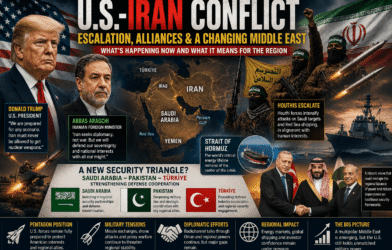
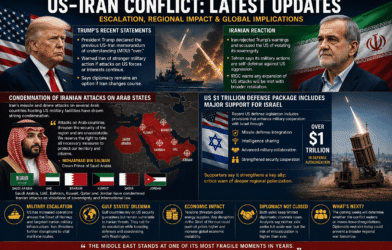
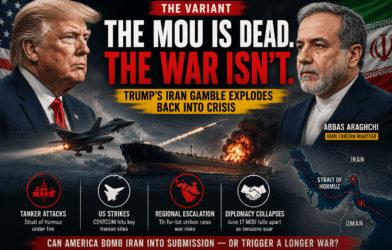
The decisive public turning point came on July 8, 2026, when President Donald Trump said that the interim U.S.-Iran accord was “over.”
The announcement came six days before July 14 and effectively ended Washington’s political commitment to the memorandum of understanding that had provided a temporary ceasefire and a 60-day negotiating window.
Trump’s declaration was more than rhetoric. It was followed by renewed American military action, the tightening of economic pressure and the reversal of sanctions relief that had been granted to support negotiations.
The president accused Iran of making diplomacy meaningless and indicated that Washington no longer believed the existing arrangement could restrain Tehran’s military and maritime activities.
The resulting escalation has exposed the central weakness of the ceasefire: the agreement temporarily reduced military operations but failed to resolve the conflict’s underlying disputes.
These included Iran’s nuclear programme, sanctions, the movement of commercial vessels through the Strait of Hormuz, American military deployments in the Gulf and Tehran’s demand that Washington recognize a significant Iranian security role in the region.
From Diplomatic Breakdown to Renewed U.S. Strikes
The United States justified the resumption of military operations by accusing Iran of attacks against commercial shipping and threats to the free movement of vessels through the Strait of Hormuz.
Washington has demanded an explicit Iranian commitment that all shipping lanes remain open, that commercial vessels not be attacked and that Tehran refrain from imposing tolls or approval requirements on ships passing through the waterway.
Iran, however, has refused to surrender what it considers its strategic authority over the northern part of the strait. That disagreement turned the waterway from a negotiating issue into the immediate military centre of the confrontation.
Following Trump’s announcement, U.S. Central Command began another series of strikes against Iranian military and maritime infrastructure. CENTCOM said its forces were targeting facilities considered capable of supporting missile, drone, naval and commercial-shipping attacks.
Official CENTCOM material shows that American forces used multiple attack systems against Iranian naval infrastructure, including strikes on submarine and ship-maintenance facilities.
CENTCOM has presented the campaign as part of Operation Epic Fury, an operation initiated under presidential direction to dismantle elements of Iran’s security and military apparatus that Washington identifies as imminent threats.
The phrase “CENTCOM started shelling” captures the intensity of the renewed operation, but the military campaign is broader than traditional artillery shelling.
It involves airstrikes, naval weapons, missiles and one-way attack drones directed at Iranian coastal positions, military bases, naval facilities and infrastructure linked to Iran’s ability to control or threaten shipping.
The attacks reportedly concentrated heavily on southern Iran and the coastline surrounding the Strait of Hormuz.
Iranian port areas and military positions near Bandar Abbas, Bushehr and strategically important islands came under pressure as Washington attempted to reduce Iran’s capacity to launch missiles, drones or fast-boat attacks against U.S. and allied forces.
The United States has framed these attacks as defensive and necessary to preserve international navigation. Iran sees them as a direct attempt to destroy its deterrence, challenge its sovereignty and establish American control over a waterway located beside the Iranian coastline.
Iran Retaliates Across the Region
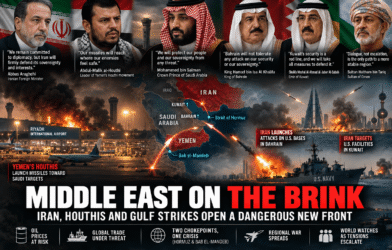
Iran responded by expanding the geographic scope of its retaliation. Iranian forces claimed attacks against American military facilities and logistical positions in Bahrain, Kuwait and Jordan, including sites connected to the U.S. Fifth Fleet.
Missile and drone attacks were also reported against regional targets associated with the American military presence and against shipping linked to states supporting Washington.
The Iranian response appeared designed not only to damage U.S. assets but also to demonstrate that any American campaign against Iran would create security consequences for Gulf governments hosting U.S. forces.
One of the most serious exchanges involved an Iranian attack directed at a U.S. airbase in Jordan, followed by prolonged American strikes on Iranian positions near the Strait of Hormuz.
The return to hostilities has created new risks for civilians and for the movement of food, fuel and medicine across the region, according to the United Nations human-rights leadership.
Iran’s strategy appears to rely on a combination of direct retaliation, disruption of maritime traffic and pressure on countries that provide operational access to the United States.
Tehran knows that it cannot easily match the conventional air and naval power of the United States. It can, however, increase the political and economic cost of the war by threatening bases, shipping lanes, oil infrastructure and regional partners.
This creates a dangerous escalation cycle. Every Iranian attack on a U.S. base or commercial vessel strengthens the argument in Washington for broader military action.
Every American strike on Iranian territory strengthens Tehran’s claim that resistance and retaliation are necessary for national survival.
Abbas Araqchi’s Message after the American Strikes
Iranian Foreign Minister Abbas Araqchi has argued that Iran will not negotiate under military coercion.
His public position has been that diplomacy remains possible, but only if the United States stops attacking Iran and abandons demands that Tehran considers one-sided or unrealistic.
Following the intense American military operations, Iran’s diplomatic message centered on the right to self-defence.
Araqchi and other Iranian officials accused Washington of destroying a negotiating process that regional mediators had worked to establish.
Iranian officials maintained that the United States could not bomb Iran while simultaneously expecting Tehran to make concessions at the negotiating table.
Araqchi’s approach reflects a difficult balancing act. Iran does not want to appear desperate for talks while its territory is under attack.
At the same time, Tehran faces enormous economic and military pressure and has reasons to avoid a prolonged direct war with the United States.
Earlier diplomatic efforts involving Oman, Qatar and Pakistan indicated that Araqchi remained engaged in discussions about maritime security and possible arrangements for the safe passage of ships.
However, Iran reportedly insisted on retaining control over parts of the Strait of Hormuz and rejected Washington’s demand for unrestricted passage under American-defined conditions.
The Iranian foreign minister’s message can therefore be understood as conditional diplomacy: Tehran is not permanently closing the door to negotiations, but it does not want talks to become a formal mechanism through which the United States applies military pressure and then demands political surrender.
Was Pakistan’s Mediation a Failure?
Pakistan’s role requires a more careful assessment than simply describing the mediation as a success or failure.
Islamabad played a significant role in previous diplomatic efforts.
Pakistan’s army chief, Field Marshal Asim Munir, was reported to have maintained direct contact with senior American and Iranian officials, including U.S. Vice President JD Vance, special envoy Steve Witkoff and Foreign Minister Araqchi, during earlier attempts to secure a ceasefire.
Pakistan and Qatar also helped facilitate the interim roadmap that offered sanctions relief and a 60-day period for negotiations.
The agreement represented a meaningful diplomatic achievement because it temporarily reduced fighting and created a formal framework for dialogue.
However, mediation should be judged not only by whether a ceasefire document is produced, but also by whether the mediator can persuade the parties to preserve it when disputes emerge.
On that test, Pakistan’s influence proved limited.
The interim agreement did not create an independent verification system strong enough to determine responsibility for maritime incidents.
It did not establish an enforcement mechanism capable of restraining either side. Nor did it resolve the fundamental disagreement over the Strait of Hormuz.
When Washington concluded that Iran had violated the spirit or terms of the arrangement, the Trump administration returned to military force.
Pakistan was unable to prevent that decision. Likewise, Islamabad could not persuade Iran to accept Washington’s maritime demands or to make a declaration guaranteeing unrestricted passage through all lanes of the strait.
Pakistan therefore succeeded as a facilitator but failed to become a guarantor.
This distinction matters. Pakistan could bring messages between Washington and Tehran, arrange meetings and help draft ceasefire terms. It could not control American military decision-making or Iranian strategic behavior.
Did Washington Set Pakistan Aside?
Pakistan remained among the countries attempting to restore communication, alongside Qatar, Oman, Turkey, Egypt and Saudi Arabia. Regional mediators continued contacting both governments after the renewed attacks.
Nevertheless, the sequence of events suggests that Pakistan was set aside at the decisive moment—not necessarily as an act of hostility toward Islamabad, but because Washington shifted from mediation to coercion.
Trump’s declaration that the interim accord was “over” was a unilateral American political decision. The subsequent strikes were conducted under U.S. military command. Pakistan’s objections or appeals for restraint did not alter the timetable.
Islamabad publicly stated that renewed conflict was “in no one’s interest” and urged all sides to exercise restraint. The statement reflected Pakistan’s concern but also revealed the limits of its leverage. It could condemn escalation diplomatically, but it could neither stop American strikes nor compel Iranian concessions.
The United States did not necessarily abandon Pakistan as a channel. It effectively bypassed the channel when it decided that military pressure would achieve more than continued negotiations under the existing framework.
This is a recurring problem for middle-power mediators. They can become highly visible when the parties want a pause, but they rapidly lose influence when one or both parties believe battlefield action will improve their bargaining position.
Discover more perspectives, breaking news, and in-depth reports from around the world by visiting The Variant.