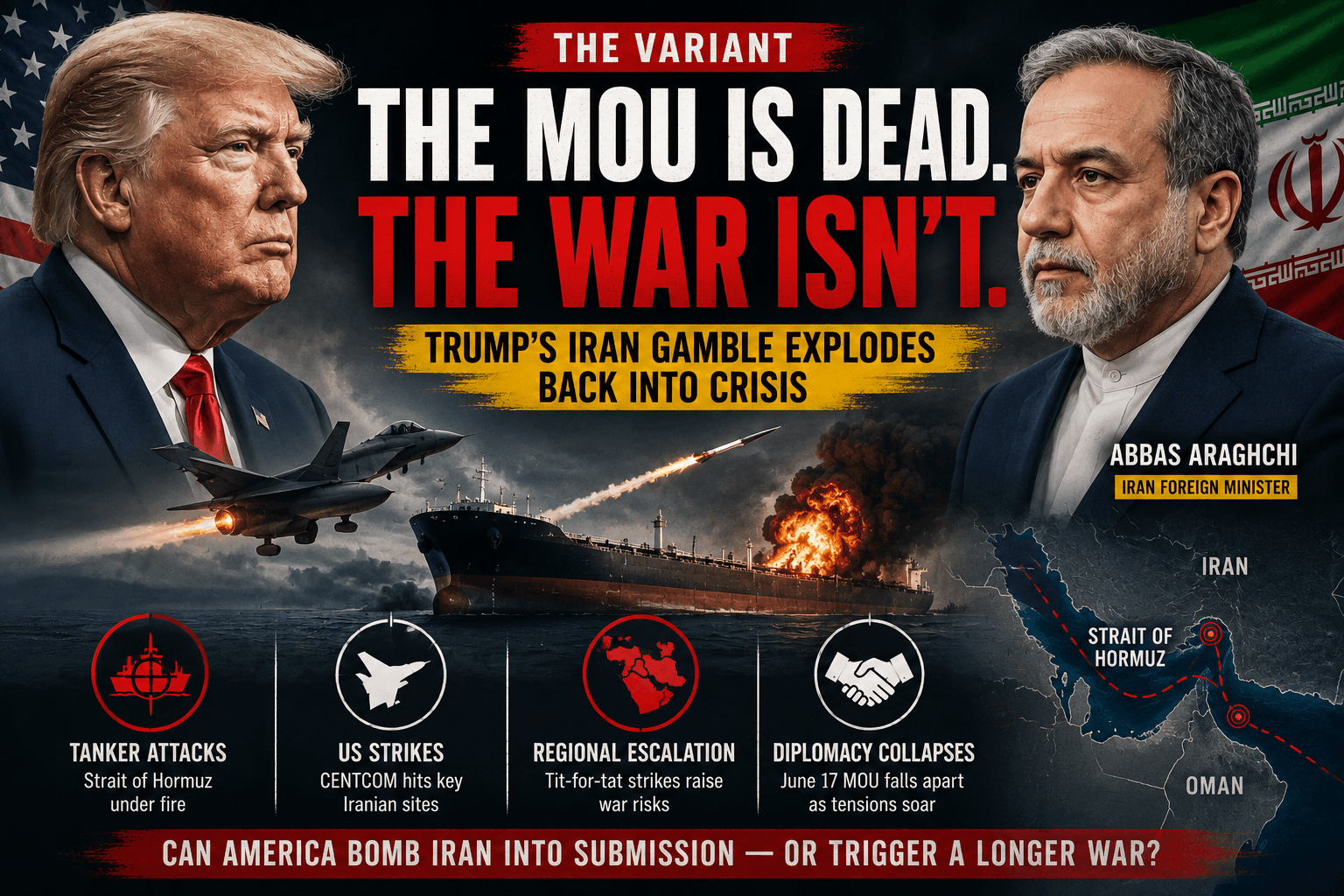
Rochester, NY: The June 17th memorandum of understanding (MOU), which the presidents of Iran and the United States signed, is now essentially dead. During today’s NATO meeting in Türkiye, Trump made it clear that he was done.
He hesitated before saying it, and he merely said it in answer to a question, but his deeds said volumes.
The issue now becomes whether he personally ordered these activities or not. According to the chronology, there were around 48 hours of fierce warfare on July 7 and 8. During those two days, bombing levels and target counts that had never been witnessed before the June 17 agreement were established at unprecedented levels of escalation.
They boasted about completing 3,300 goals in a day on February 27. It dropped to around 100 targets a few days later, and after that, they could only manage 30, 40, or 50 targets daily at most.
On to July 7, Iran claimed that three tankers had veered off the approved maritime path; therefore the Islamic Republic attacked them. The Greeks allegedly had one of the tankers while the Arabs had two.
Iran had its own justification for the strikes. Although the validity of that reasoning is up for question, Tehran maintained that the MOU would exclude ships transiting through the Strait of Hormuz from paying any tolls, fees, or other charges for the first sixty days. Iranian officials insisted, however, that the ships must still go across Iranian territory near Qeshm Island.
However, ships were to travel closer to the coast of Oman according to their own decision, rather than utilizing the path indicated by Iran, as part of Donald Trump’s so-called freedom initiative.
Tehran said this was in breach of the MOU.
In its defense, Tehran stated: “We agreed that we would not collect any fee, toll or payment for 60 days, but the route itself would remain under our control and would be used according to our regulations.”
So, naturally, one would wonder: what would Iran do if ships went through seas that weren’t under its control?
Tehran first issued a series of warnings. Iran attacked certain ships after they disregarded the warnings.
Three ships were damaged on July 7.
In response to such assaults, the CENTCOM chief authorized airstrikes against Iranian locations at Sirik, Bandar Abbas, and Qeshm Island. There are three key sites here that house equipment for keeping tabs on and regulating ships passing through the Strait of Hormuz.
After striking these three targets, the US declared the mission over.
After that, Iran said it had attacked 85 sites in Bahrain and Kuwait. American personnel and equipment allegedly decreased their presence in Qatar, Dubai, and Saudi Arabia, leading to a concentration of CENTCOM’s command infrastructure in Bahrain and Kuwait.
Thus, Iran declared war on 85 locations in Kuwait and Bahrain. It is debatable if each and every strike truly occurred, although the IRGC said as much.
Iran has leveled such accusations against Saudi Arabia, Dubai, and Qatar in the past. Subsequently, prominent American news outlets confirmed that some areas had been struck and that American assets, structures, and defense facilities had taken a heavy beating.
Consequently, it is logical to presume that a portion of the 85 sites actually attacked by Iran were hit.
General Brad Cooper, head of CENTCOM, responded by saying that the US had hit 80 more targets.
Once again, the positions that Iran is said to control a significant portion of its Strait of Hormuz operation—Qeshm Island, Bandar Abbas, and Sirik—were the targets of these attacks.
Following this back-and-forth, General Cooper declared the mission a success.
However, Donald Trump had made an intriguing statement just before that.
Midway through the week, this assault occurred. Not only did it not occur over the weekend, but it is noteworthy because Trump has established a pattern.
Basically, the point is that the MOU was almost dead after this back-and-forth of assaults.
The failure to adequately execute the ceasefire in Lebanon was the very reason why the MoU had already fallen apart. There was hardly a single full day of actual peace in Lebanon throughout the so-called ceasefire era.
Then Iran began attacking ships. The United States saw it as even another transgression, as it was against international law to attack ships.
But the Iranian side argued that the MOU gave Tehran control of the agreed-upon shipping route.
It was inevitable, therefore, that this “Memorandum of Misunderstanding” would conclude in this manner. Indeed, it was the precise outcome.
Trump basically said, “As far as I’m concerned, it’s over” when asked whether the most recent events indicated the MOU was completed.
I can tell you the truth.
Trump may not have made a well-considered policy choice, according to the evaluation, even if he has claimed so.
There’s been an intriguing trend to Trump’s actions since February 27. It seems like he’s in charge of the political and economic climate, including the markets, at first. Afterwards, he makes a shocking announcement or fires missiles against Bandar Abbas, Sirik, or the vicinity of Qeshm Island over the weekend.
There is a widespread fear that a catastrophic conflict is imminent.
When the weekend comes to a close and markets start to reopen, Trump tends to make a more diplomatic speech.
Army Chief of Staff Brad Cooper is always on the go. He has been spearheading the military’s part of this conflict in the area as commander of CENTCOM.
When necessary, commanders may act swiftly in accordance with the concept of self-defense.
Cooper may have conferred with Pentagon officials during the assault on the ships. Iranian claims of assaults on 85 sites prompted a quick response and announcement from the United States military.
War had already broken out by the time word got to Donald Trump.
As an effort to safeguard American interests and in self-defense, the attacks had been legitimately authorized.
That is why we think Trump’s reaction lacked sufficient consideration.
In my opinion, he may reconsider his stance in the next few hours, or perhaps a day or two.
The MOU is still in the works, or he may mention that talks are ongoing.
What can bombing and military strategy does today that they couldn’t accomplish before June 17? This is the most pressing issue facing the US and President Trump.
A clear solution does not exist.
The political climate at home must also be considered.
It will become very challenging for Trump if he suffers a significant political loss in November. Just four or six seats separate him from the minority in the House, and his lead in the Senate is much smaller.
If those margins vanish, Trump may find himself in the position of lame-duck president for the next two years.
Opponents and Democrats would oppose him relentlessly.
That would be very difficult for a president with Trump’s character. His political comfort level would plummet as he became more reliant on presidential executive orders.
Stay engaged with the issues shaping our future through comprehensive reporting and informed commentary from The Variant.