Courtesy: Reporting Contribution by Salman-Bin_Kareem [A Senior Journalist I Doha, Qatar]
Rochester, NY/Doha, QR: The US-Iran peace deal and the latest GCC declaration together mark a decisive turning point in the Middle East. They do not simply represent another ceasefire document or another diplomatic statement from Gulf capitals.
They reveal a deeper struggle over who will shape the region’s future security order: Washington and the Arab Gulf monarchies, or Tehran and its network of regional influence.
At the center of this contest stands the old rivalry between Iran and Saudi Arabia, now entering a new phase where open confrontation, controlled engagement and strategic competition may exist at the same time.
The proposed US-Iran understanding is being presented as a mechanism to end direct hostilities, reopen the Strait of Hormuz, begin talks on sanctions relief and push the nuclear file into a second stage of negotiations.
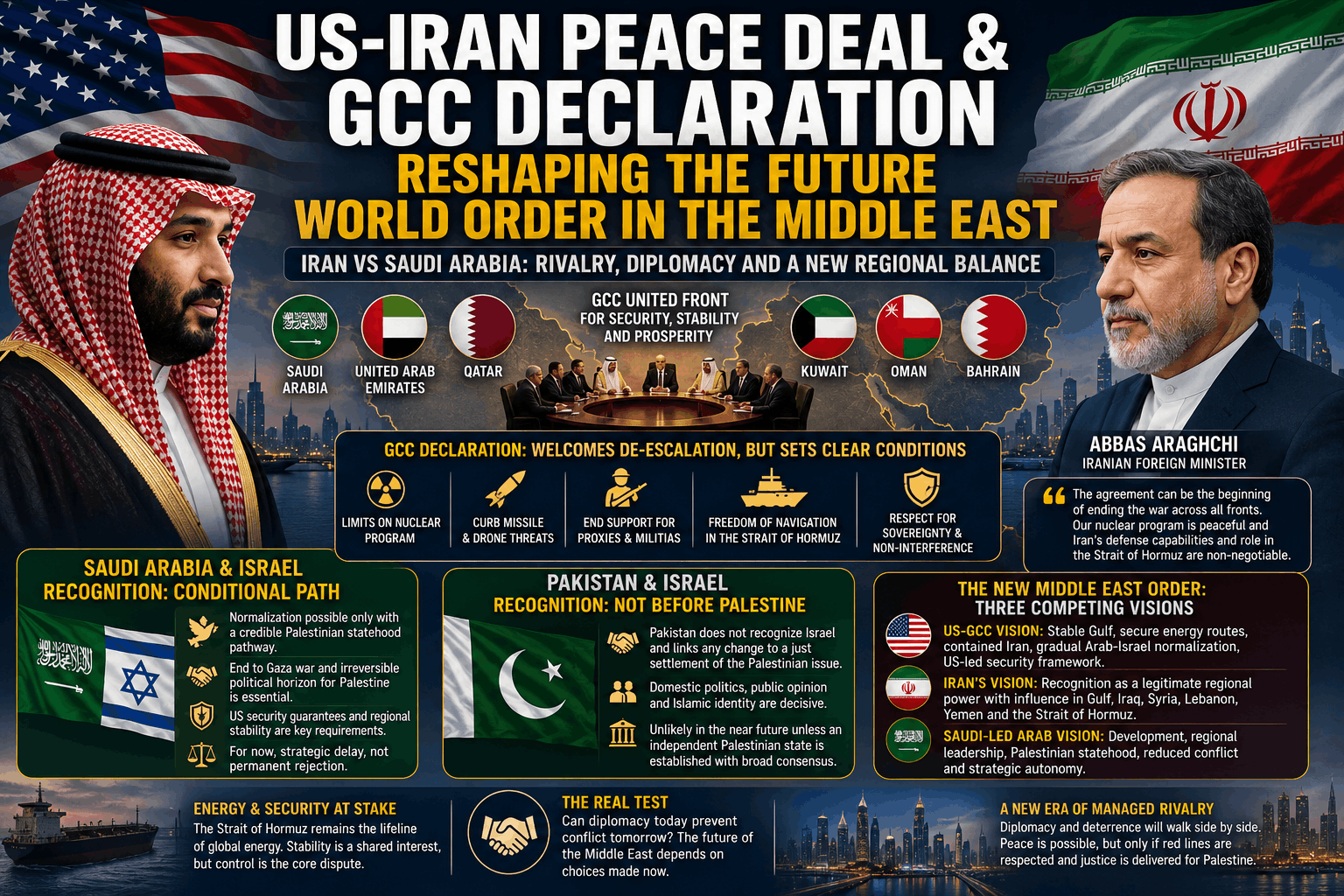
Iranian Foreign Minister Abbas Araghchi has described the deal as a possible path toward ending the war across all fronts, including Lebanon, while insisting that Iran’s sovereignty, its defensive capability and its role in the Strait of Hormuz cannot be dictated by outside powers.
His message is clear: Iran may accept diplomacy, but it will not accept humiliation.
The GCC declaration, however, shows that Gulf States are not ready to accept Iran’s version of regional security.
The Gulf monarchies welcomed de-escalation but tied any future engagement with Iran to strict conditions.
Their concerns are not limited to the nuclear program. They include missiles, drones, armed non-state groups, Hezbollah, maritime security, and Iran’s attempt to project itself as the unavoidable gatekeeper of the Strait of Hormuz.
For Saudi Arabia, the United Arab Emirates, Bahrain, Kuwait, Qatar and Oman, the central question is whether peace with Iran means genuine regional stability or merely a pause before Tehran rebuilds leverage.
The GCC Message: De-escalation without Surrender
The GCC declaration reflects a careful but firm Gulf strategy. Gulf leaders do not want another destructive regional war.
Their economies are tied to energy exports, global investment, ports, aviation, tourism, financial markets and long-term development plans. Saudi Vision 2030, UAE’s global trade model, Qatar’s diplomatic positioning and Oman’s mediation role all require stability. But stability, from the GCC point of view, cannot mean giving Iran unchecked influence over Arab capitals, waterways and armed groups.
Bahrain’s Foreign Minister Abdul Latif bin Rashid Al Zayani, as host of the US-GCC ministerial meeting in Manama, represented a Gulf position that sees Iran’s military reach as a direct threat.
Saudi leadership has also repeatedly emphasized that regional security must be based on respect for sovereignty and non-interference.
Qatar and Oman may prefer mediation and diplomatic channels, but even they cannot ignore the strategic anxiety created by missiles, drones and maritime threats.
The UAE, having experienced regional attacks and pressure on trade routes, views Iran through the lens of economic security and deterrence.
This is why the GCC statement is more than a diplomatic document. It is a regional warning: the Gulf is ready to talk to Iran, but not under Iranian terms.
The Gulf wants a security system where Iran is a neighbor, not a commander; a participant, not a veto power; a regional state, not the final authority over Arab security.
Iran’s Counter-Narrative: Resistance, Sovereignty and Hormuz
Iran’s reaction to the GCC declaration was sharp because Tehran sees the statement as an attempt to internationalize pressure on Iran at the very moment when Tehran believes it has forced Washington to negotiate.
Iran argues that its nuclear program is peaceful, its missile program is defensive, and its regional alliances are part of a resistance framework against Israeli and American power.
Araghchi’s position reflects the Iranian establishment’s broader doctrine. Iran is prepared to negotiate on sanctions, assets and limited arrangements, but it will not easily bargain away the tools that created its regional leverage.
Missiles, drones, Hezbollah, Iraqi militias, Yemen’s Houthis and influence in Syria and Lebanon are not viewed in Tehran as separate files. They are seen as strategic insurance.
The Strait of Hormuz has become the symbol of this doctrine. Iran’s message is that no future maritime order can be built without Tehran.
By insisting that Hormuz lies under the sovereignty of Iran and Oman, Iranian officials are challenging the Western and Gulf desire for unrestricted navigation under US-backed security arrangements.
In simple terms, Iran wants the world to recognize that Gulf energy security passes through Iranian power.
Saudi Arabia vs Iran: Rivalry Enters a Smarter Phase
The future of Iran-Saudi rivalry will not look exactly like the past. The old era of pure confrontation is giving way to a more complex phase of managed rivalry.
Riyadh does not want direct war with Tehran. Tehran also understands that escalation with Saudi Arabia could unite the GCC more firmly behind Washington and possibly Israel. Both sides know that total confrontation would damage their domestic priorities.
But the rivalry will continue in a sharper and more strategic form. Saudi Arabia wants to become the central diplomatic, economic and security power of the Arab and Islamic world. Iran wants recognition as the leading revolutionary and military power of the region.
Saudi Arabia is building influence through investment, normalization diplomacy, religious legitimacy and global partnerships. Iran is building influence through deterrence, ideological networks and crisis leverage.
The US-Iran peace deal may reduce open fire, but it will not automatically reduce mistrust. Riyadh will judge the deal by Iran’s behavior in Lebanon, Iraq, Yemen, Syria and the Gulf waters.
If Iran reduces proxy activity and allows stable maritime traffic, Saudi Arabia may support gradual engagement. If Iran uses the deal to gain sanctions relief while preserving military pressure, Saudi Arabia will deepen security coordination with the United States and possibly move closer to selective understandings with Israel.
Israel Recognition: Saudi Arabia’s Calculated Freeze
The future status of Saudi recognition of Israel is now directly linked to the Palestinian question and the regional balance with Iran.
Before the Gaza war and the wider Iran conflict, there was serious discussion that Saudi Arabia might move toward normalization with Israel under a US-backed security package.
That package could have included American defense guarantees, civilian nuclear cooperation and advanced weapons arrangements.
Today, however, Saudi Arabia cannot recognize Israel without a credible Palestinian statehood pathway. Riyadh has made its position increasingly firm: normalization is not possible without ending the Gaza war and creating a real political horizon for an independent Palestinian state.
This is not only a moral or religious position. It is also strategic. Saudi Arabia cannot claim leadership of the Muslim world while recognizing Israel during continuing Palestinian suffering and unresolved occupation.
Still, Saudi recognition of Israel is not impossible in the long term. It remains possible if three conditions emerge together: a ceasefire and reconstruction framework in Gaza, a recognized and irreversible path to Palestinian statehood, and a US security package strong enough to satisfy Riyadh’s concerns about Iran.
If these conditions are met, Saudi Arabia may eventually normalize ties with Israel, but it will present the move as a victory for Palestine, not a concession to Israel.
For now, the more likely scenario is strategic delay. Saudi Arabia will keep communication channels open, allow indirect coordination on security issues where necessary, and use the possibility of recognition as diplomatic leverage.
Riyadh understands that recognition of Israel is one of its most valuable diplomatic cards. It will not spend that card cheaply.
Pakistan and Israel: Recognition Remains Politically Impossible for Now
Pakistan’s position on recognizing Israel remains far more rigid than Saudi Arabia’s. Islamabad does not recognize Israel and has repeatedly linked any change to a just settlement of the Palestinian issue acceptable to the Palestinian people.
Pakistan’s position is rooted in the legacy of Quaid-e-Azam Muhammad Ali Jinnah, the country’s Islamic identity, public opinion and long-standing diplomatic alignment with Palestine.
Even if Saudi Arabia eventually normalizes relations with Israel, Pakistan will not automatically follow. Pakistan’s domestic politics, religious parties, media environment and public sentiment make recognition of Israel extremely sensitive.
Any government in Islamabad attempting such a move without Palestinian statehood would face severe political backlash.
However, Pakistan will closely watch Saudi Arabia. If Riyadh recognizes Israel after a credible Palestinian statehood arrangement, Pakistan may face pressure to reconsider its own position. But even then, Islamabad would move slowly.
Pakistan would likely demand an independent Palestinian state based on pre-1967 borders, Al-Quds Al-Sharif as its capital, and broad Muslim-world consensus before taking any formal step.
In the near future, therefore, Pakistan’s recognition of Israel remains unlikely. Islamabad may support peace initiatives, participate in diplomatic forums and quietly assess regional shifts, but formal recognition is not politically viable unless the Palestinian question is transformed.
The New Middle East Order: Three Competing Visions
The emerging Middle East order is being shaped by three competing visions. The first is the US-GCC vision, which seeks a stable Gulf, secure energy routes, contained Iranian power, gradual Arab-Israel normalization and a regional security structure still anchored by Washington.
The second is Iran’s vision, which demands recognition of Tehran as an indispensable regional power with a legitimate role in Gulf security, Lebanon, Iraq, Syria, Yemen and Hormuz.
The third is the Saudi-led Arab vision, which wants development, regional leadership, Palestinian statehood, reduced conflict and strategic autonomy from both Washington and Tehran.
These visions overlap in some areas but collide in others. Everyone wants to avoid uncontrolled war. Everyone wants economic stability.
Everyone understands that Hormuz cannot remain a permanent battlefield. But the disagreement lies in who controls the rules.
The GCC wants rules backed by international law and US security guarantees. Iran wants rules that recognize its sovereign and military leverage. Saudi Arabia wants rules that protect its rise as the central Arab power.
Conclusion: Peace Deal or Pause Deal?
The US-Iran peace deal and GCC declaration may reshape the Middle East, but only if they move beyond tactical crisis management.
If the deal only freezes hostilities while leaving missiles, proxies, nuclear ambiguity and maritime threats unresolved, it will become a pause deal, not a peace deal. If the GCC declaration becomes only a list of demands without regional dialogue, it may harden Iranian defiance. But Iran treats diplomacy as a way to gain relief without changing behavior, the region will return to confrontation.
The real test will be Saudi-Iran relations. If Riyadh and Tehran can build a controlled rivalry with clear red lines, the Middle East may enter a new phase of cautious stability. If they fail, the region will remain trapped between proxy wars, energy shocks and diplomatic breakdowns.
Saudi recognition of Israel will depend on Palestine. Pakistan’s recognition of Israel will depend even more heavily on Palestine and Muslim-world consensus.
In this new order, Israel is no longer only an Arab-Israeli question. It is tied to Iran, Saudi Arabia, Gaza, Washington’s credibility and the future of Islamic diplomacy.
The Middle East is not moving toward simple peace. It is moving toward a more complicated balance of power, where diplomacy and deterrence will walk side by side.
The coming months will show whether this balance becomes the foundation of a new regional order or merely the quiet before another storm.
The global landscape is constantly evolving. Stay connected with The Variant for reliable news and thoughtful analysis.