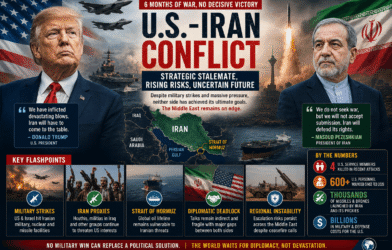
Rochester, NY: The transatlantic alliance that once appeared united on Iran is now showing visible fractures, particularly after the dramatic diplomatic and military developments of today.
While the United States under President Donald Trump intensified its hardline posture toward Tehran, several European powers increasingly signaled discomfort with Washington’s strategy, fearing that the region was being pushed toward a wider and uncontrollable conflict.
For years, the United States and Europe coordinated closely on Iran’s nuclear file through the framework of the Joint Comprehensive Plan of Action (JCPOA).
Even after Washington withdrew from the agreement during Trump’s first presidency, European states — especially France, Germany, and the United Kingdom — attempted to preserve diplomatic channels with Tehran.
However, the crisis deepened again in early 2026 when renewed military escalation, sanctions, and threats surrounding the Strait of Hormuz brought the Middle East dangerously close to regional war.
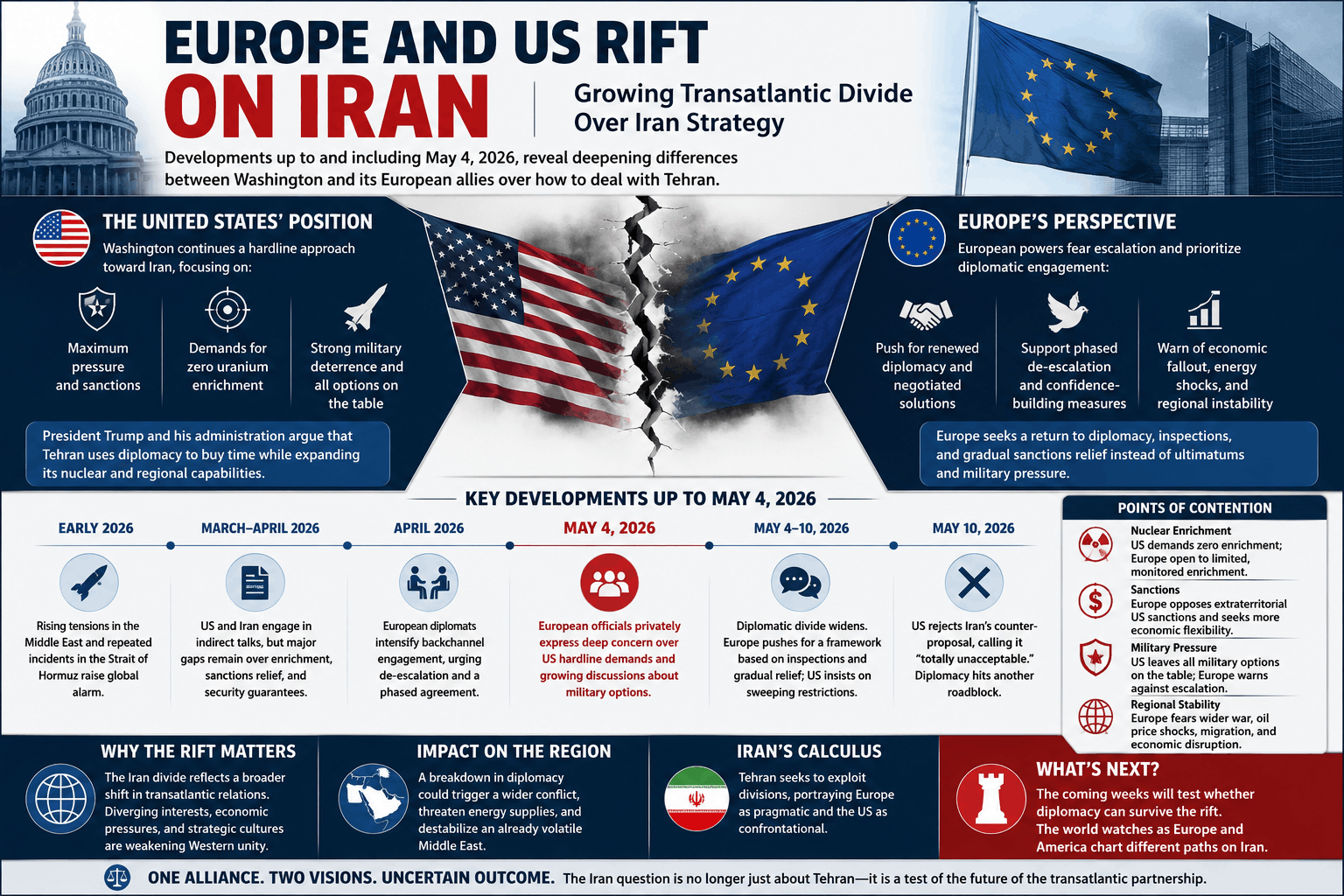
The events surrounding May 4, 2026, became a defining moment in exposing the widening divide between Washington and Europe.
Reports emerging during that week indicated that European diplomats had privately expressed concern over the United States’ uncompromising demands toward Iran, particularly the insistence on a long-term halt to uranium enrichment and broader military pressure.
European officials feared that Washington’s “maximum pressure” strategy was rapidly eliminating any remaining space for diplomacy.
At the same time, several European capitals were alarmed by growing discussions within American political circles about further military options against Iranian infrastructure and naval assets in the Gulf.
The diplomatic disagreements were not merely rhetorical. European governments increasingly viewed the American approach as strategically risky and economically damaging.
Europe remains heavily exposed to Middle Eastern instability through energy markets, maritime trade, migration pressures, and security concerns.
The renewed tensions in the Strait of Hormuz triggered sharp anxieties across European economies already struggling with inflation and energy vulnerabilities following years of geopolitical crises.
European leaders feared that another prolonged conflict involving Iran could severely disrupt global oil supplies and intensify economic uncertainty across the continent.
On May 4 and the days immediately surrounding it, diplomatic activity intensified behind closed doors. European negotiators reportedly pushed for a phased de-escalation mechanism with Tehran, emphasizing inspections, confidence-building measures, and gradual sanctions relief rather than sweeping ultimatums.
Washington, however, maintained that Iran’s nuclear and regional activities required a tougher response. American officials argued that Tehran had repeatedly used diplomacy to buy time while expanding its strategic capabilities.
This fundamental disagreement revealed two very different strategic cultures: the American preference for coercive leverage versus the European preference for negotiated containment.
The rift also became visible in military and security discussions within NATO circles. Several European officials quietly resisted any attempt to transform the Iran confrontation into a broader NATO security mission.
European policymakers worried that the United States was increasingly expecting its allies to politically endorse strategies they neither designed nor fully supported.
Reports and political commentary from early May suggested that some European governments believed Washington’s Iran policy was becoming increasingly unilateral, with limited consultation despite the enormous consequences for allied nations.
Adding to the complexity was the role of sanctions. European businesses have long opposed extraterritorial American sanctions on Iran, arguing that Washington effectively dictates global commercial behavior through the dominance of the U.S. financial system.
The debate resurfaced strongly in 2026 as discussions emerged in Europe about reviving mechanisms designed to shield European companies from American sanctions pressure. European policymakers increasingly questioned whether strategic autonomy from Washington was becoming a necessity rather than merely a political slogan.
Meanwhile, Tehran carefully attempted to exploit these divisions. Iranian officials repeatedly emphasized that Europe and the United States no longer shared a unified vision regarding the Middle East.
Iranian diplomatic messaging portrayed Europe as more pragmatic and open to compromise, while presenting Washington as driven by ideological confrontation. Iranian hardliners also argued that the growing transatlantic divide demonstrated a weakening Western consensus against Tehran.
The developments after May 4 further intensified these tensions. Reports published on May 10 revealed that the United States had rejected Iran’s latest counter-proposal during ongoing negotiations, with President Trump calling Tehran’s response “totally unacceptable.”
Iran demanded sanctions relief, an end to military pressure, and guarantees regarding future attacks, while Washington insisted on sweeping nuclear restrictions and broader security concessions. European governments observed these exchanges with increasing concern, fearing that diplomacy was once again collapsing under maximalist positions on both sides.
At the heart of this dispute lies a deeper transformation in transatlantic relations. The Iran issue is no longer only about nuclear enrichment or sanctions; it has become a test case for Europe’s strategic independence from the United States.
European leaders increasingly recognize that Washington’s geopolitical priorities may not always align with Europe’s economic and security interests. Conversely, American policymakers increasingly view European caution as weakness and indecision in confronting adversarial states.
The emerging rift over Iran therefore reflects a broader geopolitical reality: the post-Cold War unity of the West is no longer absolute.
The disagreements surrounding Iran in May 2026 exposed how diverging strategic interests, economic pressures, and political calculations are reshaping relations between Europe and the United States.
While both sides still publicly emphasize alliance and cooperation, the cracks are becoming increasingly difficult to conceal.
For Iran, these divisions create diplomatic opportunities. For Europe, they present difficult strategic choices. For the United States, they raise questions about whether traditional alliances can still function under increasingly unilateral foreign policy approaches.
And for the wider Middle East, the consequences of this growing transatlantic divide could shape the future of regional stability for years to come.
For latest news updates and analysis keep visiting The Variant US website.