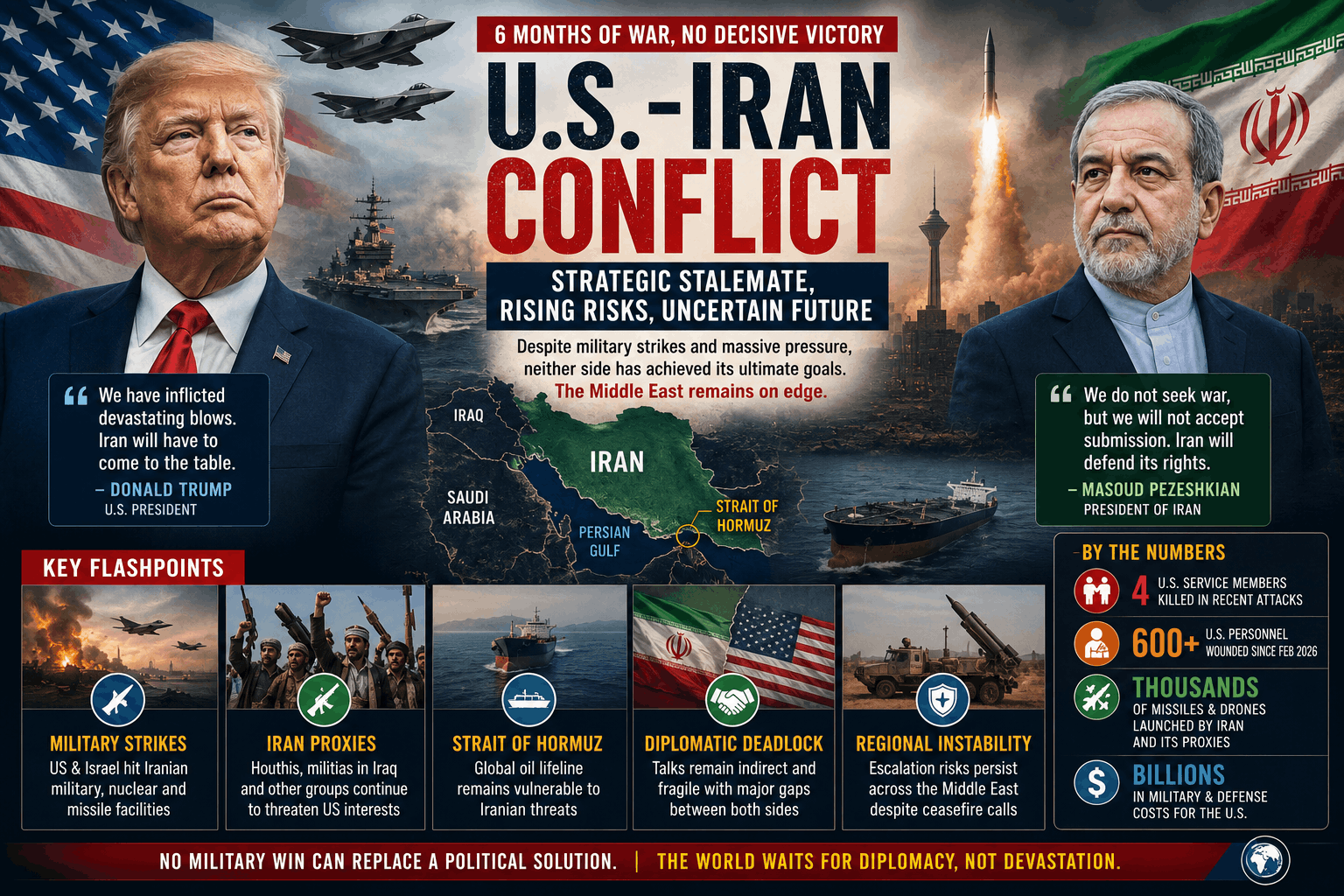
Rochester, NY: As the U.S.-Iran conflict enters its sixth month, President Donald Trump faces growing scrutiny over whether Washington’s overwhelming military superiority has translated into meaningful strategic success.
Although the United States and Israel have inflicted extensive damage on Iran’s military infrastructure, missile production facilities, naval assets and regional proxy networks, the war has yet to produce the decisive political outcome promised by the White House.
Iran’s leadership remains in power, its nuclear program remains unresolved, and Tehran continues to exert influence across the Middle East through its network of allied groups.
This distinction between tactical victories and strategic success has become the defining feature of the conflict.
The United States has demonstrated unmatched military capability, but its broader objectives—forcing Iran into accepting Washington’s demands, eliminating regional threats, and restoring long-term stability—remain elusive.
For critics of the Trump administration, this represents a strategic setback. For supporters, it reflects a deliberate strategy of sustained pressure designed to force Iran into eventual negotiations.
President Donald Trump has repeatedly defended his administration’s approach, arguing that Iran’s military capabilities have been significantly degraded and insisting that Tehran has only one realistic option: negotiate on American terms.
Through public remarks and Truth Social posts, Trump has maintained that maximum military and economic pressure will eventually compel Iran to abandon its regional ambitions and nuclear activities.
However, Iranian officials continue to reject claims that they are negotiating under American pressure.
Iran’s Strategy: Survive, Resist and Outlast
Unlike conventional wars where victory is measured by territorial gains, Iran’s strategy has focused on endurance.
Tehran understands it cannot defeat the United States militarily. Instead, its objective has been to survive sustained American and Israeli attacks while preserving enough military capability to maintain deterrence.
Iranian President Masoud Pezeshkian has consistently stated that Iran does not seek war but will defend its sovereignty against foreign aggression.
He has argued that military strikes cannot force Iran to surrender its national interests and has called for diplomacy based on mutual respect rather than coercion.
Foreign Minister Abbas Araqchi has similarly insisted that any negotiations must recognize Iran’s rights while rejecting demands presented under military pressure.
For Tehran, simply preventing Washington from achieving its declared objectives can be portrayed domestically as a strategic success.
Iranian leaders argue that despite months of airstrikes, sanctions and military operations, the country’s political system remains intact, its defense structure continues to function, and its regional alliances have not collapsed.
Trump’s Strategic Challenge
President Trump entered the conflict promising decisive action against Iran’s military infrastructure, nuclear ambitions and regional proxy network.
While American forces have achieved remarkable operational successes, the administration increasingly faces the challenge of converting battlefield achievements into lasting political gains.
Washington has repeatedly alternated between military escalation and diplomatic initiatives.
Trump has publicly described negotiations as Iran’s “last chance” while simultaneously warning of overwhelming military consequences if Tehran refuses to compromise.
Yet repeated announcements of possible diplomatic breakthroughs have often been followed by Iranian denials that formal negotiations are taking place.
This inconsistency has complicated the administration’s messaging. Every delay in achieving a political settlement raises questions about whether military pressure alone can force Iran to accept American demands.
The longer the conflict continues, the greater the financial and political burden becomes for Washington.
Sustained naval deployments, missile defense operations, protection of commercial shipping and continued military operations across the region require enormous financial resources while increasing risks to American personnel stationed throughout the Middle East.
Israel’s Perspective: Military Success but Continuing Threats
For Israel, the conflict is viewed differently.
Prime Minister Benjamin Netanyahu has argued that coordinated American and Israeli military operations have significantly weakened Iran’s ability to threaten Israel directly.
Israeli forces have targeted Iranian missile facilities, military commanders and logistics networks while also increasing pressure on Hezbollah and other Iranian-backed organizations.
From Jerusalem’s perspective, reducing Iran’s long-term military capabilities remains a strategic objective regardless of whether Tehran formally accepts an American diplomatic agreement.
Israeli officials believe every destroyed missile factory, drone facility and weapons shipment reduces future security risks.
However, Israeli security planners also recognize that Iran retains significant retaliatory capabilities.
Missile attack, drone operations and proxy activities continue to pose security challenges despite months of military operations. Consequently, Israel supports maintaining pressure on Tehran while remaining cautious about any agreement that could leave Iran with substantial military or nuclear capabilities.
Iran’s Regional Proxies Continue to Challenge U.S. Interests
One of Washington’s greatest strategic difficulties remains Iran’s network of regional partners.
Although American and Israeli operations have disrupted supply routes and damaged command structures, groups aligned with Tehran continue to threaten U.S. interests across the Middle East.
The Houthis in Yemen remain particularly significant.
Their ability to launch missiles and drones toward commercial shipping routes in the Red Sea and surrounding waters forces the United States to maintain an extensive naval presence to protect international maritime traffic.
Even limited attacks can disrupt global trade, increase insurance costs and threaten energy supplies without requiring direct confrontation between Iran and the United States.
Similarly, Iran-aligned militias operating in Iraq and Syria continue to pose risks to American military installations.
These groups allow Tehran to exert pressure indirectly while maintaining plausible deniability regarding specific attacks.
This asymmetric strategy enables Iran to impose costs on the United States without engaging in conventional warfare.
Washington must defend multiple fronts simultaneously, while Tehran only needs to create periodic instability to maintain strategic leverage.
The Strait of Hormuz Remains Central
The Strait of Hormuz continues to represent the most strategically important element of the conflict.
Approximately one-fifth of the world’s seaborne oil trade passes through this narrow waterway, making its security essential for global energy markets.
President Trump has repeatedly emphasized that freedom of navigation remains a core American objective and has stated that Iran will not be permitted to threaten international shipping. Tehran, however, continues to insist that regional security cannot be achieved solely through military force and argues that external powers bear responsibility for escalating tensions.
Every reported maritime incident reinforces the fragile security environment and demonstrates that despite months of military operations, the strategic competition over Gulf waterways remains unresolved.
Has Trump Suffered a Strategic Defeat?
Whether President Trump has experienced a strategic defeat depends largely on how success is defined.
From a military perspective, the United States has unquestionably demonstrated overwhelming superiority.
Iranian military infrastructure has suffered extensive damage, its economy has experienced additional pressure, and several regional supply networks have been disrupted.
However, strategic success requires translating military achievements into political outcomes. Iran has not accepted Washington’s principal demands regarding its nuclear activities.
Its government remains intact, regional influence persists, and proxy organizations continue operating despite sustained pressure.
Consequently, critics argue that military victories alone cannot justify the enormous financial, diplomatic and military costs associated with a prolonged conflict.
They contend that unless Washington secures an enforceable political agreement addressing Iran’s nuclear ambitions, regional proxy activities and maritime security, the campaign risks becoming another prolonged Middle Eastern conflict without a decisive conclusion.
Supporters of the administration reject this characterization, arguing that Iran’s weakened military position demonstrates the effectiveness of Trump’s maximum-pressure strategy.
They maintain that continued military and economic pressure will eventually produce favorable negotiations.
The Road Ahead
The coming months will likely determine whether the conflict ends through diplomacy or further military escalation.
Regional actors, including Oman, Qatar and Saudi Arabia, continue supporting mediation efforts aimed at reducing tensions and restoring maritime stability.
Meanwhile, Israel appears prepared to continue military operations against Iranian military infrastructure should Tehran attempt to rebuild its capabilities.
Iran, for its part, is expected to continue combining diplomatic engagement with asymmetric military pressure through its regional partners.
The Houthis, Iraqi militias and other Iranian-aligned organizations remain capable of creating periodic security crises that complicate American military planning and regional stability.
For President Trump, the challenge is increasingly political as well as military.
A negotiated settlement that restricts Iran’s nuclear program, protects international shipping and reduces regional proxy activity could allow the administration to claim strategic success.
Failure to achieve these objectives after months of fighting, however, would strengthen arguments that American military superiority has not produced the decisive political victory initially envisioned.
Conclusion
After nearly six months of conflict, the United States has won many battles but has yet to secure an uncontested strategic victory.
American and Israeli forces have inflicted significant damage on Iran’s military capabilities, yet Tehran continues to resist Washington’s political objectives while maintaining influence through regional partners.
The conflict illustrates a central reality of modern warfare: overwhelming military power does not automatically guarantee political success.
Iran’s strategy has focused on endurance rather than battlefield victory, while the United States seeks to convert military pressure into lasting diplomatic concessions.
Whether history ultimately judges President Trump’s Iran campaign as a strategic success or a strategic failure will depend not on the number of targets destroyed, but on whether Washington can transform military achievements into a stable regional order.
Until such a political settlement emerges, the war is likely to remain defined by tactical victories, strategic uncertainty and an increasingly complex balance between military force and diplomacy.
Keep following The Variant as we continue to monitor developments and provide informed perspectives on this evolving situation.