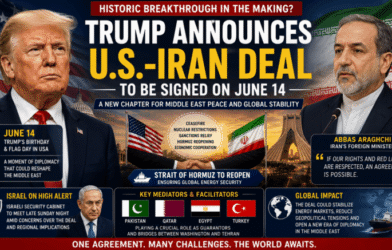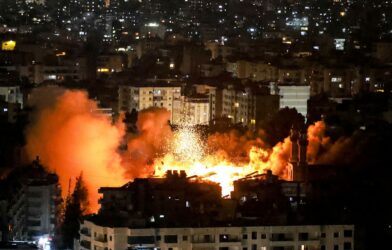
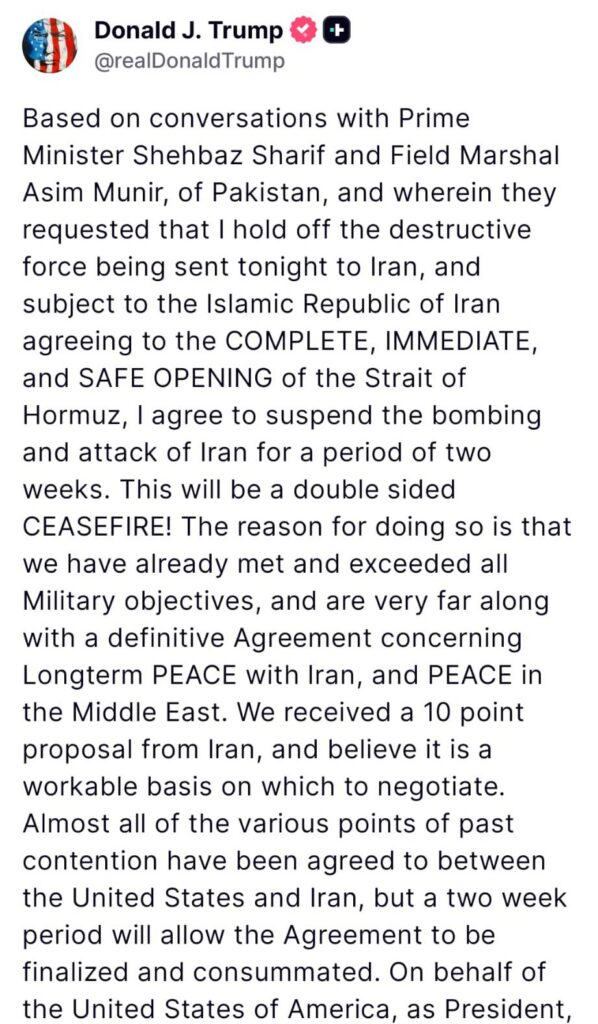
Rochester, NY: On April 7, 2026, U.S. President Donald Trump said on his platform that he had agreed to a two-week truce with Iran. This stopped planned bombing missions and heavy fighting for 14 days.
He noted that this deal depended on Iran immediately and completely reopening the Strait of Hormuz, which is a major shipping route for oil and commerce.
The deal was based on a proposal that came via Pakistani mediation efforts. Trump said the decision was required to conclude a larger peace deal and called the arrangement “double-sided.” He stressed that many of the most difficult problems between Washington and Tehran had been dealt with sufficiently to merit a diplomatic pause.
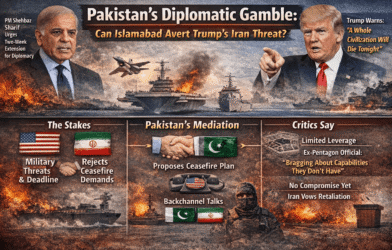
Trump’s own article on Truth Social made it clear that this choice was based on diplomacy rather than further violence. He shared a letter from Pakistan’s Prime Minister Shehbaz Sharif that spoke about Pakistan’s promise to assist the US and Iran speaks about peace and stop fighting for a short time.
This cross-posting on Truth Social, which boosted both presidents’ messages, showed that two leaders whose nations have not historically been recognized as co-mediators in Middle East disputes were surprisingly on the same page about de-escalation.
Trump successfully promoted Sharif’s appeal for diplomatic discussions on social media and emphasized Pakistan’s offering as the main part of the ceasefire framework. Sharif’s initial message called for a temporary halt to hostilities and suggested Islamabad as a place for discussions. Trump used this as part of his argument for extending the truce.
This was not simply talk for Prime Minister Shehbaz Sharif; it was part of a larger diplomatic trend. In the last year, Sharif has worked to make Pakistan a mediator in the area, talking to international leaders in the Middle East and beyond to push for diplomatic solutions and an end to the escalating violence that started in late February 2026.
His government’s call for a two-week break before Trump’s military deadline was part of a larger framework called the Islamabad Accord. This was a ceasefire proposal made in early April that called for an immediate end to fighting and negotiations over 15 to 20 days, with the goal of reopening the Strait of Hormuz.
Leaders throughout the world reacted with a combination of cautious hope and careful planning. Iran’s authorities, notably Foreign Minister Abbas Araghchi, said they were prepared to work within the ceasefire’s limits and agreed to coordinate on reopening the Strait of Hormuz.
However, Tehran’s words did not fully support all of the U.S. criteria. Israel also decided to stop military operations for the time being, which shows that other countries in the area are also on board with a halt, even if there is still a lot of distrust on both sides.
Outside of the battlefield, global markets responded quickly. U.S. stock futures rose and oil prices fell, showing that investors were relieved that geopolitical risk had gone down and that the flow through Hormuz may start up again.
This economic aspect shows how closely linked security issues in the Middle East are to global energy markets and financial stability.
The important thing to remember here is that Pakistan became a diplomatic middleman at a time of great tension. Islamabad’s offer and Sharif’s active diplomacy gave Trump a politically acceptable way to put off military action while claiming progress toward peace.
This was a key story for both domestic and foreign audiences who were worried about a wider regional conflict. Trump’s amplification of Sharif’s message on Truth Social was not only a strategy, but also a symbol of a group of people asking for diplomacy instead of military action on its own.
In short, the ceasefire deal is a tentative but important step toward peace between the U.S. and Iran, thanks to Pakistan’s mediation, Trump’s conditional diplomacy, and a group of countries that want to end the conflict.
The next two weeks will be very important. Whether the peace process lasts longer or falls apart into violence will depend on whether all sides meet the requirements, notably the reopening of the Strait of Hormuz and real vows to negotiate.