


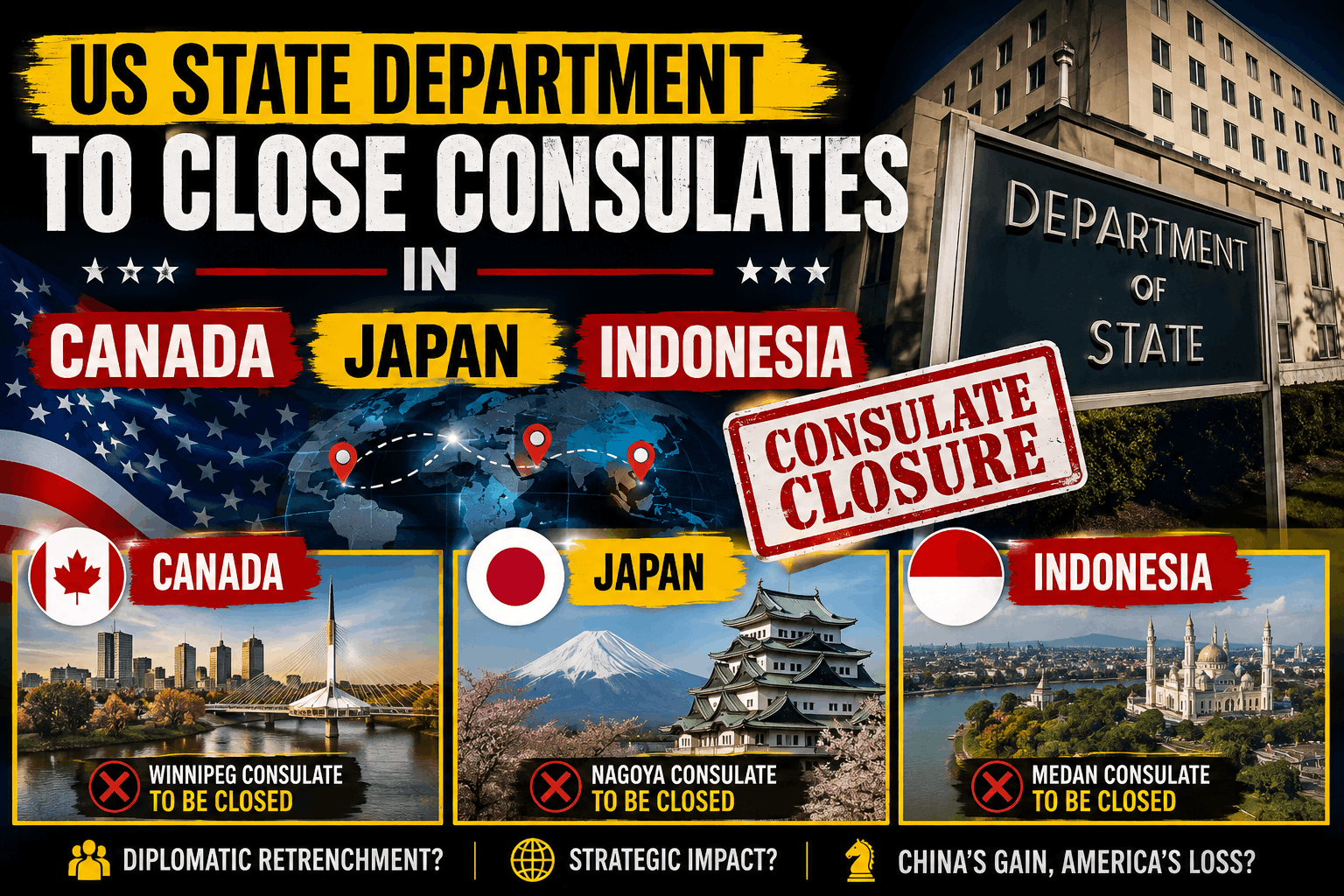
Rochester, NY: The U.S. State Department’s reported decision to close several diplomatic missions—including the consulates in Winnipeg (Canada), Nagoya (Japan), and Medan (Indonesia)—marks one of the most significant reductions in America’s diplomatic footprint in recent years.
According to officials familiar with congressional notifications, the plan also includes closing diplomatic posts in Grenada and Cameroon as part of a broader restructuring of the U.S. Foreign Service under the Trump administration.
Although the administration frames the move as an effort to improve efficiency and reduce costs, the decision raises broader questions about whether Washington is sacrificing long-term strategic influence in pursuit of short-term budget savings.
Since returning to office, President Donald Trump’s administration has continued its emphasis on the “America First” doctrine, seeking to reduce federal spending while reshaping government institutions.
Secretary of State Marco Rubio has defended efforts to streamline the State Department, arguing that U.S. diplomatic resources should be concentrated where they produce the greatest strategic value.
The department has not publicly confirmed every reported closure but has stated that it is focused on maintaining an “efficient and effective” diplomatic network while following congressional notification procedures.
From Washington’s perspective, maintaining diplomatic facilities in locations with relatively limited consular demand or overlapping regional coverage may no longer be financially justifiable.
Advances in digital consular services and the ability of nearby embassies or consulates to absorb responsibilities have strengthened the administration’s argument that physical presence is no longer essential everywhere.
However, diplomacy is measured not only by efficiency but also by presence, relationships, and influence—factors that are difficult to quantify in a budget review.
Why Canada, Japan and Indonesia Matter
The reported closure of the U.S. Consulate in Winnipeg is symbolically significant despite the exceptionally close relationship between the United States and Canada.
Winnipeg serves as an important gateway to central Canada and maintains close economic, agricultural, energy and security ties with neighboring U.S. states.
While other U.S. diplomatic missions remain across Canada, reducing America’s physical presence could be interpreted as a diminished commitment to regional engagement.
The proposed closure of the Nagoya Consulate may have even broader economic implications.
Nagoya lies at the heart of Japan’s manufacturing sector, hosting major automotive, aerospace and advanced technology industries with deep commercial links to American companies.
The region has long served as a hub for U.S.-Japan industrial cooperation.
Although the U.S. Embassy in Tokyo and other consulates would continue operating, reducing America’s representation in one of Japan’s most important industrial centers may limit commercial diplomacy and local engagement.
In Indonesia, the planned closure of the Medan Consulate comes at a time when Southeast Asia has become a central arena of strategic competition between the United States and China.
Medan provides access to northern Sumatra, an area located near the Strait of Malacca—one of the world’s busiest maritime trade routes.
As Washington seeks stronger partnerships throughout the Indo-Pacific, reducing its diplomatic footprint in Indonesia appears difficult to reconcile with broader strategic objectives.
The China Factor
Perhaps the greatest criticism of the proposed closures is their potential geopolitical impact.
China has steadily expanded its diplomatic presence through new embassies, consulates, infrastructure financing and development partnerships under the Belt and Road Initiative.
Beijing increasingly views diplomacy as an instrument of strategic competition, particularly across Southeast Asia, Africa and the Pacific.
Former diplomats and national security analysts have argued that every American diplomatic withdrawal creates opportunities for China—and, in some regions, Russia—to strengthen political influence, economic partnerships and security cooperation.
They contend that diplomatic missions provide far more than visa services; they collect political and economic information, support American businesses, build relationships with local governments and advance U.S. strategic interests.
This concern is especially relevant in Indonesia, where Chinese investment has expanded significantly over the past decade.
Financial Savings VS Strategic Costs
The Trump administration has consistently argued that government agencies must operate more efficiently, and the State Department has not been exempt from that philosophy.
Closing overseas missions undoubtedly reduces operating expenses, personnel costs and infrastructure maintenance.
These savings align with broader efforts to shrink the federal bureaucracy and redirect resources toward higher-priority missions.
Yet diplomacy is often one of the least expensive instruments of national power compared with military deployments.
A relatively modest investment in diplomatic engagement can prevent misunderstandings, facilitate trade, support intelligence cooperation and reduce the need for more costly interventions later.
Many foreign policy experts therefore question whether the financial savings justify the potential loss of American influence.
Impact on U.S. Citizens and Businesses
For American citizens living or traveling in the affected regions, the closures could increase travel times and administrative burdens for passport renewals, emergency assistance and other consular services.
American companies operating in manufacturing centers such as Nagoya or commercial hubs near Medan may also experience reduced access to diplomatic support.
While many services can be transferred to neighboring missions, physical proximity often remains important during emergencies, commercial disputes and investment promotion.
The State Department has increasingly relied on regional service models in recent years, reflecting a broader trend toward consolidating operations.
What This Signals About U.S. Foreign Policy
Beyond the individual closures, the decision reflects a broader evolution in American foreign policy.
Rather than maintaining an expansive global diplomatic network built after World War II, the Trump administration appears to favor a more selective model focused on strategic priorities, measurable outcomes and fiscal discipline.
Supporters argue this represents a realistic adaptation to modern technology and changing geopolitical realities.
The critics counter that diplomacy cannot be measured solely by immediate financial returns.
Consulates often spend decades cultivating political relationships, facilitating trade and projecting American influence—benefits that may disappear quietly once a mission closes.
Outlook
Congress still has an opportunity to review the proposed closures before implementation, and details could change during that process.
If the closures proceed, they will represent one of the most visible examples of the Trump administration’s effort to reshape American diplomacy under the “America First” agenda.
Whether this restructuring ultimately produces a leaner, more effective diplomatic service—or instead weakens U.S. influence at a time of intensifying global competition—will depend on whether
Washington can maintain its strategic presence through fewer but more capable diplomatic missions.
In an increasingly competitive international environment, where diplomacy complements military power and economic statecraft, the reduction of America’s overseas presence may prove to be a cost-saving measure today whose strategic consequences become fully apparent only years from now.
Follow our latest coverage for deeper insights into the policies, trends, and developments influencing today’s world.


