


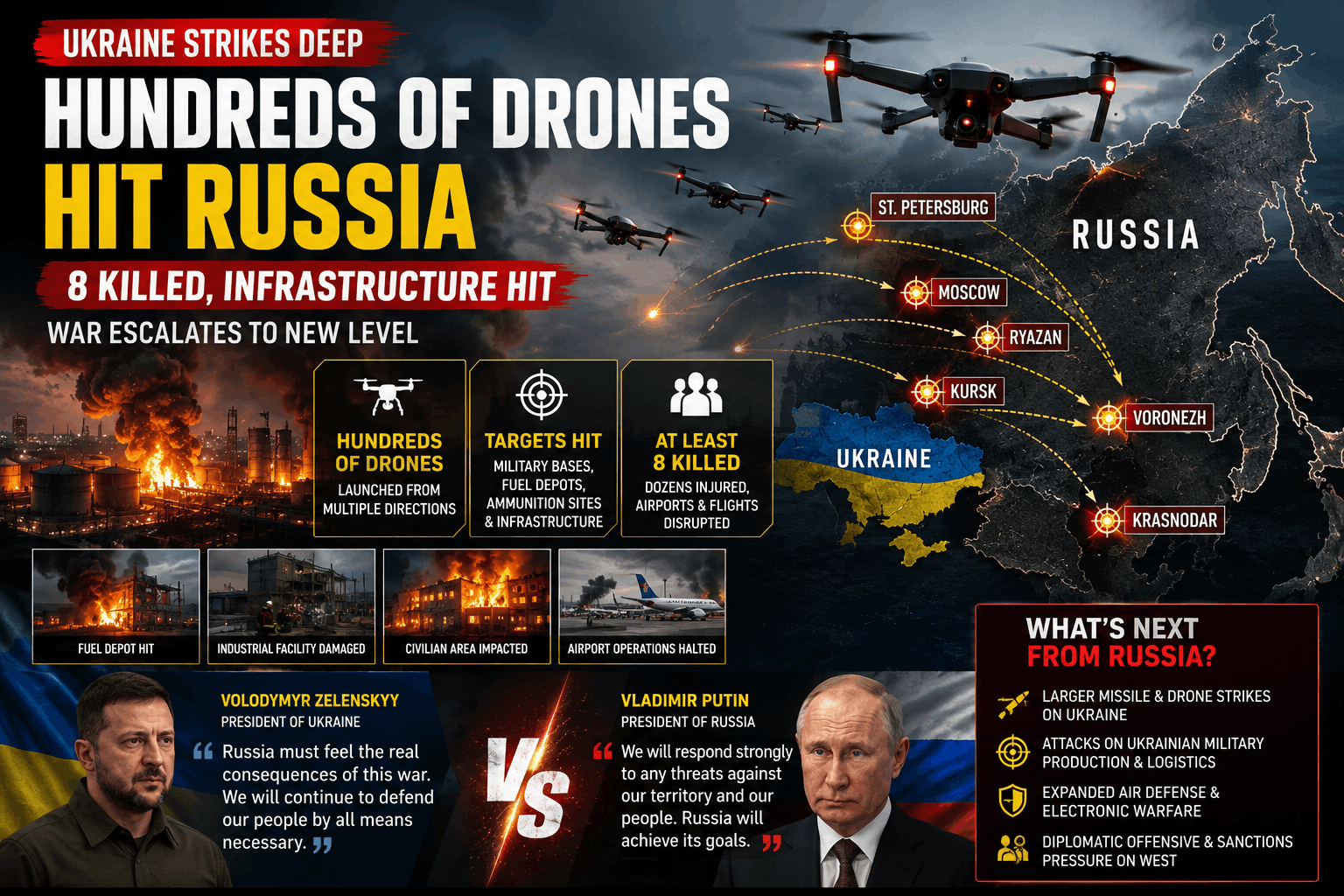
Kyiv, UA/Moscow, RU/Rochester, NY: The war between Ukraine and Russia has entered another dangerous phase following one of Kyiv’s largest coordinated drone offensives against Russian territory.
Russian authorities said Ukraine launched hundreds of drones targeting multiple regions across the country, including areas surrounding Moscow, military facilities, logistics hubs, fuel infrastructure, and occupied Crimea.
Russian officials reported that at least eight people were killed in the attacks, while air defense systems intercepted hundreds of incoming drones across numerous regions.
Independent verification of every Russian casualty claim remains difficult because of wartime restrictions on information from both sides.
The scale of the operation demonstrates how dramatically the character of the war has evolved since Russia’s full-scale invasion in 2022.
What began as a conventional ground conflict increasingly resembles a technologically driven war of long-range precision strikes, with unmanned aerial systems becoming one of the most decisive weapons available to both militaries.
Ukraine has steadily expanded its domestic drone production over the past two years, allowing it to project force hundreds of kilometers beyond the front lines.
These operations are designed not only to inflict physical damage but also to force Russia to disperse air defense assets, disrupt military logistics, and increase the economic cost of continuing the war.
Zelenskyy: Russia Must Feel the Consequences of the War
Ukrainian President Volodymyr Zelenskyy has consistently argued that Russia should no longer remain insulated from the consequences of the conflict.
Following recent Russian missile and drone attacks on Ukrainian cities, Zelenskyy emphasized that Ukraine would continue developing long-range strike capabilities and deepen cooperation with international partners on drone production and advanced defense technologies.
He has also repeatedly called for stronger sanctions on Moscow while urging allies to accelerate deliveries of advanced air-defense systems, particularly Patriot batteries, which Kyiv considers essential against Russian ballistic missiles.
For Kyiv, expanding drone operations serves multiple strategic objectives. Militarily, they force Russia to devote significant resources to homeland defense instead of frontline operations.
Economically, strikes on oil depots, industrial facilities, logistics centers, and transportation infrastructure raise operational costs.
Politically, attacks deep inside Russia challenge the Kremlin’s narrative that the conflict remains geographically distant from everyday Russian life.
Ukraine’s leadership increasingly presents these operations as a form of strategic deterrence rather than symbolic retaliation.
Putin Maintains Pressure While Expanding Air Campaign
Russian President Vladimir Putin has shown little indication that Moscow intends to reduce military pressure.
The Kremlin continues to argue that its military objectives remain unchanged and has consistently portrayed Ukrainian long-range attacks as terrorist acts against Russian civilians while promising firm retaliation.
Rather than scaling back operations, Russia has intensified the frequency of combined missile and drone assaults against Ukrainian cities, energy infrastructure, military installations, and logistics networks.
Recent Russian attacks have involved hundreds of drones alongside cruise and ballistic missiles, illustrating Moscow’s growing reliance on mass saturation tactics designed to overwhelm Ukrainian air defenses.
Russian military planners appear convinced that sustained pressure on Ukraine’s infrastructure can gradually weaken Kyiv’s economy, strain civilian morale, and complicate military logistics as the conflict becomes increasingly one of endurance.
Drone Warfare Is Reshaping Modern Conflict
The latest attacks underline how inexpensive unmanned systems have transformed military strategy.
Traditional concepts of strategic depth have become increasingly obsolete.
Facilities once considered safely beyond the battlefield—including oil refineries, aircraft bases, industrial plants, command centers and transportation hubs—are now within reach of relatively low-cost drones.
Ukraine has demonstrated remarkable innovation in long-range unmanned systems despite facing significant constraints in conventional firepower.
Russia, meanwhile, has expanded domestic drone production while continuing extensive use of Iranian-designed Shahed-type systems alongside indigenous platforms.
Both sides are now competing not only over territory but also over industrial capacity, technological adaptation, electronic warfare capabilities, and air-defense sustainability.
The conflict has become one of the world’s largest testing grounds for next-generation drone warfare.
Can Russia Sustain Its Air Defense Shield?
Although the Russian Defense Ministry regularly reports intercepting the vast majority of incoming drones, the sheer volume of Ukrainian attacks presents an increasingly complex challenge.
Protecting an enormous national territory requires thousands of air-defense personnel, radar systems, interceptor missiles, electronic warfare units, and continuous surveillance. Every successful interception consumes expensive resources against comparatively inexpensive unmanned aircraft.
Military analysts note that Ukraine’s strategy does not necessarily depend on every drone reaching its intended target.
Even forcing Russia to activate extensive air-defense networks, suspend flights, interrupt industrial production, or temporarily close critical infrastructure imposes strategic costs over time.
The expanding geographic reach of Ukrainian strikes also increases pressure on Russian regional authorities responsible for civilian protection.
What Could Russia Do Next?
The Kremlin is unlikely to respond with restraint. Instead, several potential courses of action appear increasingly plausible.
Russia may intensify large-scale missile and drone barrages against Ukrainian urban centers, military headquarters, and energy infrastructure in an effort to reassert deterrence.
Moscow could also increase attacks against Ukraine’s expanding drone manufacturing facilities, launch sites, command-and-control centers, and logistics networks supplying long-range strike systems.
Another likely response involves expanded electronic warfare operations intended to disrupt Ukrainian navigation and communications systems while increasing investment in layered air defenses around strategically important regions.
Diplomatically, Russia will continue seeking international support for its position that Ukrainian strikes on Russian territory constitute attacks on civilians, while portraying Western military assistance as enabling those operations.
At the same time, Moscow may accelerate production of missiles, drones, and precision-guided munitions as both sides enter what increasingly resembles an industrial war of attrition.
International Implications
The latest escalation arrives amid continued Western military support for Ukraine and growing concern over the long-term sustainability of military assistance.
European governments remain committed to strengthening Ukraine’s air-defense capabilities, while discussions continue regarding additional sanctions targeting Russia’s defense and energy sectors. The United States and NATO allies continue balancing support for Kyiv with efforts to prevent direct military confrontation between Russia and NATO members.
Each successful Ukrainian strike inside Russia is likely to renew debates among Western governments regarding the appropriate scope of military assistance and the acceptable use of supplied technology.
Strategic Outlook
The latest drone offensive demonstrates that neither Kyiv nor Moscow currently appears prepared for meaningful de-escalation.
Ukraine seeks to raise the domestic and economic costs of Russia’s invasion by extending the battlefield deep into Russian territory, while Russia continues relying on overwhelming missile and drone campaigns to erode Ukraine’s military and civilian resilience.
Rather than marking a turning point toward negotiations, the recent escalation suggests that both governments believe additional military pressure can improve their bargaining positions before any future diplomatic process begins.
As drone technology becomes more sophisticated, production expands, and air-defense systems face mounting pressure, the conflict is entering an even more unpredictable phase.
The coming weeks are likely to witness further cycles of large-scale retaliation, making the prospect of a negotiated settlement increasingly distant while reinforcing the reality that modern warfare is now being shaped as much by autonomous systems and industrial capacity as by conventional armies.
Stay engaged with the issues shaping our future through comprehensive reporting and informed commentary from The Variant.


