


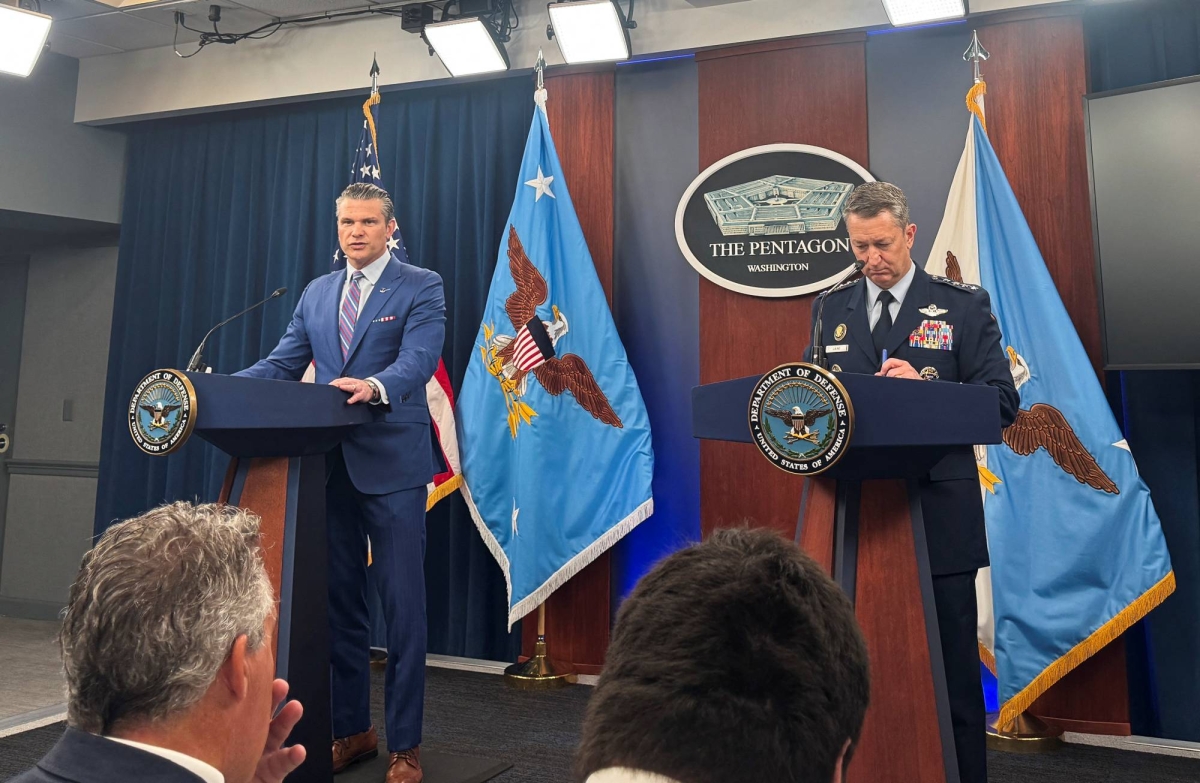
WASHINGTON, D.C. — Striking Iran was “a calculated and necessary action to defend American interests and neutralize imminent threats,” U.S. Secretary of Defense Pete Hegseth declared early Monday during a high-stakes press conference at the Pentagon.
Standing beside Gen. Dan Caine, Chairman of the Joint Chiefs of Staff, Hegseth delivered a detailed account of the weekend’s coordinated military campaign against Iranian targets, describing it as one of the most complex joint operations in recent U.S. military history.
The operation, conducted in close coordination with Israel, targeted Iranian missile production facilities, naval assets in the Persian Gulf, radar installations, and command-and-control infrastructure. Hegseth emphasized the campaign was focused on degrading Iran’s military capabilities rather than pursuing regime change.
“We struck with precision, with purpose, and with resolve,” Hegseth told reporters. “Our objective was clear: dismantle the missile networks, disrupt operational command structures, and ensure Iran cannot threaten U.S. forces, our allies, or international shipping lanes.”
According to Gen. Caine, U.S. forces deployed long-range bombers, carrier-based aircraft, and naval assets in what he described as a “multi-domain synchronized assault.” The first wave of strikes reportedly hit missile production complexes and air defense batteries. A second wave targeted naval vessels and logistics hubs believed to be supporting Iranian drone operations.
Caine confirmed that more than 120 precision-guided munitions were deployed within the first 36 hours of operations. U.S. naval forces in the Gulf launched cruise missiles targeting coastal radar sites, while fighter aircraft conducted suppression-of-enemy-air-defense missions to establish air superiority.
“We achieved immediate air dominance in the operational theater,” Caine stated. “Iranian air defenses were neutralized within hours, significantly limiting their ability to respond effectively.”
Pentagon officials indicated that key infrastructure supporting ballistic missile manufacturing was “substantially degraded,” though no definitive damage assessment percentages were released pending intelligence verification.
Within hours of the strikes, Iran launched retaliatory drone and missile barrages across Gulf airspace. Regional air defense systems were activated in Kuwait, Bahrain, Qatar, and the United Arab Emirates.
The most alarming development occurred over Kuwait, where a tragic friendly-fire incident unfolded amid the chaos of incoming threats. Kuwaiti air defense batteries, engaged in intercepting Iranian drones, mistakenly targeted three U.S. F-15E Strike Eagle jets operating in support of coalition forces.
Gen. Caine confirmed that all six American aircrew members successfully ejected and were recovered with minor injuries. “It was a misidentification under extreme combat pressure,” he said, noting that a joint U.S.-Kuwaiti investigation is underway. Kuwaiti officials reportedly expressed immediate regret and pledged full cooperation.
Defense analysts described the incident as a stark reminder of the “fog of war” in complex, multi-layered airspace engagements.
When pressed on casualty figures, Hegseth declined to provide exact numbers but acknowledged that both U.S. and allied forces had sustained losses in previous exchanges leading up to the main operation. Iranian state media has claimed civilian casualties, though U.S. officials say they have seen no verified evidence of large-scale civilian harm resulting directly from American strikes.
Pentagon sources estimate Iranian military infrastructure losses in the billions of dollars, particularly in missile production capabilities and naval equipment. However, officials stressed that comprehensive satellite and intelligence analysis remains ongoing.
The strikes immediately ignited debate across Capitol Hill. Supporters described the action as long overdue and necessary to deter Iranian aggression. Critics questioned whether congressional authorization was sufficiently consulted prior to launching the operation.
President Donald Trump, speaking separately at the White House, called the mission “a decisive blow against terror infrastructure,” while reiterating that the United States “does not seek endless war.”
Military experts warn the operation could reshape power dynamics in the Middle East. With U.S. forces on high alert and Iranian retaliation still unfolding, the risk of further escalation remains significant.
Gen. Caine emphasized readiness. “Our forces remain postured to respond to any additional aggression. We will defend ourselves and our partners without hesitation.”
Hegseth closed the briefing with a resolute message: “We did not choose this confrontation lightly. But when American lives and global stability are at stake, we will act.”
As the conflict enters a volatile phase, the Pentagon’s early Monday briefing has set the tone for what could become a defining military engagement of the decade. The world now watches closely to see whether the strikes will deter further escalation — or ignites a broader regional war.
Explore related stories, expert opinions, and exclusive insights to better understand the broader implications of today’s headlines.







