


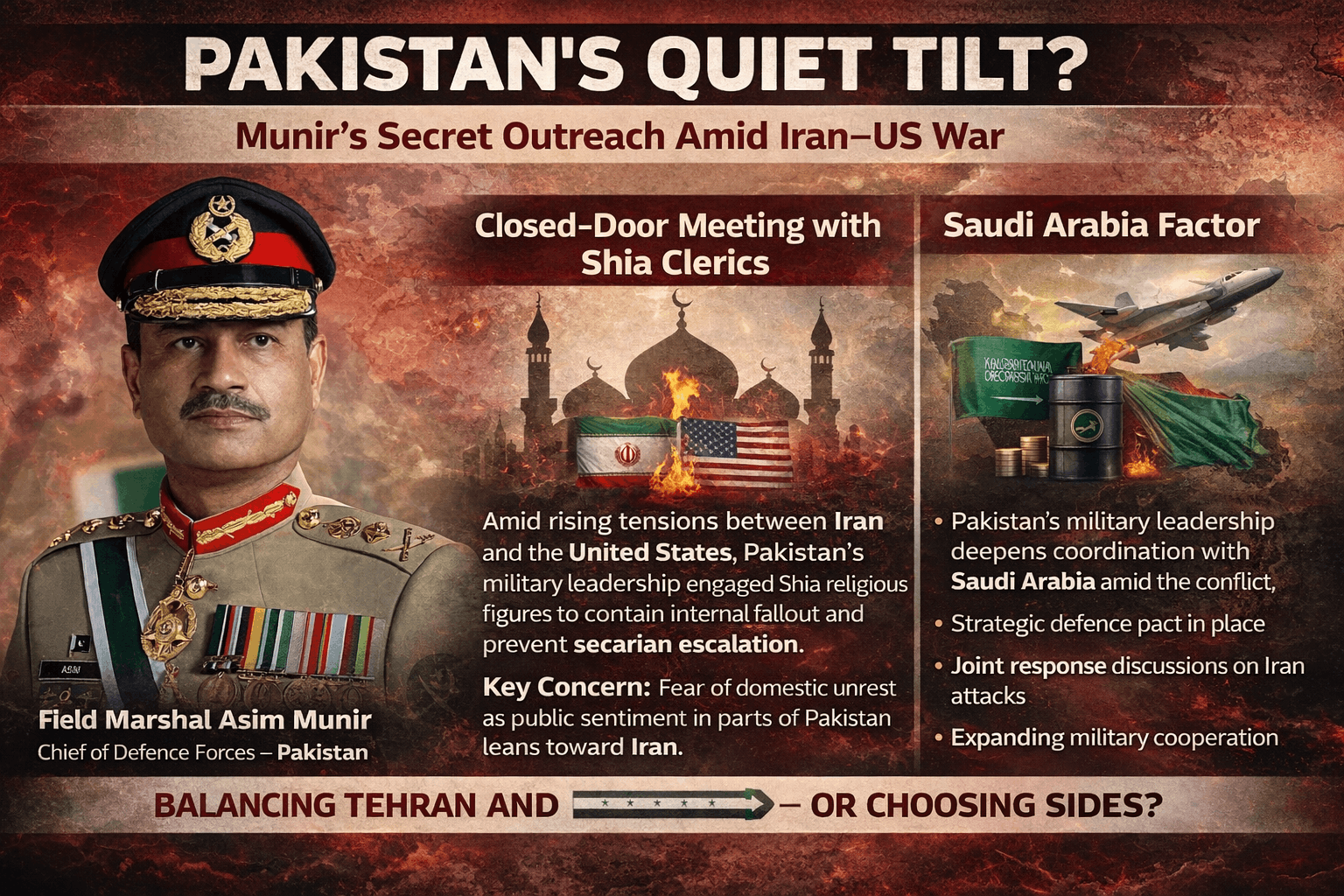
Rochester, NY: In the shadow of the escalating confrontation between Iran and the United States, Pakistan’s military leadership convened a highly sensitive and politically charged meeting that is already sending ripples through Islamabad’s strategic circles.
At the center of this quiet but consequential engagement was Asim Munir, Pakistan’s Chief of Army Staff, who met with prominent Shia clerics in what insiders describe as an attempt to manage a growing sectarian and geopolitical dilemma.
The meeting, held away from media glare, was not merely a routine consultation. It reflected the military’s mounting concern that the Iran–US conflict could ignite internal fault lines within Pakistan, where sectarian sensitivities are deeply intertwined with foreign policy alignments.
According to sources familiar with the discussions, the tone of the engagement was cautious, even tense, as clerical representatives raised fears about Pakistan being perceived as complicit in any anti-Iranian alignment.
Balancing Sectarian Optics and Strategic Commitments
Pakistan’s military leadership has long attempted to maintain a delicate equilibrium between its domestic sectarian composition and its external alliances. However, the current crisis is testing that balance more than ever.
The outreach to Shia clerics appears to be a preemptive move to contain potential unrest, particularly as images and narratives from Iran resonate strongly among Pakistan’s Shia population.
Clerics reportedly pressed the military leadership to adopt a neutral stance in the Iran–US conflict, warning that any visible tilt could trigger unrest at home. In response, General Munir is believed to have reassured participants that Pakistan would not allow its territory to be used against Iran. Yet, behind these assurances lies a more complex strategic reality that cannot be easily masked.
The Saudi Factor: Strategic Dependency or Quiet Alignment?
Despite public messaging of neutrality, Pakistan’s military establishment remains deeply entangled with Saudi Arabia. This relationship, historically rooted in defense cooperation and financial support, is now under renewed scrutiny. Pakistan’s economic vulnerabilities have reinforced its reliance on Gulf allies, and Saudi Arabia, in particular, continues to hold significant leverage.
Recent financial arrangements underscore this dependency. Islamabad reportedly owes nearly $2 billion to Riyadh, a liability that carries not just economic implications but strategic expectations.
Within defense circles, there is growing speculation that Saudi Arabia is seeking tangible returns on its support—particularly in the form of military hardware cooperation.
One of the most sensitive aspects of this evolving dynamic is the reported Saudi interest in Pakistan’s JF-17 Thunder fighter jets. Developed jointly with China, the JF-17 represents a cornerstone of Pakistan’s indigenous defense production.
Discussions about potential exports to Saudi Arabia are being interpreted by analysts as more than a commercial transaction; they signal a deeper strategic alignment that could position Pakistan closer to the Saudi camp in the broader regional contest.
Quiet Signals, Loud Implications
The timing of these developments is critical. As the Iran–US confrontation intensifies, regional actors are being compelled to clarify their positions, whether overtly or through subtle policy shifts.
Pakistan’s engagement with Shia clerics suggests an awareness of the domestic risks, but its parallel defense and financial interactions with Saudi Arabia point toward an external alignment that may be harder to conceal.
This dual-track approach—managing internal sensitivities while accommodating external pressures—reflects the military’s attempt to navigate an increasingly polarized environment. However, such a strategy carries inherent risks. Any perception of duplicity could erode trust both domestically and regionally, particularly with Iran, which closely monitors Pakistan’s actions.
A Precarious Path Forward
For General Munir and Pakistan’s military leadership, the challenge is not merely diplomatic but existential in terms of internal cohesion.
The Iran–US conflict has transformed from a distant geopolitical contest into an immediate strategic test for Islamabad. The meeting with Shia clerics, while significant, may only be the first step in a series of efforts to prevent domestic spillover.
Yet, the broader question remains unresolved: can Pakistan genuinely maintain neutrality while its economic and military dependencies pull it toward Saudi Arabia? The answer will likely define not only Pakistan’s role in the current crisis but also its long-term position in a rapidly shifting Middle Eastern order.
As the region edges closer to a wider confrontation, Pakistan finds itself walking a narrow and increasingly fragile tightrope—one where every move is scrutinized, and every silence speaks volumes.







