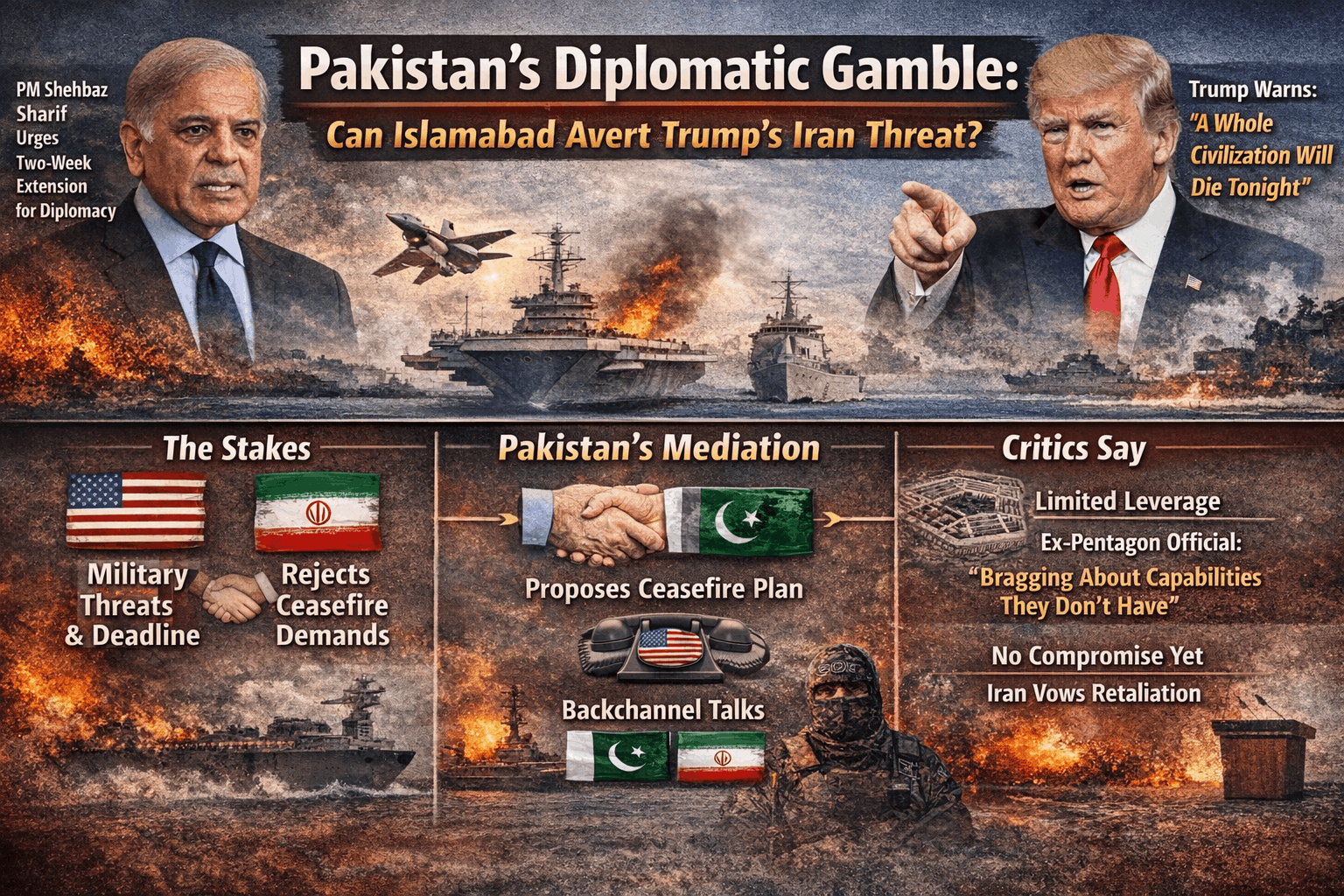
Rochester, NY: Pakistan’s last-minute diplomatic intervention to delay Donald Trump’s threat against Iran has unfolded at a moment of extreme volatility, where rhetoric, military escalation, and backchannel diplomacy are colliding in real time.
The development is less a conventional mediation effort and more a high-risk geopolitical gamble—one that exposes both Pakistan’s strategic ambitions and its structural limitations.
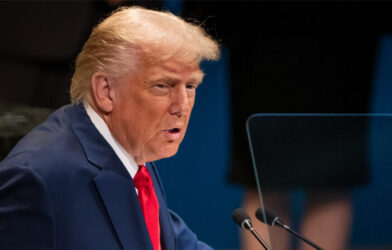
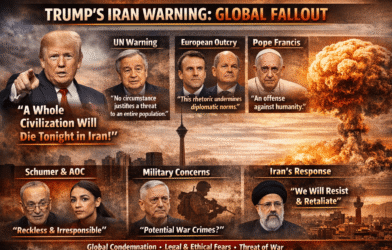
The immediate backdrop to Pakistan’s intervention is Trump’s unprecedented warning that “a whole civilization will die tonight,” a statement that has alarmed global capitals and effectively froze diplomatic channels with Tehran.
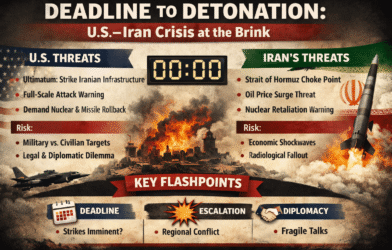
The ultimatum—linked to Iran reopening the Strait of Hormuz—came with a fixed deadline and credible military signaling, including U.S. strikes on Iranian targets.
Within Washington, even senior leadership attempted to recalibrate the tone. Vice President JD Vance emphasized that the U.S. still had “tools in the toolkit,” implicitly suggesting that total annihilation rhetoric did not necessarily reflect operational intent.
At the same time, internal dissent has surfaced. Reports indicate bipartisan concern, with some American political figures questioning the proportionality and strategic wisdom of Trump’s language, reflecting unease even within U.S. political circles.
Pakistan’s Last-Minute Diplomatic Push
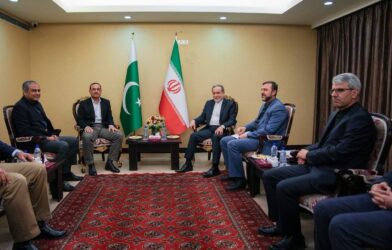
Amid this brinkmanship, Shahbaz Sharif, the Premier of Pakistan stepped in with an urgent request: a two-week extension of Trump’s deadline to allow diplomacy to proceed.
Sharif’s message was framed around cautious optimism. He argued that negotiations were “progressing positively” and urged both sides to adopt interim confidence-building measures—particularly reopening the Strait of Hormuz and observing a temporary ceasefire.
Pakistan has not acted in isolation. Its mediation architecture includes coordination with U.S. interlocutors and indirect communication channels with Tehran. A proposed framework—often referred to as the Islamabad ceasefire plan—includes a phased de-escalation and a negotiation window of 15–20 days.
From the U.S. side, the tone has been cautious but not dismissive. The White House acknowledged Pakistan’s request and indicated it is “reviewing” the proposal, while Trump himself described ongoing talks as “heated,” signaling that diplomacy has not entirely collapsed.
Iranian Position: Strategic Defiance
Tehran’s response has been far less accommodating. Iranian leadership has rejected ceasefire proposals that do not address core demands such as sanctions relief, security guarantees, and regional concessions.
Military messaging has also hardened. Iran’s Revolutionary Guard has warned of severe retaliation, including strikes on U.S.-aligned infrastructure across the Gulf.
This creates a structural contradiction for Pakistan’s mediation: it is attempting to bridge two positions that are not merely divergent but fundamentally incompatible in the short term.
U.S. Military and Strategic Skepticism toward Pakistan
Perhaps the most revealing aspect of this episode is the skepticism within American strategic circles about Pakistan’s role.
Former Pentagon official Michael Rubin dismissed Pakistan’s mediation posture as exaggerated, accusing Islamabad of “bragging about capabilities they don’t have.”
This critique reflects a deeper institutional view in Washington: Pakistan may serve as a communication conduit, but it lacks the leverage—military, economic, or diplomatic—to compel either Washington or Tehran into concessions.
Even within ongoing negotiations, Pakistan’s role appears limited to message transmission rather than agenda-setting, with key decisions still being shaped directly by U.S. and Iranian strategic calculations.
The Strategic Logic behind Pakistan’s Move
Despite skepticism, Pakistan’s intervention is not without rationale. Islamabad occupies a uniquely sensitive geopolitical position.
It maintains longstanding security ties with Saudi Arabia, has a complex but functional relationship with Iran, and remains dependent on the United States for economic and military support. This triangular positioning gives Pakistan a narrow but real diplomatic window.
Moreover, the economic stakes are existential. The closure of the Strait of Hormuz has disrupted global energy flows and directly impacts Pakistan’s fuel supply and economic stability.
Thus, Pakistan’s mediation is not purely altruistic—it is driven by immediate national interest and regional survival.
Political Theatre or Genuine Mediation?
The critical question is whether Pakistan’s role is genuinely workable or primarily symbolic.
On one level, there is substance. Pakistan has facilitated indirect talks, transmitted proposals, and secured at least nominal engagement from both sides. It has also introduced a structured ceasefire framework, which suggests more than mere diplomatic posturing.
However, the limitations are stark. Iran has already rejected earlier proposals, and there is “no sign of a compromise” despite ongoing efforts.
Furthermore, Pakistan lacks enforcement capability. Unlike major powers or multilateral institutions, it cannot guarantee compliance, offer security assurances, or impose costs for non-cooperation.
This creates the perception—particularly in Western policy circles—that Pakistan’s move is partly performative: an attempt to elevate its global diplomatic profile and project relevance in a crisis dominated by larger powers.
Final Assessment: A Narrow Window, Not a Breakthrough
Pakistan’s last-minute bid is best understood as a fragile diplomatic buffer rather than a decisive intervention. It may delay escalation, create space for backchannel negotiations, and provide both Washington and Tehran with a face-saving pause.
But it is unlikely, on its own, to resolve the crisis.
The structural realities remain unchanged: Trump’s coercive strategy is built on deadlines and threats, while Iran’s posture is rooted in resistance and strategic endurance. Pakistan, positioned between these extremes, can facilitate dialogue—but not transform the underlying conflict dynamics.
In that sense, its role is both real and limited: a mediator with access, but without authority; a bridge, but not a destination.