Riyadh, SA/Sana, YE: The latest escalation between Yemen’s Houthi movement and Saudi Arabia has introduced another dangerous dimension to an already volatile Middle East.
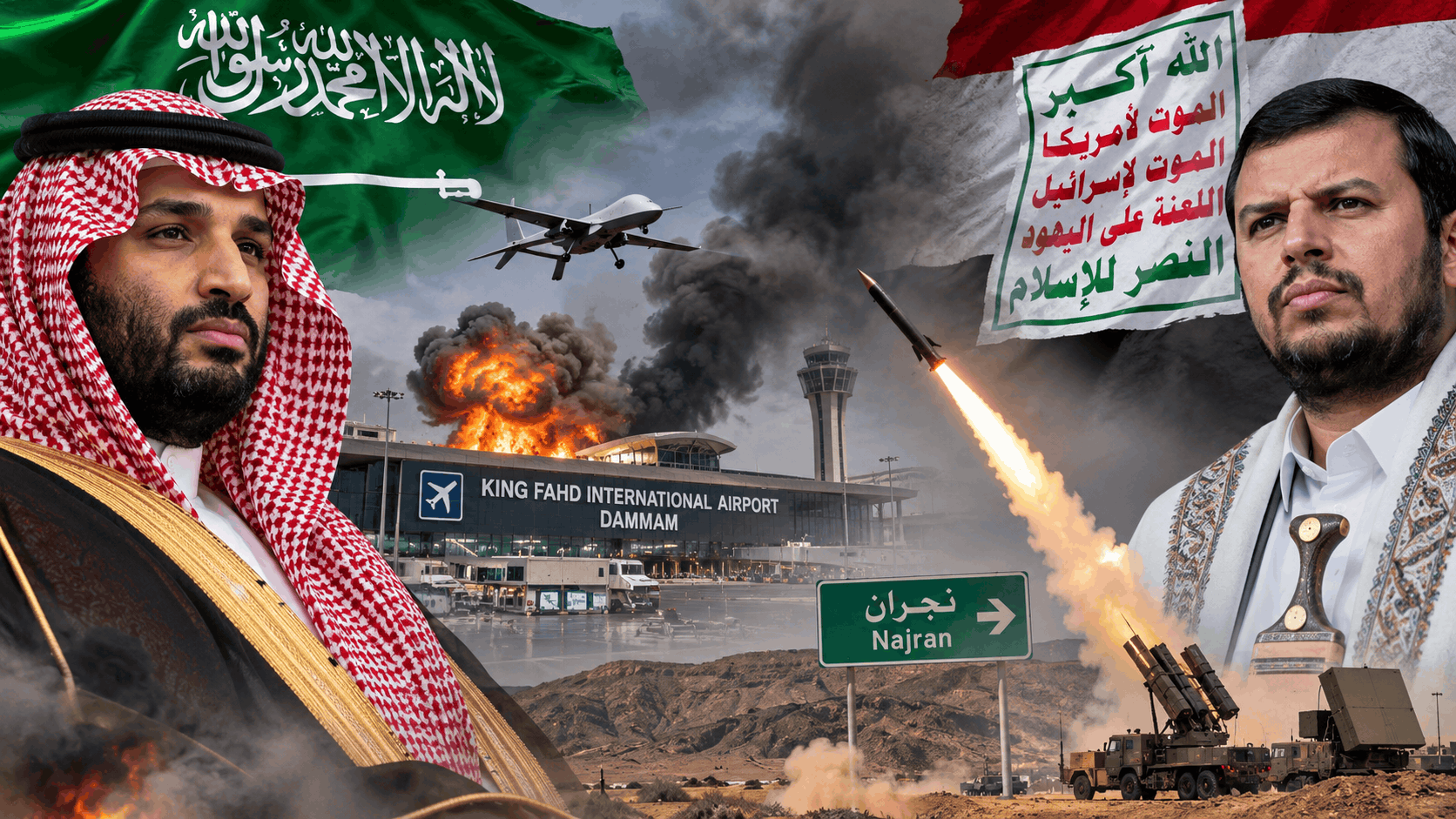
Within 48 hours, the Houthis claimed a drone operation against King Fahd International Airport in Dammam on November 5, while Saudi authorities announced the interception of two ballistic missiles directed toward Najran on November 6.
The incidents illustrate how an armed movement operating from a war-torn country can challenge the security architecture of one of the Middle East’s most economically influential states.
More importantly, the confrontation reflects a strategic struggle extending beyond Yemen’s borders, involving Iranian influence, Saudi national security, international aviation, global energy markets, and Washington’s increasingly complicated regional calculations.
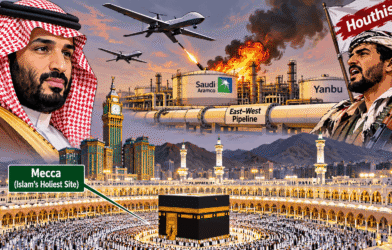
The November 5 incident attracted particular attention because of its reported target. Houthi military spokesman Yahya Saree announced that the group had launched a drone toward King Fahd International Airport in Dammam, claiming that the operation disrupted air navigation.
CBS News reported the announcement, while Reuters-linked coverage noted that the claimed disruption could not be independently verified and that Saudi authorities had not immediately confirmed the specific attack.
That distinction matters. Although the Houthi statement demonstrates an intention to project military reach into Saudi Arabia’s Eastern Province, the actual operational consequences of the November 5 incident remain less certain than the group’s public declaration suggests.
Nevertheless, the strategic implications of targeting a major international airport are substantial. Airports are not merely transportation facilities.
They connect national economies to international investment, tourism, logistics, and commercial activity.
Even the credible threat of drone attacks can force aviation authorities to reassess flight operations, impose additional security measures, and increase the costs of protecting civilian infrastructure.
Dammam’s geographical position makes the incident particularly sensitive. Situated in Saudi Arabia’s Eastern Province, the city serves a region closely associated with the kingdom’s petroleum industry, industrial development, and Gulf trade.
Any sustained deterioration in security around Dammam could affect international perceptions of Saudi Arabia’s ability to protect its critical economic infrastructure.
The significance of the attack therefore lies not exclusively in whether a drone reached its intended destination. It also lies in the possibility that repeated threats could undermine commercial confidence and impose substantial defensive costs on Riyadh.
Najran Missile Interceptions Reveal the Persistence of Cross-Border Warfare
The following day, November 6, Saudi Arabia’s military coalition announced that its air defenses had intercepted and destroyed two ballistic missiles launched toward Najran, a southwestern province bordering Yemen.
Coalition spokesman Major General Turki Al-Malki confirmed the interceptions, adding that falling debris had prompted an assessment of possible damage. Saudi civil defense authorities issued a warning concerning potential danger in Najran before subsequently lifting it.
Unlike the Dammam incident, which remained an unverified Houthi claim, the Najran interceptions were officially acknowledged by Saudi authorities.
The difference highlights the difficulties of interpreting battlefield information in a conflict where military announcements serve political and psychological objectives alongside operational ones.
For Saudi Arabia, successful interception demonstrates the importance of maintaining advanced defensive capabilities.
However, missile interception does not eliminate the broader strategic challenge. Defending a large territory against repeated low-cost drones and more sophisticated ballistic missiles requires continuous surveillance, expensive defensive systems, and extensive military coordination.
For the Houthis, the ability to launch attacks toward Saudi territory provides an opportunity to demonstrate continued military relevance despite Yemen’s prolonged devastation and the substantial technological superiority of the Saudi armed forces.
The strategic imbalance is particularly important. An attacker does not necessarily need to destroy a major facility to impose significant costs. Repeated threats can disrupt commercial planning, consume defensive resources, and create uncertainty among civilian populations.
This represents an increasingly prominent feature of contemporary warfare: relatively inexpensive offensive systems can generate disproportionate economic and security consequences.
Yemen’s Civilian Population Remains Trapped between Competing Military Narratives
While Saudi Arabia faced aerial threats, Yemen continued to experience the devastating consequences of military operations.
Houthi officials accused Saudi aircraft of carrying out extensive airstrikes across Yemeni territory, including Taiz governorate. Separately, Houthi authorities alleged that an attack on a vegetable market in Taiz killed approximately 30 people. The internationally recognized Yemeni government disputed the allegation of Saudi responsibility and blamed the Houthis.
The casualty figure and responsibility for the market incident have not been independently established in the reporting reviewed.
Regardless of which account ultimately proves accurate, allegations involving attacks on marketplaces demand serious independent investigation.
International humanitarian law requires parties to armed conflicts to distinguish civilians and civilian objects from military objectives. It also prohibits indiscriminate attacks and attacks expected to cause excessive civilian harm relative to the anticipated concrete and direct military advantage.
These obligations apply to every party, irrespective of its political objectives or claims of retaliation.
Yemen’s humanitarian suffering cannot be separated from the military calculations of regional powers. Years of fighting have damaged infrastructure, weakened public institutions, disrupted livelihoods, and left millions dependent on humanitarian assistance.
Further escalation threatens to reverse fragile recovery efforts and deepen the suffering of communities already exposed to prolonged insecurity.
Iran’s Regional Influence and the Expanding Strategic Battlefield
The renewed Houthi-Saudi confrontation cannot be understood without examining Iran’s regional position.
The Houthis have long maintained political and military relationships with Tehran, which has supported the movement as part of its broader regional strategy. Nevertheless, Iranian support does not establish that every Houthi operation is directly ordered or controlled by Iranian authorities.
That distinction is essential when evaluating the November attacks.
The broader confrontation involving Iran and the United States has increased the strategic importance of Yemen. The Houthis possess the geographical position and military capabilities to threaten Saudi territory and maritime activity around the Red Sea and Bab el-Mandeb.
Their involvement can potentially expand the geographical scope of regional hostilities without requiring direct confrontation between Iranian and American forces in every theater.
For Tehran, the existence of armed regional partners complicates adversaries’ military planning. For Riyadh, those relationships increase the danger that Saudi infrastructure could become a target during confrontations originating beyond the kingdom’s immediate borders.
However, treating the Houthis exclusively as an extension of Iranian foreign policy would overlook the movement’s domestic political ambitions, ideological motivations, and independent calculations.
The result is a conflict shaped by overlapping local, regional, and international interests, making diplomatic solutions especially difficult.
Washington Faces a Complicated Security and Diplomatic Dilemma
The escalation presents another challenge for President Donald Trump’s administration as Washington confronts the consequences of its military conflict with Iran.
The United States has longstanding security relationships with Saudi Arabia and other Gulf partners. Protecting regional stability, safeguarding energy transportation, and preventing attacks on strategically important infrastructure remain central American interests.
Yet a broader military response against the Houthis could increase the risk of an expanding regional war.
The dilemma is particularly acute because military pressure may weaken certain Houthi capabilities without necessarily eliminating the movement’s ability to launch missiles or drones.
Washington must therefore consider whether additional military operations would strengthen deterrence or produce another cycle of retaliation.
Saudi Arabia faces a similar calculation. Its leadership has substantial incentives to protect economic modernization initiatives, attract foreign investment, and avoid prolonged regional instability.
A renewed large-scale military campaign in Yemen could impose economic and diplomatic costs while exposing additional Saudi facilities to retaliation.
Consequently, Riyadh’s long-term security may depend as much on successful diplomacy and regional de-escalation as on advanced air-defense systems.
Oil Markets, Aviation and the Economic Cost of Escalation
The implications extend well beyond the immediate battlefield.
Saudi Arabia remains one of the world’s most influential oil producers, while the Persian Gulf and Red Sea form essential corridors for international energy transportation.
Repeated attacks or credible threats against airports, ports, oil installations, and shipping routes can increase insurance costs, complicate logistics, and introduce additional uncertainty into energy markets.
CBS News reported that Brent crude rose approximately 2.2% to $96.70 per barrel after a sharp decline following the American midterm elections. The movement reflected broader uncertainty surrounding the Iran conflict rather than a demonstrable price response to the Dammam incident alone.
This distinction is important because energy markets respond to multiple factors, including supply expectations, demand forecasts, geopolitical risk, and investor sentiment.
Nevertheless, sustained insecurity around Saudi infrastructure could reinforce an existing geopolitical risk premium.
For ordinary consumers, prolonged instability could eventually translate into higher transportation costs, more expensive imported goods, and additional pressure on household budgets.
For Gulf governments, the consequences include the possibility of reduced investor confidence and greater spending on security at a time when economic diversification remains a strategic priority.
A Military Victory May Not Produce a Political Solution
The November 5 and 6 incidents reveal the limitations of military deterrence in a conflict characterized by asymmetrical capabilities, competing political objectives, and deep regional mistrust.
Saudi Arabia may successfully intercept missiles and drones, yet still face recurring threats. The Houthis may demonstrate an ability to challenge Saudi security, yet remain unable to translate military pressure into sustainable political gains for Yemen.
Meanwhile, civilians on both sides of the border bear the consequences of decisions made by armed actors and political leaders.
The central question is whether the latest escalation will encourage renewed negotiations or become another stage in an expanding regional confrontation.
A durable settlement would require more than temporary military restraint. It would demand credible security arrangements, accountability for attacks against civilians, meaningful Yemeni political participation, and diplomatic engagement capable of addressing the regional dimensions of the conflict.
Without these elements, even successful defensive operations may provide only temporary reassurance.
Conclusion: The Middle East Cannot Afford another Open-Ended War
The reported drone operation against Dammam’s King Fahd International Airport and the confirmed missile interceptions over Najran represent more than isolated security incidents. Together, they demonstrate the fragility of regional stability at a moment when the Middle East is already confronting an exceptionally dangerous strategic environment.
For Saudi Arabia, the immediate priority is protecting civilian infrastructure and preserving economic confidence.
For the Houthis, military escalation risks prolonging Yemen’s isolation and suffering. For Iran and the United States, the danger lies in allowing interconnected regional conflicts to develop into an increasingly uncontrollable confrontation.
Ultimately, the most consequential outcome will not be measured solely by the number of missiles intercepted or drones launched. It will be determined by whether regional governments and armed movements recognize that military escalation carries costs extending far beyond the battlefield.
The deeper warning from Dammam and Najran is that a war without a credible political exit can threaten an entire region’s economic security, civilian safety, and prospects for lasting peace.
Editorial verification note: This analysis distinguishes the Houthis’ unverified November 5 airport-disruption claim, Saudi Arabia’s officially reported November 6 missile interceptions, and disputed allegations concerning civilian casualties in Taiz. Its strategic assessments are analytical judgments rather than independently established battlefield findings.