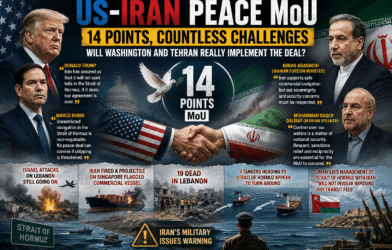
Sacramento, CA: Washington maintains its blockade as leverage, but Tehran responds by weaponizing geography, turning the Strait of Hormuz into a central bargaining tool in a high-stakes standoff.
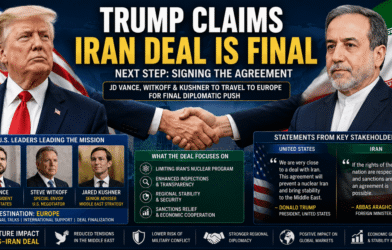
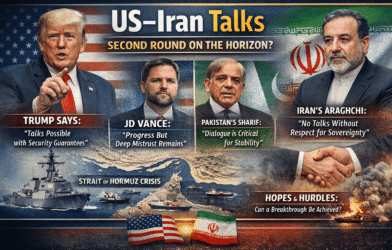
The renewed closure of the Strait of Hormuz by Iran marks a sharp escalation in an already volatile geopolitical standoff, unfolding just hours after U.S. President Donald Trump expressed optimism about a potential deal with Tehran.
The contradiction between diplomatic signaling and military-economic pressure underscores a central paradox in the current crisis: negotiations are advancing rhetorically, but realities on the ground are hardening.
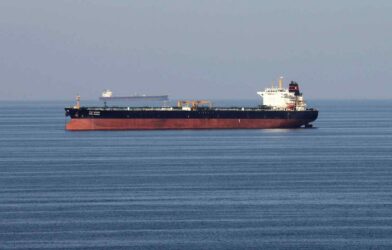
Iran’s decision to shut the strategic waterway—through which roughly 20% of global oil supply flows—comes explicitly in response to Washington’s refusal to lift its naval blockade on Iranian ports.
This action is not merely symbolic; it represents Tehran’s most potent leverage in a conflict defined by economic warfare and maritime control.
Trump’s Optimism vs. Strategic Pressure
President Donald Trump has maintained a dual-track posture—projecting optimism about a deal while doubling down on coercive leverage.
He recently extended a ceasefire to allow negotiations to continue, signaling that diplomacy remains viable. Yet, in parallel, Trump has insisted that the U.S. naval blockade will remain “in full force,” framing it as essential to forcing Iranian concessions.
This contradiction has weakened U.S. credibility in Tehran’s eyes. Iranian officials interpret the continuation of the blockade—despite ceasefire extensions—as a violation of good-faith negotiation principles.
Analysts note that Trump’s fluctuating rhetoric, alternating between threats and optimism, has introduced uncertainty into the diplomatic process.
Iran’s Position: Conditional Engagement
Iranian Foreign Minister Abbas Araghchi initially attempted to de-escalate tensions by declaring the Strait open during a temporary ceasefire. However, that move was quickly reversed when the U.S. maintained its blockade.
Araghchi and other Iranian negotiators have made Tehran’s position clear: meaningful negotiations cannot proceed under what they describe as “economic siege.”
Iran has framed the U.S. blockade as an act of war and a breach of the ceasefire framework, demanding its removal as a precondition for sustained dialogue.
This stance reflects a broader Iranian strategy—leveraging asymmetric tools like maritime chokepoints to counterbalance U.S. military and financial dominance.
IRGC’s Assertive Posture
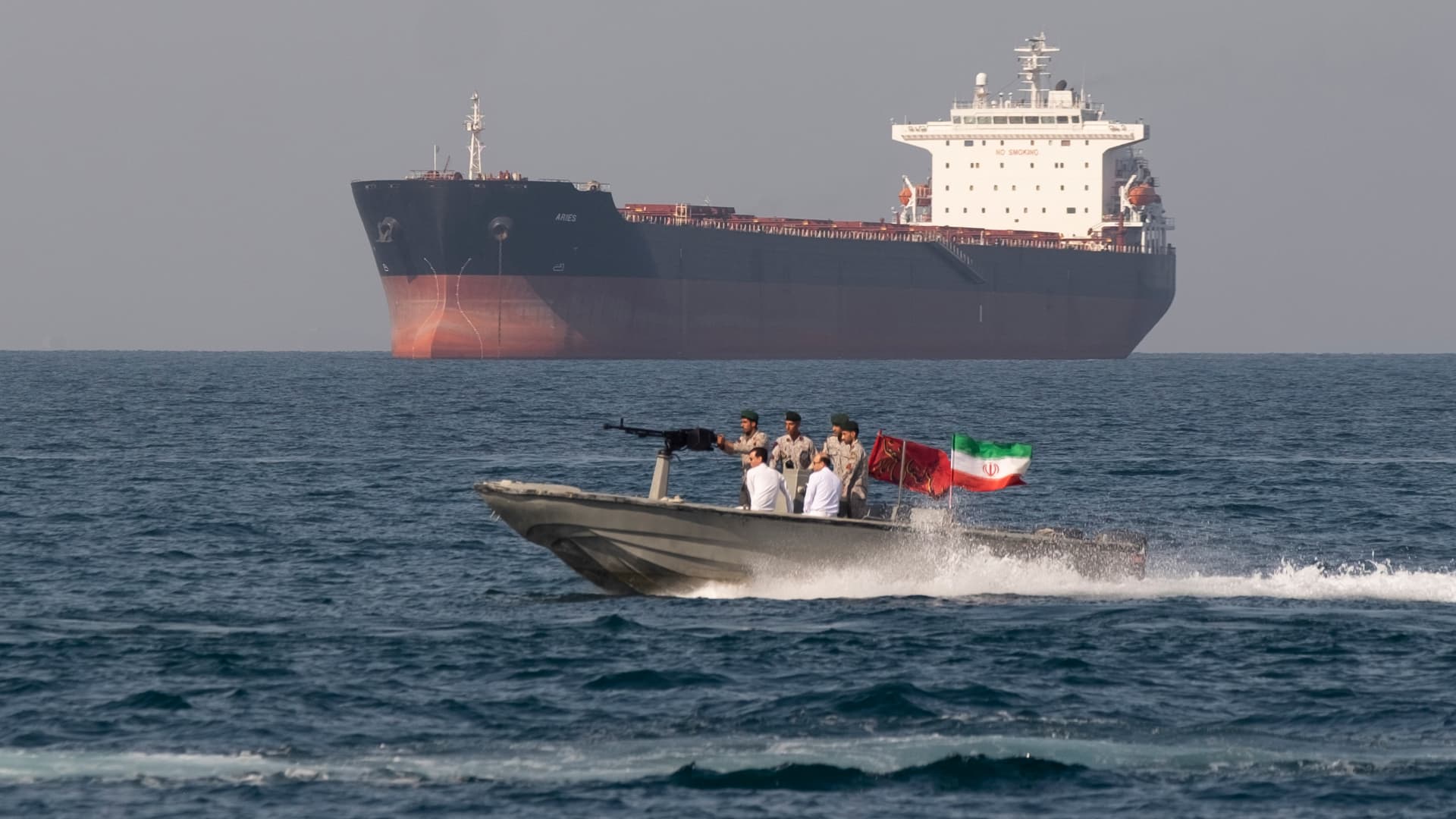
At the operational level, Iran’s response has been driven by the Islamic Revolutionary Guard Corps (IRGC), which has taken direct control of the Strait.
The IRGC declared that the waterway would remain closed until the U.S. lifts its blockade, explicitly linking military action to economic demands.
Reports indicate that Iranian forces have enforced the closure aggressively, including warning or firing on vessels attempting passage.
This signal expresses a willingness to escalate tactically while maintaining a strategic objective: compel Washington to negotiate on Iran’s terms.
Hormuz Becomes the Battlefield of Diplomacy as U.S.-Iran Tensions Intensify
Washington maintains its blockade as leverage, but Tehran responds by weaponizing geography, turning the Strait of Hormuz into a central bargaining tool in a high-stakes standoff.
With nearly 20% of global oil flows at risk, major economies brace for volatility while world leaders call for restraint amid fears of a broader regional crisis.
The closure of the Strait has immediate global implications. Oil markets have already reacted with volatility, reflecting fears of prolonged disruption. With nearly one-fifth of global energy supplies transiting the waterway, even temporary closures send shockwaves through international markets and supply chains.
Major Powers have responded cautiously. European states have urged de-escalation and protection of maritime routes, while countries heavily dependent on Gulf energy—such as China and India—are closely monitoring developments.
However, there is little appetite for direct military involvement, leaving the U.S.-Iran standoff largely bilateral but globally consequential.
Strategic Analysis: A Cycle of Leverage and Mistrust
The current crisis reflects a classic coercive bargaining scenario, but with heightened risks due to military proximity and economic interdependence.
Trump’s strategy relies on maximizing pressure through blockade and sanctions while offering diplomatic off-ramps. Iran’s counter-strategy leverages geographic chokepoints and controlled escalation to impose reciprocal costs.
However, both approaches are undermined by a lack of trust. The U.S. fears that lifting the blockade would weaken its negotiating position, while Iran views continued pressure as evidence that Washington seeks capitulation rather than compromise.
Conclusion: Diplomacy at the Edge of Escalation
The reclosure of the Strait of Hormuz illustrates how fragile the path to diplomacy remains. While public statements—particularly from Donald Trump—suggest optimism, the underlying dynamics point toward a deepening confrontation.
For any breakthrough to occur, one side must recalibrate its strategy: either Washington eases economic pressure to build trust, or Tehran reduces its use of maritime leverage to stabilize negotiations. Until then, the Strait of Hormuz will remain both a physical chokepoint and a symbolic fault line in one of the world’s most consequential geopolitical conflicts.