San Francisco, CA: The recent heat wave across America, Europe, Asia and South Asia is not an isolated seasonal event. It is a warning signal from a planet that is heating faster than societies, cities and governments are adapting.
From extreme heat alerts across the United States to deadly temperatures in Europe and prolonged hot spells in India and Pakistan, the summer of 2026 has exposed how climate change is no longer a future threat; it is a present-day human, economic and security crisis.
According to National Oceanic and Atmospheric Administration (NOAA), May 2026 was the second-warmest May in its 177-year global record, with temperatures 1.07°C above the 20th-century average.
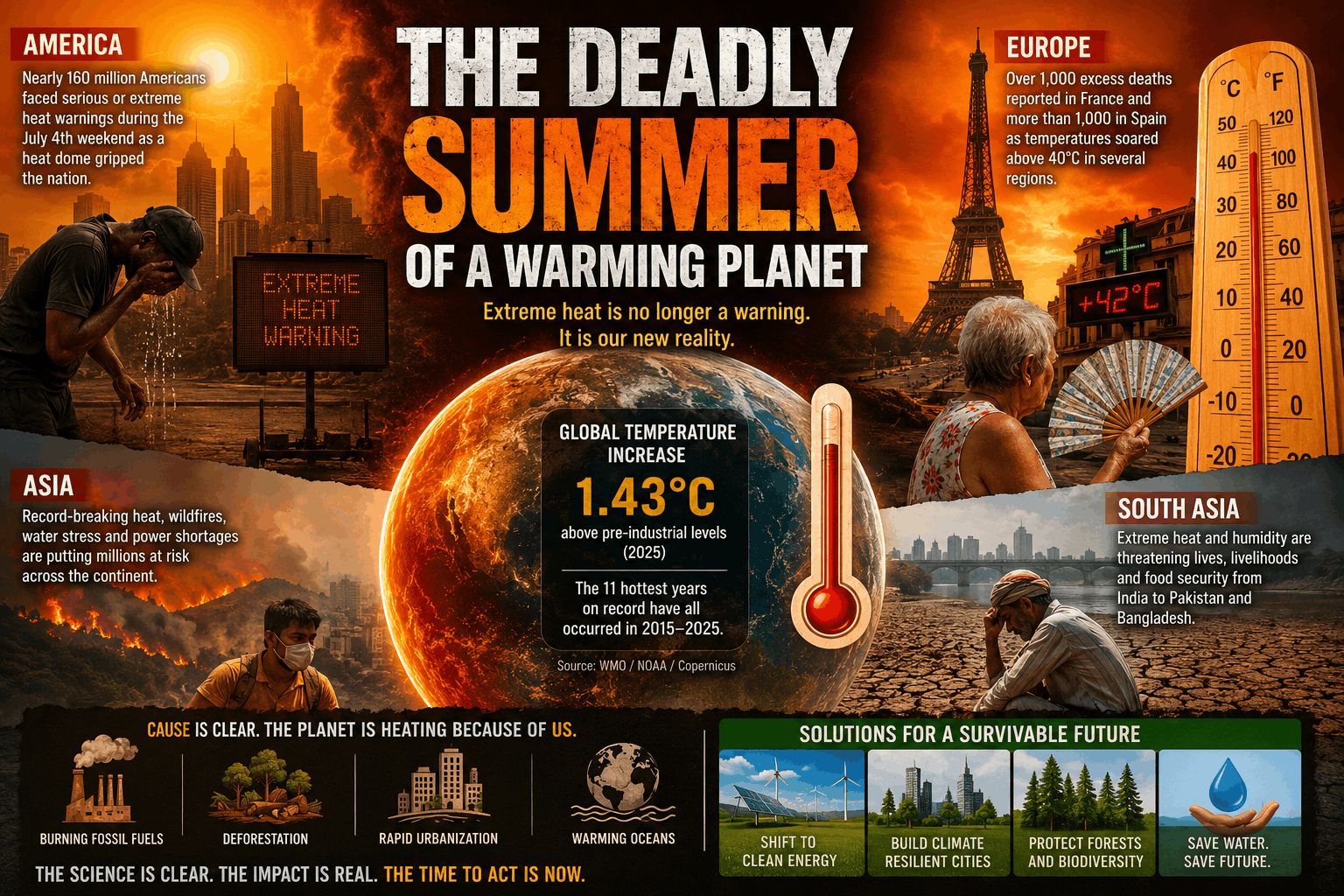
The World Meteorological Organization (WMO) also reported that 2015–2025 were the hottest 11 years on record, while 2025 stood around 1.43°C above the pre-industrial average.
This matters because the Paris Agreement’s 1.5°C threshold is no longer an abstract scientific line. The world is already touching it in individual years and months.
The Intergovernmental Panel on Climate Change (IPCC) has made clear that human greenhouse gas emissions are responsible for roughly 1.1°C of warming since 1850–1900, and that human influence has increased the frequency and intensity of heat extremes across most land regions.
America: Heat Dome over a Divided Nation
In the United States, the Fourth of July weekend was hit by extreme heat and storm threats, with reports saying nearly 160 million Americans faced serious or extreme heat warnings.
The heat was driven by a strong “heat dome,” where high pressure traps hot air and humidity, turning cities into outdoor ovens and placing heavy stress on power grids, hospitals and outdoor workers.
This is especially dangerous because American cities are built around concrete, asphalt and car-dependent infrastructure.
Urban heat islands can make poor neighborhoods, warehouse workers, elderly people and homeless citizens suffer far more than wealthy communities with cooling access.
Europe: A Continent Unprepared for Tropical Heat
Europe has also faced a brutal summer. France, Spain, Germany, the Czech Republic and other countries recorded severe heat conditions, with reports of more than 1,000 excess deaths in France and more than 1,000 in Spain during the recent heat period.
Some parts of Europe saw temperatures exceeding 40°C, while health systems, railways, schools and care homes struggled.
Europe’s crisis is also cultural and infrastructural. Air conditioning remains limited in many countries, while older buildings, dense cities and aging populations increase vulnerability.
The World Health Organization has warned that Europe is warming faster than the global average, making adaptation urgent, not optional.
Asia and South Asia: Heat as a Daily Survival Crisis
Asia and South Asia are among the most exposed regions. India, Pakistan and Bangladesh face a deadly mix of high temperatures, humidity, poverty, water stress and power shortages.
In South Asia, extreme heat is not only a weather issue; it directly affects labor productivity, food prices, agriculture, electricity demand and public health.
When nighttime temperatures remain high, the human body cannot recover. This increases heatstroke, kidney stress, heart problems and deaths among workers, children and elderly people.
For Pakistan and India, climate change is also becoming a national security issue because it intensifies water disputes, crop failures, migration pressure and public anger.
Why This Summer Is So Deadly
The main reason is the long-term accumulation of greenhouse gases from burning coal, oil and gas.
These emissions trap heat in the atmosphere.
Warmer oceans then add more energy and moisture to the climate system. In June 2026, reports citing Copernicus data said ocean surface temperatures reached record levels, raising fears of stronger heat waves, storms and wildfires.
El Niño conditions, heat domes, deforestation, rapid urbanization and poor planning are making the situation worse. But these are amplifiers. The root cause remains human-driven global warming.
The victims of heat waves are often invisible. They are delivery drivers, construction workers, farm laborers, elderly citizens living alone, children in poorly ventilated homes and families unable to afford cooling.
Heat also damages roads, rail lines, crops, livestock and power systems. It reduces productivity and increases public spending on emergency health care.
Climate change is therefore not only an environmental issue. It is an economic justice issue, a public health issue and a governance test.
Solutions: From Emergency Response to Climate Repair
The world needs two strategies at the same time: adaptation and mitigation. Adaptation means protecting people from heat that is already unavoidable.
Governments must create heat emergency plans, cooling centers, shaded public spaces, green roofs, tree-covered streets, water stations and early-warning systems. Hospitals, schools, care homes and workplaces must be redesigned for extreme heat.
Mitigation means stopping the problem from getting worse. Countries must reduce dependence on fossil fuels, expand renewable energy, modernize electricity grids, improve public transport, protect forests and regulate industrial emissions.
Rich nations must also support poorer countries with climate finance, because countries like Pakistan contribute far less to global emissions but suffer heavily from climate disasters.
The recent global heat wave is a message written in rising temperatures, burning forests, overloaded hospitals and exhausted workers.
America, Europe, Asia and South Asia are experiencing different versions of the same crisis. The science is clear, the warnings are visible, and the human cost is already rising.
The question is no longer whether climate change is real. The real question is whether governments, industries and societies will act fast enough to protect human life before deadly summers become the new normal.
Follow The Variant for timely updates and comprehensive coverage of global affairs, politics, business, and international relations.