


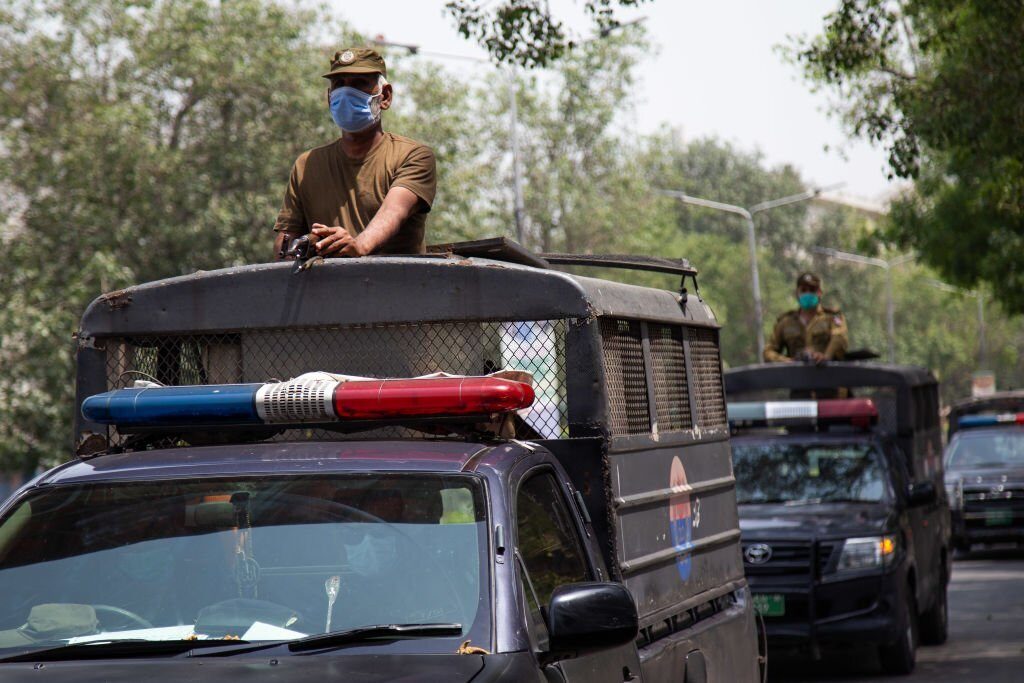
New York: The Crime Control Department (CCD) was set up by the provincial government of Pakistan under Chief Minister Maryam Nawaz Sharif in early 2025. It is a new specialized branch of the Punjab Police that is supposed to fight organized crime. In February, the provincial government authorized the department, hired workers, and gave it the ability to record FIRs, arrest suspects, and deal with criminals all around the province. It now has more than 4,625 officers.
In Punjab province, the phrase “crime control” has once again become a useful cover for something far worse: the normalization of state violence that is not legal. The Crime Control Department (CCD) was created and expanded by Chief Minister Maryam Nawaz Sharif. This has brought back a dark time in Pakistan’s government when bullets replaced courts and police officials became judge, jury, and executioner.
In Punjab, extrajudicial murders, which are sometimes called “encounters,” are not a new thing. They are, in fact, rather well-known. History demonstrates a troubling pattern: every time the ruling elite-Sharif family takes over in the province, police interactions go up, civil freedoms go down, and accountability silently vanishes. The CCD is not a break from this history; it is its most recent, more institutionalized form.
Pakistan has signed the International Covenant on Civil and Political Rights (ICCPR), which protects the right to life and forbids taking someone’s life without cause. International law is clear: police may only use deadly force as a last option to defend life. But in today’s Punjab, killings in police custody or “crossfire” occurrences on the side of the road are more often seen as administrative successes than constitutional failures.
Critics point out that Punjab has a lengthy history of police interactions with different regimes. From 1990 to 2025, there were more than 6,450 police encounters in the province, and more than 4025 suspects died as a consequence. The most deaths happened in 1998, when incumbent Prime Minister of Pakistan Shahbaz Sharif was in charge of Punjab province, and hundreds of people died in these killings. Similar patterns came again in succeeding years, as from 2013 to 2018, when more than 1,650 interactions led to deaths.
The CCD is especially scary not just because of the amount of claimed contacts, but also because of the governmental support behind them. The provincial government set up, financed, and ran the department with little public discussion and much less independent scrutiny. This is not reforming the police; it’s policing by exception, where police have special powers without having to answer for them.
People who support the CCD believe that crime needs strong reactions. But this reasoning falls apart when you look at it closely. No democratic government stops crime by getting rid of its judicial system.
When suspects are slain instead being apprehended, evidence is never investigated, networks are never revealed, and the truth is never found. The short-term benefits of “swift action” come at the long-term expense of the breakdown of institutions.
The UN’s Basic Principles on the Use of Force and Firearms say that force should only be used after all other options have been tried and that deadly force should only be used when absolutely necessary.
Key UN Human Rights Conventions & Quotations
International Covenant on Civil and Political Rights (ICCPR), Article 6(1):
“Every human being has the inherent right to life. This right shall be protected by law. No one shall be arbitrarily deprived of his life.”
Arbitrary Arrest & Detention – ICCPR
ICCPR, Article 9(1):
“Everyone has the right to liberty and security of person. No one shall be subjected to arbitrary arrest or detention.”
Fair Trial & Due Process
ICCPR, Article 14(1):
“All persons shall be equal before the courts and tribunals.”
UN Basic Principles on the Use of Force and Firearms by Law Enforcement Officials (1990)
“Law enforcement officials shall, as far as possible, apply non-violent means before resorting to the use of force and firearms.”
“Intentional lethal use of firearms may only be made when strictly unavoidable in order to protect life.”
UN Special Rapporteur on Extrajudicial, Summary or Arbitrary Executions
“States have an obligation to investigate all suspected cases of extrajudicial, summary or arbitrary executions and bring those responsible to justice.”
Routine interactions, which commonly include unarmed individuals, conflicting stories, and the same police statements, do not fulfill this standard. They fit the criteria of an extrajudicial execution.
The fact that Punjab’s political elites are silent—or even worse, tacitly approving—makes the situation much worse. Maryam Nawaz, the Chief Minister, has openly supported the CCD as a sign of strong government. But strong government without the law is not strength; its authoritarian drive wrapped up in bureaucratic rhetoric. It’s not how many people killed that shows leadership, but how strong institutions are.
The superior court has started to receive applications that question the constitutionality of CCD killings.
This is a reminder that the courts are still one of the final lines of defense against the full breakdown of institutions. But the state has to work with the courts for them to be able to do anything. When FIRs are made up, postmortems are put off, and investigation panels are purely for show, justice becomes a show.
Killing people outside of court does not make society safer. They create it such that cops can’t be held responsible, people are scared, and governments are morally exposed. They also ask people from other countries to look into them. Pakistan already has a bad reputation on human rights, and Punjab’s police force that uses violence to solve problems makes it seem much worse on the world stage.
This isn’t simply a matter of law and order; it’s a matter of the Constitution. Article 9 of Pakistan’s Constitution ensures the right to life and freedom. No provincial administration, police agency, or chief minister of Punjab province has the power to take away this privilege whenever they choose.
Punjab is at a really hazardous point right now. It can either fight crime by making investigations, prosecutions, and the independence of the courts stronger, or it may keep going down the same old route where the state murders to make up for its own mistakes. The second option has already been proved to lead to bad things in the past.
The question is no longer whether extrajudicial killings are occurring. The issue is whether the people in charge will keep making excuses for them or eventually realize that a government that breaks the law in the name of order ends up losing both.







