


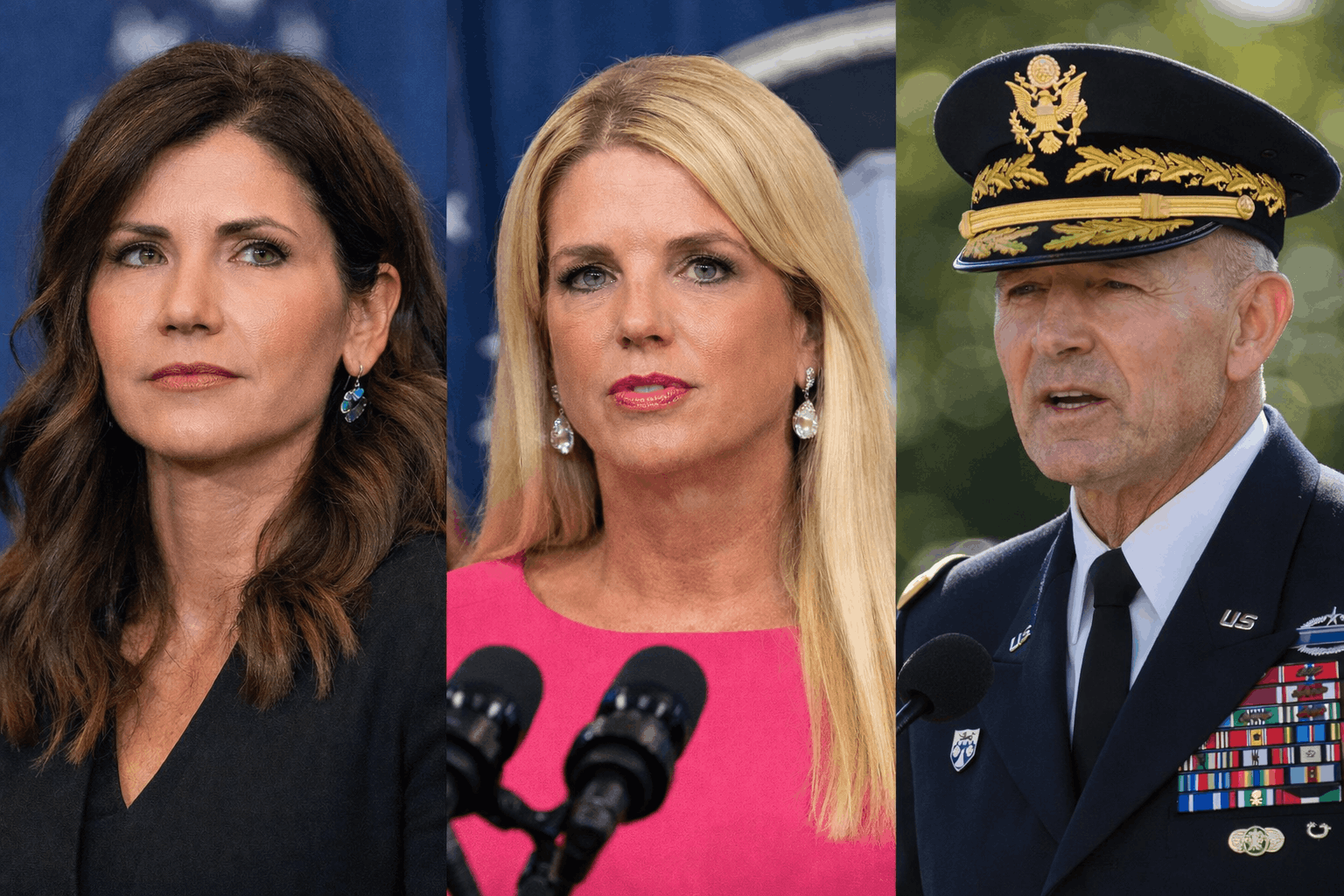
Washington D.C/Rochester, NY: From the Pentagon to the Department of Justice and Homeland Security, Donald Trump has overseen a series of high-level dismissals including Randy George by Pete Hegseth, the firing of Pam Bondi, and the earlier removal of Kristi Noem—signaling a sweeping restructuring of America’s top leadership institutions.
A growing institutional divide between political leadership and the conventional power centers of the United States government is indicated by the most recent round of firings within President Trump’s administration, which includes positions in the Department of Homeland Security, the Department of Justice, and the Pentagon.
A consolidation of ideological dominance, rather than administrative change, seems to be the goal of Pete Hegseth shake-up at the Pentagon, which included the dismissal of Randy George the Army Chief of Staff, as well as the previous removal of Kristi Noem and Pam Bondi.
Concerns over the stability of governance and civil-military ties have been heightened by recent reports that show how these choices are being made quickly with little institutional participation.
Pentagon Turmoil: Loyalty over Doctrine
Within the Pentagon, the most startling crack has appeared. General Randy George and other senior commanders were ousted from their positions without warning by Defense Secretary Pete Hegseth as part of a larger leadership purge, according to authorities.
Despite the lack of an official explanation, several media outlets have reported that the dismissal was linked to disagreements on military strategy and alignment with the administration’s long-term goals.
Both Reuters and Al Jazeera said that the goal was to replace the current leadership with someone who would be more amenable to enacting Trump’s military agenda without facing any pushback from inside the organization.
Hegseth has stressed before that the Pentagon’s leadership must not be “roadblocks” to presidential orders. The long-standing ideal of an apolitical armed force has been questioned by his viewpoint, which represents a trend toward placing a premium on ideological conformity among military leadership.
Official Pentagon announcements expressed thanks for General George’s service and framed his resignation diplomatically, even if he did not openly criticize it.
Concerns over operational continuity and the politicization of military command structures have been heightened by the timing, which occurs amid continuous geopolitical tensions.
Department of Justice: Loyalty Tested, Then Discarded
A separate but no less serious rift has opened up between Trump and one of his most faithful political supporters with the departure of Pam Bondi.
Pursuing lawsuits against political opponents and reorganizing prosecutorial priorities were among Bondi’s attempts to bring the Justice Department into tight alignment with the administration’s political agenda.
The Washington Post, AP News, and The Guardian all reported that she was unpopular in the Oval Office because to her handling of sensitive investigations (such the ones involving Jeffrey Epstein) and her failure to achieve significant legal triumphs.
According to reports, Donald Trump told her, “I think it’s time” in a discussion just before she was fired, indicating a direct and personal decision to fire her.
Bondi openly reaffirmed her support for Trump and described her tenure in office as “an honor” in spite of her dismissal. This departure by her exemplifies a trend in Trump’s leadership style: loyalty is key, but performance—particularly on subjects of great political visibility—remains vital.
DHS Shake-Up: The Noem Precedent
Kristi Noem’s previous discharge from the Department of Homeland Security laid the groundwork for the present round of firings. According to media accounts, her dismissal was related to administrative difficulties and discontent with the outcomes of immigration enforcement.
There is a growing impression that stability at the cabinet level under Trump is quite conditional, even though Noem refrained from publicly criticizing the government after her ouster.
Some critics have pointed to trends in the dismissal of officials after the back-to-back departures of Noem and Bondi, prompting political discussion; however, the government has not publicly addressed these accusations.
The Pattern: Centralization of Power
All things considered, these firings are indicative of a more systemic approach to leadership that prioritizes conformity, alignment, and the swift use of executive power.
In his time back in office, President Trump has replaced top executives in several government agencies with people he believes better understand his political and strategic goals.
Several interrelated aspects seem to form the basis of the reasoning.
Ideological conformity comes first. Regardless of institutional conventions, Trump is systematically replacing officials who are seen to be too discordant with his goal, whether it on military operations, legal strategy, or domestic security.
The second is the influence of political results on performance-based pressure. In high-profile political and judicial problems, even close friends are evaluated based on their capacity to produce concrete outcomes, as Bondi’s case shows.
Third, the federal institutions need to be adjusted more broadly. Leadership that unwaveringly backs these changes is necessary, since the changing role of agencies such as the Pentagon and DHS implies a move toward stronger internal security and the execution of policies led by the executive branch.
Political Fallout: Institutional Trust at Risk
This round of firings has major political ramifications. The gradual loss of autonomy at crucial points in American government is what critics see as the eventual result.
Military personnel worry about continuity, morale, and the traditional practice of protecting the military from political interference in the wake of top leadership’s departure at a time of global stress.
Politically motivated leadership turnover at the Justice Department threatens the public’s faith in the department’s ability to fairly enforce the law.
On a political level, these actions might win over Trump’s loyalists, who generally embrace his attempts to undermine long-established bureaucratic systems.
The counterargument, that democratic standards and checks and balances are being undermined, is equally well-supported by these facts.
Conclusion: A Presidency Defined by Disruption
Disagreements with the Departments of Defense, Justice, and Homeland Security all occurred at the same time and are indicative of a larger trend characterizing Trump’s second term in office.
There is a blurring of the lines between political leadership and institutional autonomy, a consolidation of power, and a dampening of internal dissent.
Whether this approach improves executive efficiency or adds to institutional instability in the long run is the key issue going ahead.
There is increasing strain on the delicate equilibrium between democratic government and political power in the US as these trends persist.







