


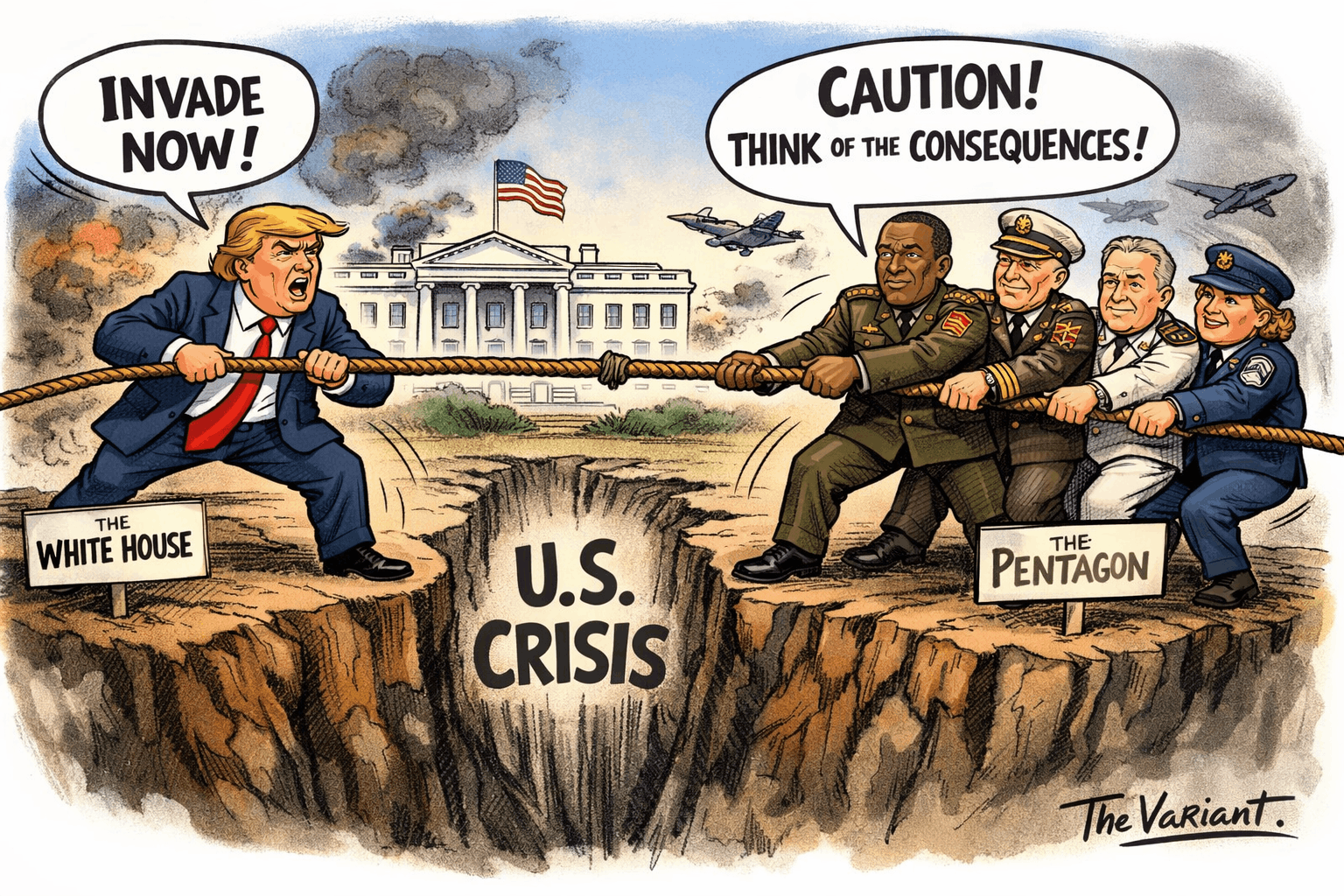
Washington, D.C/New York City, NY/Rochester, NY: The evolving tensions between the White House and the Pentagon have exposed one of the most serious civil-military strains in modern American history.
What began as a policy disagreement over strategic direction—particularly regarding escalation in the Middle East—has transformed into a broader institutional conflict, raising urgent questions about authority, professionalism, and the stability of U.S. governance itself.
At the center of this divide stands Donald Trump, whose leadership style has consistently emphasized rapid decision-making and centralized control.
In contrast, senior military leadership has shown increasing reluctance to endorse aggressive strategies, especially those that risk prolonged entanglement or lack clear operational feasibility.
This divergence has not remained confined to internal debate; it has spilled into public view through dismissals, leaks, and visible policy inconsistencies.
Strategic Disagreement or Institutional Breakdown
The roots of the rift lie in fundamentally different approaches to military engagement. The White House has projected confidence in swift, decisive action, often framing military escalation as a tool for immediate geopolitical gains.
However, the Pentagon’s leadership, guided by operational realities, has expressed concerns over logistics, troop sustainability, and the unpredictable consequences of large-scale conflict.
This is not the first time American civilian and military leaders have disagreed, but the current situation is distinct in tone and scale.
The resistance emerging within military circles is less about defiance and more about caution—an attempt to align political ambitions with battlefield realities. Yet, in a highly charged political environment, such caution has been interpreted by some within the administration as obstruction.
The Purge of Senior Military Leadership
The most visible manifestation of this conflict has been the removal of several high-ranking officials, signaling an unprecedented reshaping of military leadership during a period of heightened global tension.
Among those reportedly dismissed or sidelined is Randy George, who served as Army Chief of Staff, and Charles Q. Brown Jr., a key figure in joint military command structures. Other notable removals include David Hodne and William Green Jr., along with Linda Fagan, whose dismissal drew particular attention given her historic role.
These dismissals have been interpreted by analysts as more than routine administrative changes. They reflect a broader effort to align military leadership more closely with the administration’s strategic vision. However, such actions carry significant risks, particularly the perception that military professionalism is being subordinated to political loyalty.
Pentagon as a Quiet Counterbalance
Despite the constitutional framework that places the military firmly under civilian control, the Pentagon has increasingly assumed the role of a stabilizing force within this turbulent landscape.
Rather than openly challenging the White House, military leadership has relied on procedural mechanisms, strategic briefings, and operational constraints to shape policy outcomes.
In practical terms, this has meant slowing the pace of escalation, emphasizing risk assessments, and recalibrating the scope of military actions.
The Pentagon’s influence is not exercised through direct opposition but through the subtle application of expertise and institutional inertia.
By controlling how and when orders are implemented, military planners effectively act as a filter between political intent and operational execution.
This dynamic creates a paradox. While civilian authority remains formally intact, the Pentagon’s growing influence over the implementation of policy has introduced an informal layer of oversight.
It is not a challenge to authority, but rather a recalibration of how that authority is exercised in practice.
Political Turmoil and Institutional Erosion
The implications of this rift extend far beyond military strategy. Domestically, the United States is experiencing a period of heightened political polarization, and the visible discord between its most powerful institutions has only deepened public uncertainty.
The removal of senior military leaders during a time of geopolitical tension has raised concerns about continuity, readiness, and the long-term health of civil-military relations.
Internationally, allies are closely watching these developments, wary of inconsistency in U.S. policy. The perception of internal division weakens Washington’s ability to project stability and leadership, particularly in regions already marked by volatility.
At its core, the current crisis is not simply about disagreements over a specific conflict. It is about the balance between political authority and institutional expertise, between urgency and prudence, and between loyalty and professionalism.
Conclusion: A Precarious Balance of Power
The unfolding rift between the White House and the Pentagon represents a critical test for American governance.
It highlights the challenges of managing complex global conflicts within a highly politicized domestic environment. While there is no evidence of outright insubordination, the depth of disagreement suggests a system under strain.
The Pentagon’s role as a moderating force may prevent immediate escalation, but it also underscores a deeper issue: a growing disconnect between those who set policy and those tasked with it. If left unresolved, these divide risks reshaping the foundational principles of civil-military relations in the United States.
In the end, the stability of the system will depend not on the dominance of one institution over another, but on their ability to restore a functional balance—one where strategic decisions are informed by both political vision and operational reality.







