


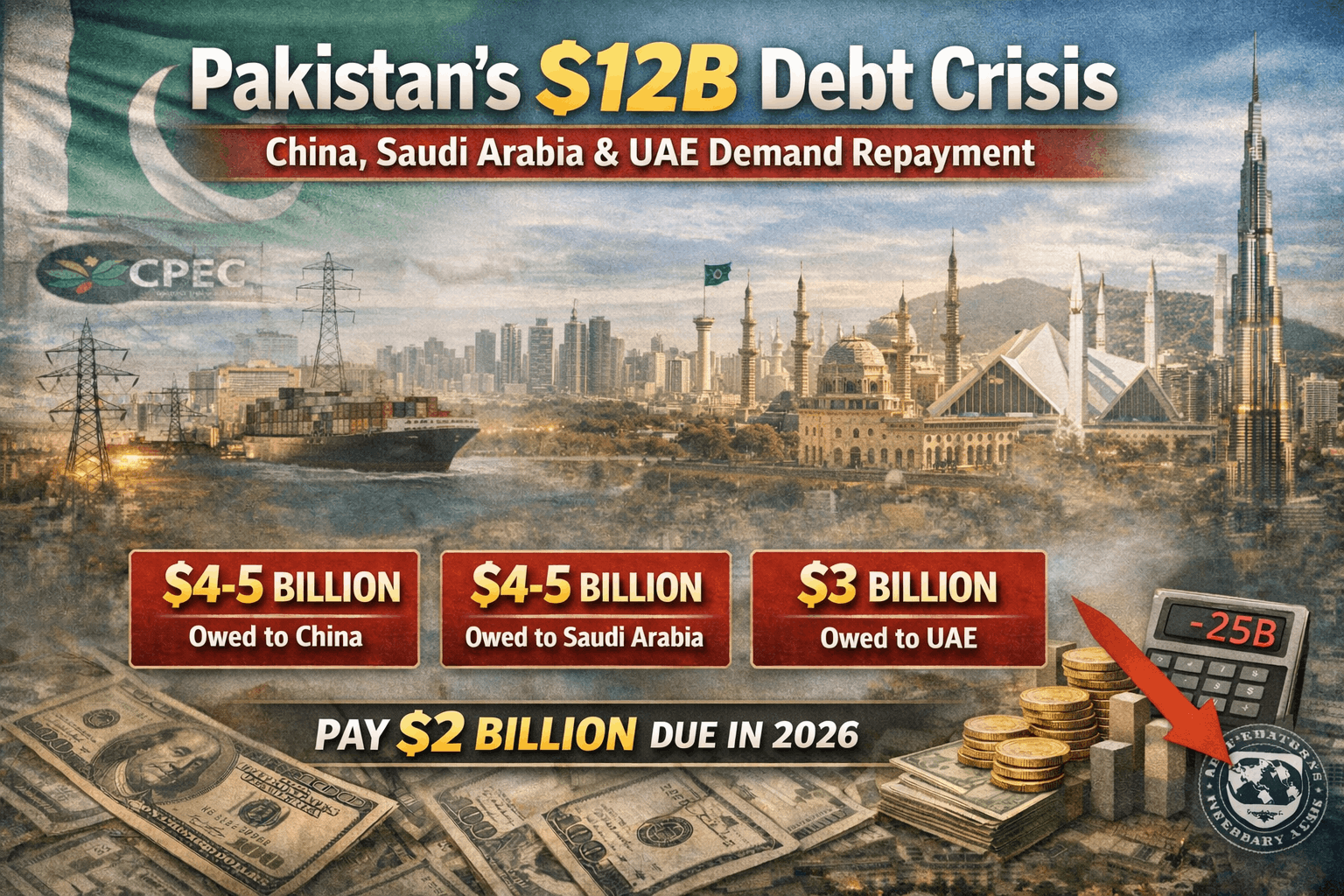
Rochester, NY: Pakistan is entering a precarious phase in its economic and diplomatic trajectory as three of its closest partners—China, Saudi Arabia, and the United Arab Emirates—are no longer content with routine loan rollovers and are increasingly signaling repayment expectations.
What was once a quiet understanding among strategic allies has now evolved into a visible pressure campaign, exposing the fragility of Pakistan’s financial architecture and the limits of its foreign policy balancing act.
At the center of this crisis lies roughly $12 billion in short-term bilateral support, a lifeline that has kept Pakistan’s foreign exchange reserves afloat for years. Of this, approximately $4 to $5 billion is owed to China, largely tied to commercial and infrastructure financing under the China-Pakistan Economic Corridor.
Saudi Arabia has extended a similar amount, around $4 to $5 billion, primarily in the form of central bank deposits and deferred oil payment facilities. The United Arab Emirates accounts for another $3 billion, also deposited in Pakistan’s central bank to stabilize reserves.
For years, these sums were not repaid but simply rolled over upon maturity, creating an illusion of stability. That illusion is now fading.
From Strategic Support to Financial Pressure
The turning point has emerged gradually but decisively. During the period from 2018 to 2023, Pakistan relied heavily on Gulf bailouts to avoid default, with Saudi Arabia and the UAE repeatedly extending deposit maturities.
China, meanwhile, continued to refinance and expand its exposure through energy and infrastructure loans, making it Pakistan’s largest bilateral creditor.
However, by 2024 and into 2025, a noticeable shift began to take shape. These countries, facing their own economic recalibrations and growing frustration with Pakistan’s lack of structural reforms, started attaching stricter conditions to financial support.
The most telling development came in early 2026, when Pakistan prepared to repay $2 billion to the UAE, rather than simply securing another rollover. This marked a symbolic but critical shift: allies were beginning to behave like conventional lenders.
Saudi Arabia, while still supportive, has increasingly linked its assistance to investment frameworks rather than unconditional deposits. China, too, has slowed the pace of new commitments under CPEC, focusing instead on securing returns and repayments.
Collectively, this reflects a broader loss of patience with Pakistan’s “rollover economy,” where debts are perpetually extended rather than resolved.
The Timeline of Dependency
Pakistan’s dependence on these three countries did not emerge overnight but is the result of a decade-long trajectory. The launch of the China-Pakistan Economic Corridor in 2015 marked the beginning of large-scale Chinese financial inflows, primarily in energy and transport infrastructure.
While these projects addressed critical gaps, they were often financed on commercial terms, adding to Pakistan’s repayment burden.
The economic crisis of 2018 forced Pakistan to seek emergency assistance from Saudi Arabia and the UAE, both of which stepped in with multi-billion-dollar deposits and oil credit facilities.
This pattern continued through successive IMF programs, where these countries played a crucial role by providing the financial assurances required for bailout approvals.
By 2023, Pakistan’s economic survival had become structurally dependent on the annual rollover of roughly $12 billion from these three capitals. Without these extensions, the country’s reserves would struggle to cover even a few weeks of imports. What initially appeared as strategic support had effectively turned into a cycle of dependency.
Diplomacy Under Strain
This financial pressure cannot be separated from Pakistan’s evolving diplomatic posture, particularly its attempts to balance relations between Iran and the Gulf states.
For decades, Pakistan has walked a tightrope, maintaining cordial ties with Iran due to geographic and security considerations while aligning closely with Saudi Arabia and the UAE for economic and political support.
In recent years, however, this balancing act has come under strain. Pakistan has occasionally positioned itself as a mediator between Iran and Saudi Arabia, attempting to carve out a role as a regional bridge.
Yet this ambition has been undermined by its own economic vulnerabilities. A country heavily reliant on Gulf financial assistance cannot credibly claim neutrality in disputes involving those very benefactors.
From the Gulf perspective, Pakistan’s engagement with Iran raises concerns about strategic alignment, particularly at a time of heightened regional competition. From Iran’s viewpoint, Pakistan’s deep military and economic ties with Saudi Arabia and the UAE cast doubt on its independence.
The result is a growing perception that Pakistan is attempting to play both sides without fully committing to either—a perception that erodes trust.
The Cost of Strategic Ambiguity
The consequences of this perceived “double game” are now becoming tangible. Financial leverage is being used, subtly but effectively, to influence Pakistan’s policy choices.
The shift from unconditional support to conditional engagement reflects not just economic caution but also strategic signaling. Pakistan is being reminded that financial dependence comes with expectations.
At the same time, the country’s ability to act as a regional mediator has diminished. Without economic stability or diplomatic credibility, its role in bridging divides between Iran and the Gulf states appears increasingly symbolic rather than substantive.
This represents a significant setback for a country that has long sought to punch above its weight in regional diplomacy.
An Economy on the Edge
Underlying all of this is a deeper structural problem. Pakistan faces annual external financing needs exceeding $25 billion, including debt repayments and current account obligations. In this context, even a single demand—such as the UAE’s request for $2 billion—can trigger significant stress on reserves and currency stability.
The reliance on short-term deposits rather than long-term investment has left the economy vulnerable to sudden shifts in lender behavior. Without meaningful reforms to boost exports, broaden the tax base, and reduce fiscal deficits, Pakistan remains trapped in a cycle of borrowing and rollover.
Conclusion: A Moment of Reckoning
The growing insistence by China, Saudi Arabia, and the UAE on repayments marks more than just a financial adjustment; it signals a broader reassessment of Pakistan’s value as a strategic partner.
Economic fatigue, coupled with concerns over diplomatic inconsistency, has transformed these relationships from partnerships of convenience into transactions of caution.
Pakistan now faces a moment of reckoning. Its ability to navigate this संकट will depend not only on economic reforms but also on a clearer and more coherent foreign policy.
The era of balancing competing powers while relying on their financial support is rapidly drawing to a close. What comes next will determine whether Pakistan can regain credibility—or sink deeper into dependency.







