


Toronto,ON: The war between the United States and Iran has caused unprecedented disruption at the world’s most important oil chokepoint, the Strait of Hormuz, sending energy prices soaring and global oil markets into chaos.
Worldwide energy markets have been rocked by the intensifying US-Iran conflict, which has caused oil prices to skyrocket and sparked concerns of a catastrophic supply shortage. Tanker traffic has dropped significantly, and energy markets are preparing for further volatility, as military tensions rise in the Strait of Hormuz, a small maritime passage that processes a substantial portion of the world’s oil shipments.
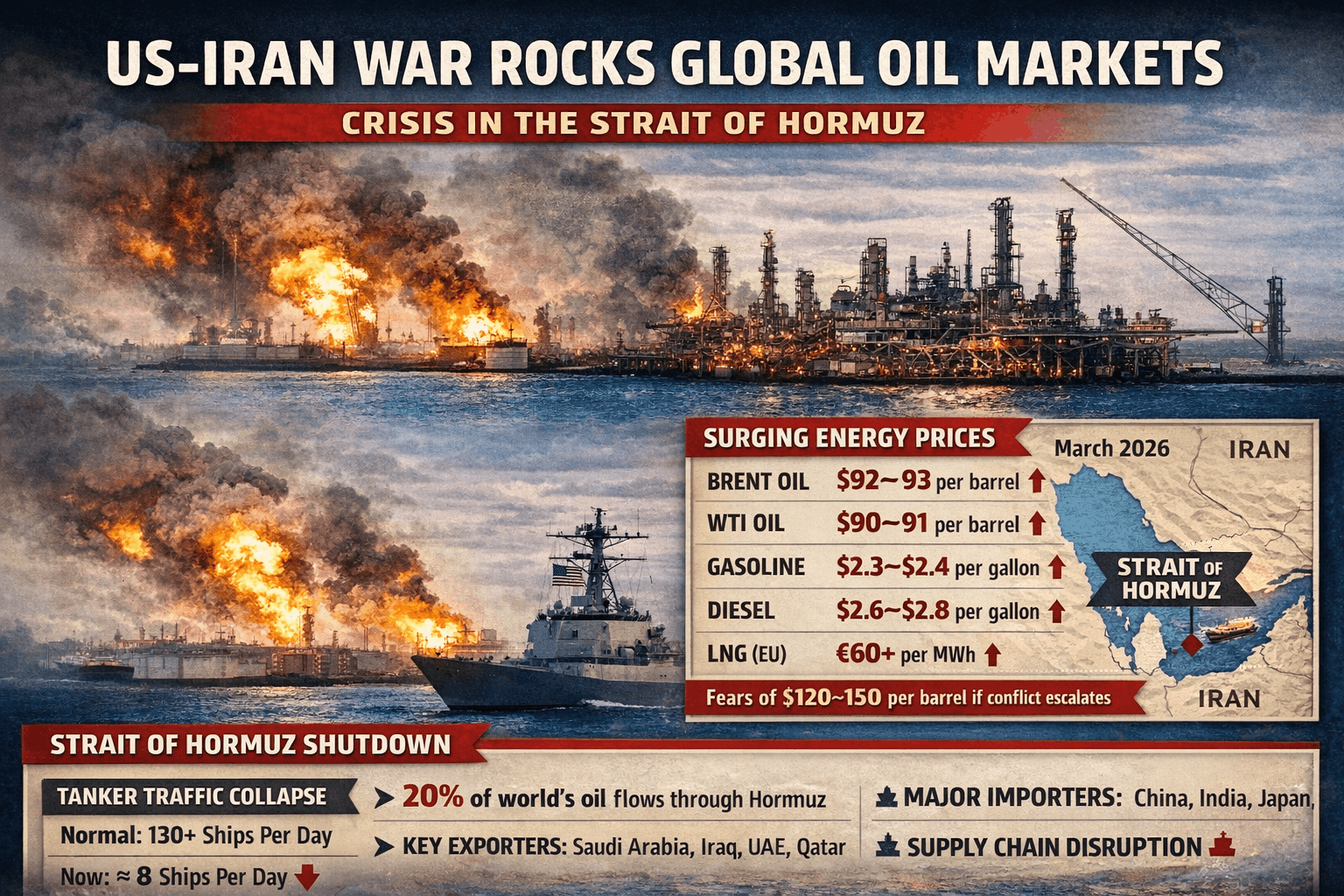
Approximately 20% of the world’s oil typically travels via this vital canal, which connects the Persian Gulf to worldwide shipping lanes. However, due to the region’s new status as one of the world’s most hazardous shipping zones, energy corporations, insurers, and tanker operators are reevaluating their plans to travel through the corridor.
Crude Oil Prices Soar as Investors Respond to Supply Concerns
Since hostilities broke out, global gasoline prices have soared, because to concerns that supply from the Middle East might be delayed for a long time.
Crude oil benchmark prices have risen to levels not seen in almost a year. The worldwide standard for crude oil, Brent, is trading at about $92-93 per barrel, while the US benchmark, West Texas Intermediate (WTI), has risen to around $90–91 per barrel.
There is also rising pressure on refined petroleum products. Gasoline costs around $2.3–$2.4 per gallon at the pump in the US, while diesel is predicted to be $2.6–$2.8 per gallon. The price of natural gas has also recently risen and fallen, with the US benchmark price hovering at $3.1 per MMBtu.
The markets for liquefied natural gas throughout the world have also seen some wild fluctuations. As worries about potential long-term disruptions to energy imports from the Gulf area mounted, European LNG benchmarks momentarily soared over €60/MWh.
If military tensions develop or shipping routes are constrained, oil prices might soar over $120 per barrel, according to energy experts. This could lead to renewed inflationary pressure in the global economy.
The Strait of Hormuz Tanker Traffic Collapse
The most concerning change is the precipitous decline in tanker traffic across the Strait of Hormuz, often recognized as the most crucial oil chokepoint on Earth.
On a daily basis, around 130 ships pass through the strait, carrying petroleum products, liquefied natural gas, refined oil, and crude oil from the Gulf to markets in Asia, Europe, and North America. Nevertheless, data from marine surveillance shows that the passage is now only being used by around eight ships each day since the fighting began.
Shipping businesses are increasingly worried about security, which is reflected in the fall of trade. Not having access to naval escorts or security guarantees has caused several tanker operators to postpone journeys or even dock their tankers outside of the Persian Gulf. This has left ships carrying millions of barrels of crude oil stuck in the river, unable to pass.
Some insurance companies consider the area to be a combat zone, which explains the sharp increase in rates for tankers entering the region.
Importance of Energy Security on a Global Scale
More than just local politics is at stake in the Strait of Hormuz. This maritime route is vital for the export of energy resources from major oil-producing countries including Qatar, Saudi Arabia, Iraq, Kuwait, and the United Arab Emirates.
Any protracted interruption may put a heavy burden on national energy supply for countries that import energy, such China, India, Japan, and South Korea.
Since the same marine route is relied upon by several of the world’s major LNG plants in Qatar, liquefied natural gas exports are also at risk.
Increasing Global Economic Dangers
Already, worries about wider economic ramifications have been voiced in response to the spike in oil costs. Inflation might flare up again throughout the world as a result of rising oil and gasoline prices, which could hit transportation, manufacturing, and food prices particularly hard because many countries are still bouncing back from earlier energy shocks.
The stock market and other financial markets have also shown signs of anxiety as investors keep a careful eye on the situation in the Gulf. Commodity and stock markets throughout the world might become even more unstable if the crisis escalates any further.
Meanwhile, if demand for alternate energy sources rises, oil prices might end up benefiting some non-conflict zone oil-producing nations like Norway, Brazil, and the US.
Energy Markets Face an Uncertain Future
Whether or if commerce via the Strait of Hormuz can be safely restored will primarily determine the future direction of the oil market, according to experts, notwithstanding the enormous spike in prices.
Energy prices could go back to normal if diplomatic attempts are successful or if naval escorts manage to pacify the situation. One of the worst interruptions to the world’s energy supply in recent history may occur if the fighting was to intensify or the strait were to be completely sealed.
As geopolitical tensions and energy security become more entwined in one of the world’s most strategically important areas, the global economy is on high alert.







