


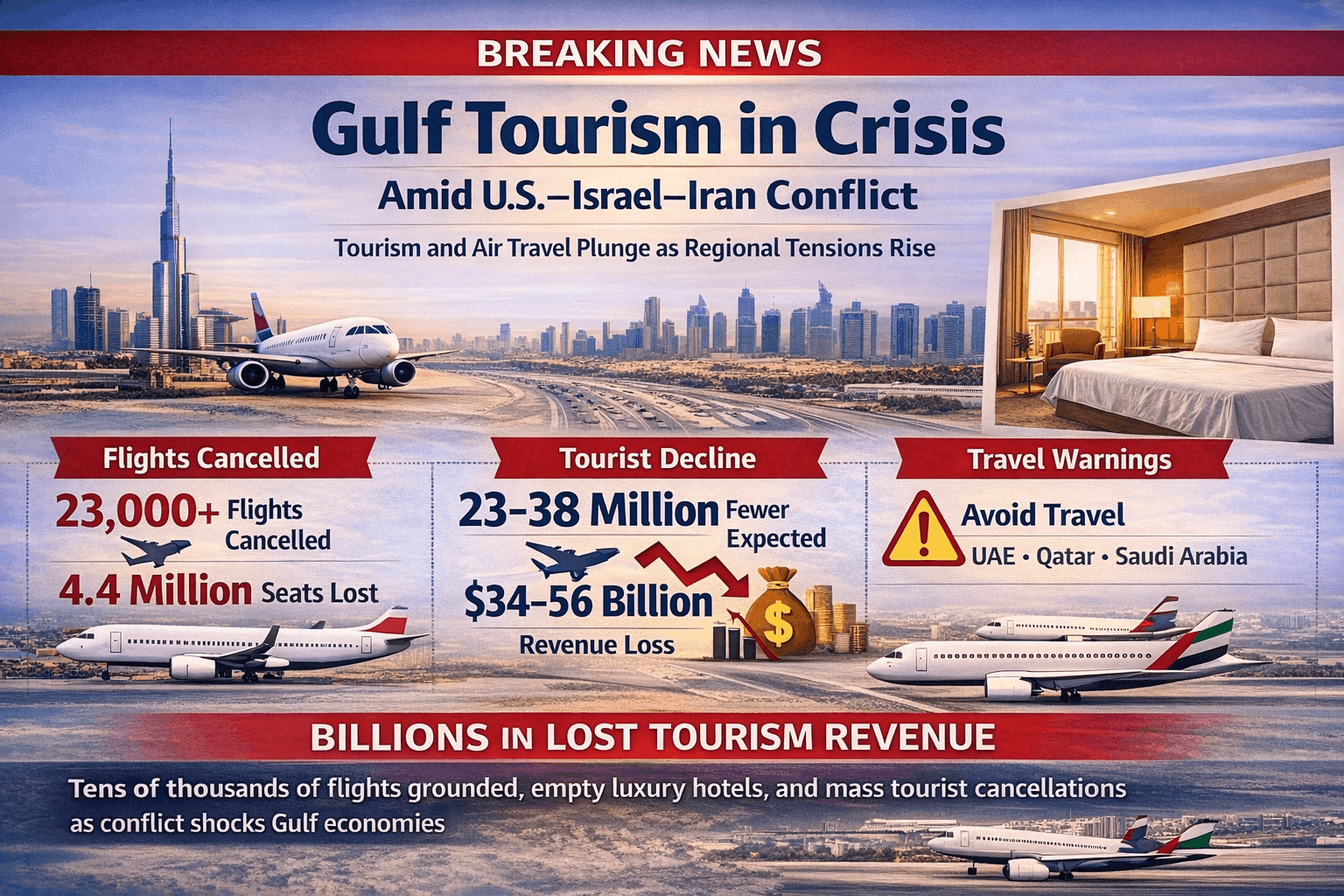
Rochester, NY: The U.S.–Israel–Iran war is sending shockwaves through the Gulf, grounding tens of thousands of flights, emptying luxury hotels, and forcing travelers to cancel plans en masse. Once a booming hub for global tourism, Dubai and neighboring Gulf cities are now confronting billions in lost revenue, shattered business forecasts, and the stark reality of a region where geopolitical instability has turned paradise into uncertainty overnight.
The Gulf region — one of the fastest growing destinations for global tourism — has seen a sharp downturn in visitor arrivals and bookings since the escalation of conflict involving the United States, Israel, and Iran.
Before the current crisis, the Middle East welcomed about 100 million international tourists in 2025, representing nearly 7 % of global travelers, with numbers on the rise year‑on‑year.
Dubai, the region’s powerhouse for luxury, events, and transit travel, saw record 19.59 million international visitors in 2025, driven by strong demand from Europe and South Asia.
Now That Growth Has Reversed
According to industry analysis, inbound tourism to the Middle East could decline 11 – 27 % in 2026 compared to earlier forecasts, meaning 23 – 38 million fewer international visitors than projected before the war.
Financial Losses: Tens of Billions at Stake
Tourism Revenue Drop
Industry reports estimate that the Gulf and Middle Eastern tourism sector could lose between $34 billion and $56 billion in visitor spending in 2026 if conflict conditions persist.
In relative terms, these losses would erase much of the projected growth for the sector and mark one of the largest downturns in regional travel since the COVID‑19 pandemic.
Hotel and Hospitality Losses
Dubai and other Gulf cities are already seeing sharp declines in hotel bookings — with some data pointing to 15 %–28 % drops in hotel occupancy rates and thousands of cancellations in urban and resort properties.
Luxury hotels that once operated near full capacity are now offering deep discounts to attract the few remaining guests.
Impact on Gulf Airlines and Flights
Airspace Closures and Flight Cancellations
The conflict has significantly disrupted regional air traffic — one of the major sources of connectivity for global tourism and commerce.
Official data and news reports indicate tens of thousands of flights have been disrupted across the Gulf since the conflict intensified, including cancellations, delays, and reroutes at key hubs like Dubai, Doha, and Abu Dhabi.
Thousands of travelers were left stranded as airspace restrictions forced carriers to halt or reroute services, with effects spreading globally.
Major Gulf carriers such as Emirates, Etihad, and Qatar Airways — which together handle nearly 300,000 passengers daily — were forced to reduce operations dramatically after airspace shutdowns.
Longer Routes & Higher Costs
With direct routes disrupted, airlines rerouting flights to avoid conflict zones have generated increased fuel and crew costs. Carriers are facing higher operating expenses at a time when demand is wavering.
Repatriation and Limited Flights
Some Gulf airlines are now operating limited repatriation flights to return stranded passengers to Europe and other regions, but regular commercial services remain significantly reduced.
Wider Travel Industry Ramifications
Travel Advisories and Booking Cancellations
Foreign travel advisories from governments like the UK now recommend against non‑essential travel to the UAE, Qatar, Bahrain, and other Gulf states — directly reducing future bookings and tourism demand.
Many travel agencies have pulled pending departures to the region and are offering refunds or rebooking options as customer confidence drops.
Shifts in Global Travel Patterns
Travelers and tour operators are increasingly rerouting plans to safer regions such as Europe and Southeast Asia, further eroding Gulf tourism growth momentum.
Economic and Social Impact on Gulf Economies
Tourism accounted for a significant portion of some Gulf states’ GDP — for example, in the UAE tourism made up roughly 12 % of the economy before the conflict.
Reduced visitor spending and aviation revenues affect not just hotels and airlines, but retail, events, hospitality jobs, real estate rentals, and service providers linked to travel.
Outlook: Recovery Uncertain but Possible
The region has proven resilient to previous crises, bouncing back after both the pandemic and local conflicts. However, experts warn that extended geopolitical instability could delay recovery of tourism and aviation confidence well into 2026 and beyond.
In summary: Once booming Gulf tourism — particularly in Dubai — is now in retreat amid the ongoing U.S.–Israel–Iran conflict. International visitor numbers are set to drop sharply, potential revenue losses could top $50 billion, and Gulf airlines are navigating one of the largest disruptions since COVID‑19, with long-term implications for the region’s travel and economic landscape.







