


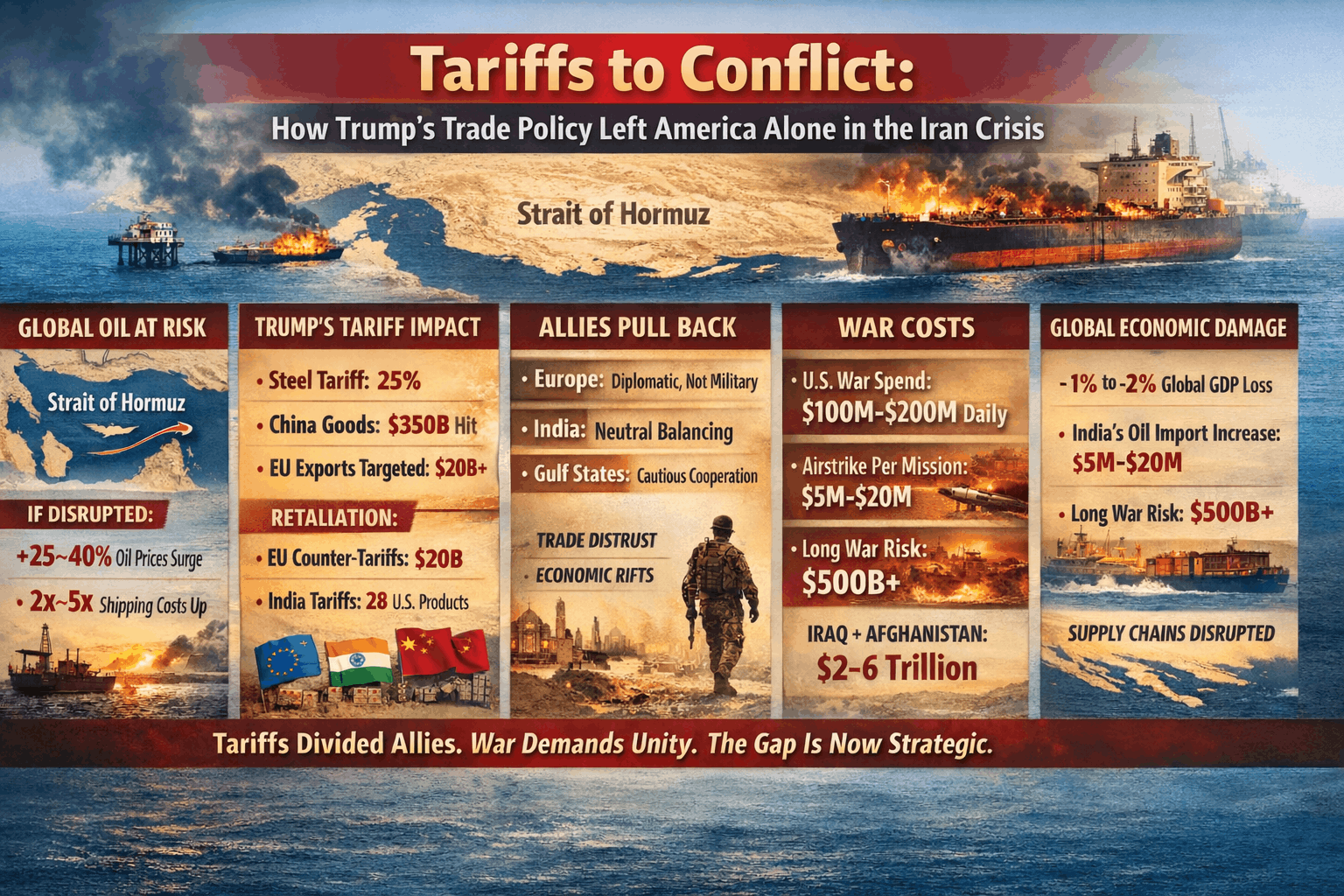
Rochester, NY: The issue in the Middle East isn’t simply a military conflict; it’s the result of years of economic choices that have quietly changed the way countries work together. The Strait of Hormuz is very important to both the US and Iran, and things are becoming worse between the two countries.
The world is seeing a hazardous mix of trade conflicts and actual warfare, where economic nationalism is clashing with geopolitical realism.
According to estimates from throughout the globe, this tiny corridor carries between 17-20 million barrels of oil every day, or over 20% of the world’s total oil consumption.
The strait is the most important oil transportation chokepoint in the world, with commerce worth more than $600 billion per year. Even little problems in the past have caused the market to respond almost away.
For example, oil prices have gone up 25 to 40 percent in only a few weeks after big geopolitical escalations. At the same time, marine insurance rates in the Gulf have gone up by as much as 300% during times of high risk, which has put even more stress on global supply networks.
But what makes this moment so dangerous for Washington is not just the size of the economic risk, but also the lack of robust support from allies.
The US worked with large coalitions in past battles in the Middle East, and these coalitions shared both military and budgetary responsibilities. That alignment seems to have broken down today.
European governments have mostly stuck to diplomacy, while nations like India, which is now the world’s third-largest oil importer, bringing in over 4.5 million barrels per day; have taken a careful neutral stance to defend their energy security.
This reluctance shows the long-term effects of Donald Trump’s strong tariff strategy, which aimed to change the way countries trade with each other by putting “America First.” Starting in 2018 and growing over time, the US put 25 percent tariffs on steel and 10 percent on aluminum.
These duties impacted imports worth more than $48 billion a year. At the same time, taxes were put on more than $350 billion worth of Chinese imports, making this one of the biggest trade fights in recent history.
Key partners were not safe. The European Union had to deal with tariffs that affected more than $20 billion in exports, which led to retaliatory penalties on American items that were politically sensitive.
India put duties on 28 American goods in response to U.S. trade actions. This affected commerce worth between $6-$8 billion. China’s countermeasures affected hundreds of billions of dollars in trade between the two countries, which caused a noticeable slowdown in global trade.
International financial organizations say that these trade problems together cut global GDP growth by 0.8 to 1.2 percent at their worst.
These measures destroyed trust and damaged the economic ties that usually strengthened strategic partnerships over time. So, as tensions with Iran rose, the reflexive response of siding with Washington was not there. Instead, allies have thought about how to respond in a way that is best for their own country, especially because they are dealing with both trade problems and increasing energy prices.
The present crisis is already having more and more effects on the economy. The European Union gets almost all of its crude oil from other countries. If the price of oil goes up by only $10 per barrel for a long time, it may cost the EU an extra $80 to $100 billion a year to buy oil.
Estimates say that every $10 rise in oil prices adds $15 billion to $20 billion to its import bill each year, which makes its budget deficits worse and puts more pressure on inflation.
These hazards are not just theoretical; they have a tangible impact on how politicians make decisions in capitals that are now apprehensive to become further involved in a U.S.-led battle.
At the same time, the cost of being involved in the military is going up. It is thought that operations by the U.S. in the Middle East now cost between $100 million and $200 million a day, depending on how big and intense they are.
Individual airstrike operations may cost anything from $5 million to $20 million each time, especially when modern weapons and long-range assets are used.
The wars in Iraq and Afghanistan have cost the United States between $2 trillion and $6 trillion, according to different scholarly and official estimates. This shows how big the possible long-term expenditures might be.
Washington bears the brunt of these expenses without significant contributions from allies. This has a cumulative effect, where tariffs that hurt the economy lead to strategic isolation during conflict.
The United States has the best military in the world, but not sharing the cost makes things harder financially and more dangerous.
It’s not just a short-term diplomatic vacuum that is happening; it’s a bigger change in the way the world works. The European Union is working harder to become strategically independent so that it doesn’t have to rely on U.S. commerce and security systems as much.
India’s foreign policy is still multi-aligned, which means it tries to have good ties with all of the world’s major countries. At the same time, China is becoming a more stable economic partner by signing long-term energy contracts and investing in infrastructure. This is in contrast to Washington’s more aggressive strategy.
As things change, it becomes apparent that a policy based on tariffs has its limits. Tariffs may help settle trade conflicts between two countries, but they can also encourage diversification and make countries less dependent on the United States in the long run.
When a geopolitical crisis calls for concerted action, those same partners may not want to engage right away because they have to think about the economic implications and their strategic obligations.
This leads to a dilemma at the core of U.S. policy. In this time of crisis, efforts to build the local sector and gain economic supremacy have made people feel strategically isolated.
The US still has the strongest military in the world, but might alone doesn’t win contemporary wars. They rely on alliances, similar economic interests, and political trust—things that take years to build up and may be broken down far more swiftly.
As tensions build in the Strait of Hormuz, the stakes go well beyond what happens in the short term.
They include the safety of the world’s energy supply, the stability of the economy, and the trustworthiness of international alliances. The lesson that may be learned from this mix of commerce and conflict is clear and measurable:
Tariffs changed trade flows worth hundreds of billions of dollars, but they may have also damaged partnerships worth much more.







