


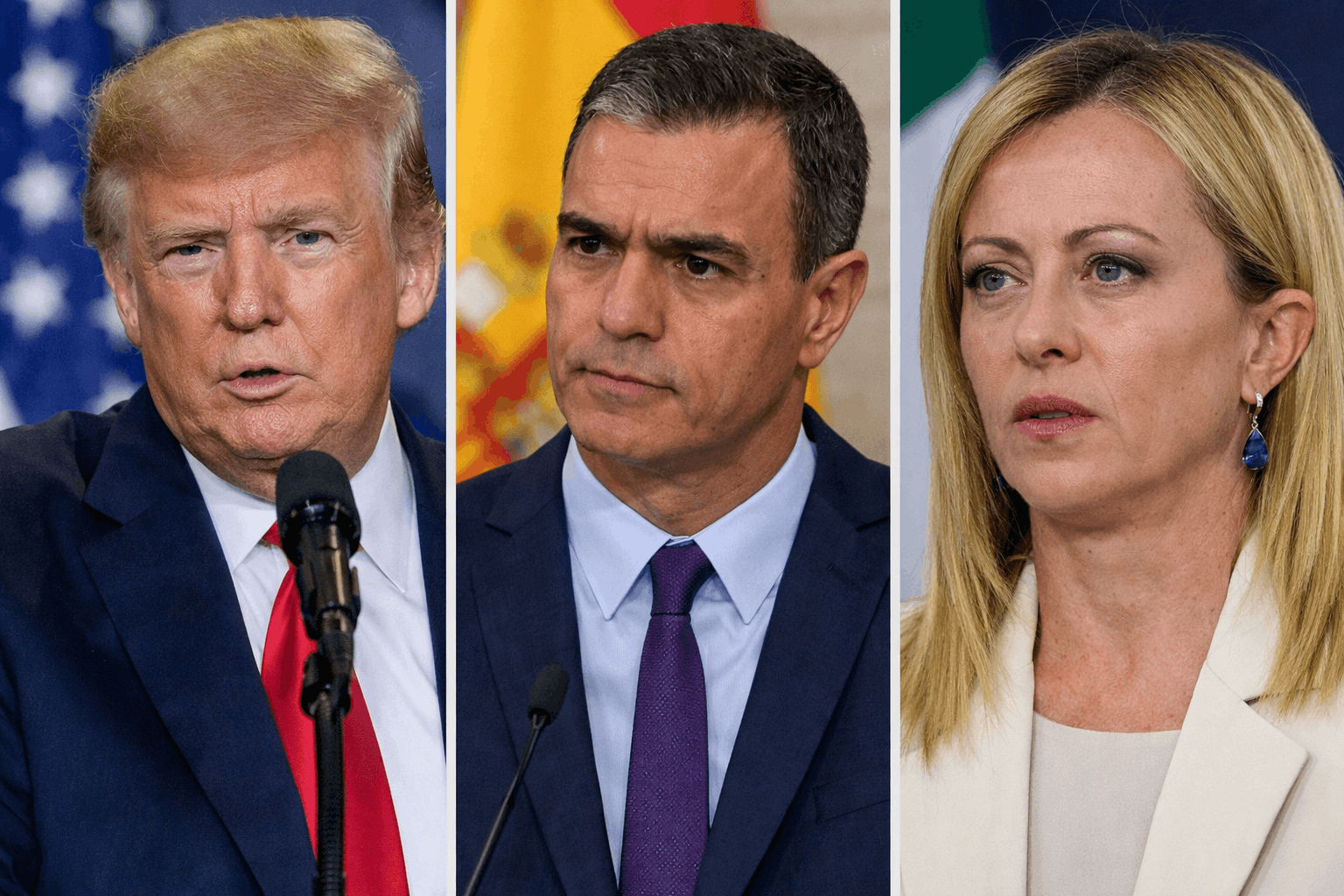
Rochester, NY: One of the most significant operational disputes between Washington and its European allies in recent years is the recent decision by Pedro Sánchez’s government to close Spanish airspace to U.S. military aircraft, which was followed by Italy’s refusal to permit U.S. planes to land at critical bases such as Sigonella.
These actions are directly associated with the ongoing conflict in Iran, in which numerous European governments have disassociated themselves from what they perceive as a unilateral military campaign headed by the United States.
Margarita Robles, Spain’s Defense Minister, has verified that the airspace prohibition is applicable to aircraft that are explicitly engaged in the Iran conflict.
This has resulted in the necessity for U.S. flights to divert and has complicated logistics across the Mediterranean.
Giorgia Meloni has advocated for a more procedural approach in Italy, contending that the United States’ requests for participation in active combat operations did not satisfy legal and parliamentary prerequisites.
At a time when unity is essential, these actions collectively reveal a growing strategic divide within NATO.
Strategic and Military Implications for the United States
Spain and Italy are not peripheral actors from a military perspective; they are central logistical centers for U.S. operations in the Middle East and Europe.
Spain is home to significant facilities such as Rota and Morón, while Italy’s Sigonella base in Sicily serves as a critical transit and surveillance center.
These countries effectively increase operational costs and delays for the U.S. military by restricting landing rights and closing airspace.
The requirement for aircraft to travel lengthier routes has resulted in an increase in fuel consumption and a reduction in their ability to deploy quickly.
Analysts have observed that the efficacy of missions in high-intensity conflict zones can be considerably impacted by even a simple delay of a few hours.
Throughout history, the United States has depended on a concentrated network of bases in Europe. Italy and Spain are among the most strategically significant hosts, with approximately 80,000 American personnel stationed throughout Europe.
The vulnerability in U.S. force projection is indicated by the disruption of even a portion of this network.
Additionally, the refusal challenges the presumption of automatic allied support, which is a fundamental component of NATO’s operational doctrine.
European Autonomy and Political Messaging
Madrid and Rome’s decisions are not merely logistical; they are profoundly political. Pedro Sánchez has publicly characterized the Iran conflict as “illegal” and “reckless,” emphasized the importance of adhering to international law and the United Nations framework.
In the interim, the Italian leadership has emphasized that offensive operations are not covered by existing agreements without explicit sanction.
European leaders are indicating a transition to strategic autonomy. This is indicative of a more general tendency within the European Union, in which policymakers are increasingly seeking autonomy from U.S. foreign policy decisions, particularly in conflict zones such as the Middle East.
Divisions are apparent even within NATO. Although Germany has permitted the continuation of U.S. base operations, France has restricted over flight privileges, and Spain has taken the most extreme posture by completely closing its airspace.
The Trump Doctrine and Washington’s Response
Donald Trump has responded with fury, criticizing European allies for what he perceives as a lack of strategic commitment and burden-sharing. He has already discussed the potential for retaliatory trade measures, primarily against Spain, and has cautioned that the United States “will remember” such actions.
This is a continuation and intensification of Trump’s long-standing approach to alliances, which is transactional, conditional, and frequently associated with economic leverage.
His administration has consistently associated military cooperation with trade concessions and defense expenditure targets, such as NATO’s proposed 5% of GDP benchmark.
In practical terms, this could be expressed as:
- Increased tariffs or trade restrictions on European countries that are not cooperative
- Selective military cooperation or diminished intelligence sharing
- Pressure on defense procurement decisions that favor U.S. contractors
Spain has already responded to U.S. pressure on defense expenditure by proposing a level of approximately 2.1% of GDP, rather than increasing the targets, which has served to escalate tensions.
Effects on the Export of Military Equipment and the Defense Trade
The defense relationship between the United States and Europe is intricately linked. European nations are significant purchasers of American military equipment, which encompasses surveillance technologies, missile systems, and F-35 fighter aircraft.
Nevertheless, the present rift has the potential to alter this dynamic.
European nations may expedite their efforts to diversify defense procurement if tensions rise. Joint defense funds and indigenous weapons programs within the European Union may acquire momentum as alternatives to U.S. systems.
France has already established itself as a prominent supplier in Europe, and any decline in U.S.-EU relations could be advantageous to European defense firms.
In fact, Israel has reportedly suspended defense procurement from France in response to comparable disputes, which serves as an illustration of the rapidity with which geopolitical tensions can alter defense markets.
For the United States, the reduction of arms exports to Europe would not only have an impact on revenues, which are valued at tens of billions annually, but it would also erode the long-term strategic influence we have over allied militaries.
Is there an emergence of a new bloc that is hostile to the United States?
It would be imprudent to infer that a unified anti-U.S. bloc is forming, despite the fact that the current situation indicates a growing resistance.
Europe continues to be divided.
Germany and the United Kingdom continue to provide cautious support for certain aspects of U.S. operations. Spain and France, on the other hand, are more candid in their criticism. Italy is in a position of compromise, as it must balance its alliance obligations with domestic political and legal constraints.
Rather than a new bloc, a “multi-speed alliance” is forming, a fragmented NATO in which participation is contingent upon political calculations and national interests.
Nevertheless, there is a genuine possibility that a coalition of European states could establish a more autonomous security framework, thereby decreasing dependence on U.S. leadership, if the Iran conflict escalates further.
Future of Transatlantic Relations
These developments have the potential to have a significant long-term effect. In the past, transatlantic relations were characterized by a shared strategic vision; however, they are now being influenced by a growing disparity in political priorities, legal frameworks, and threat perception.
However, the Trump administration prioritizes swift, unilateral action, while European leaders emphasize diplomacy and multilateralism. Operational decisions on the ground are currently demonstrating this fundamental distinction.
Despite Italian officials’ assurances that there is “no tension” with Washington, the reality is more intricate. The trust deficit is increasing, and each new disagreement weakens the cohesion of the alliance.
NATO may not dissolve if current trends persist; however, it may transform into a less predictable, looser alliance in which coordination is no longer an assurance.
In summary, the event was a turning point, not a complete failure
The refusal of Spain and Italy to provide support for U.S. military operations represents a significant turning point in transatlantic relations.
It is indicative of a more profound transition toward European strategic independence and conditional alliance behavior, rather than merely a disagreement over a single conflict.
The United States will face the challenge of recalibrating its approach to balance the realities of allied consent with assertive foreign policy. The test for Europe will be whether it can convert political autonomy into a coherent strategic capability.
The current situation is not yet a rupture; however, it is undeniably a redefinition of the Western alliance in a geopolitical order that is swiftly evolving.







